Filmlexikon.
Support
Stagecraft
Camera · Technique

Stagecraft

Murnau AI illustration
stativkamera schulterkamera steadicam shot steadicam stereographer tiffen steadicam

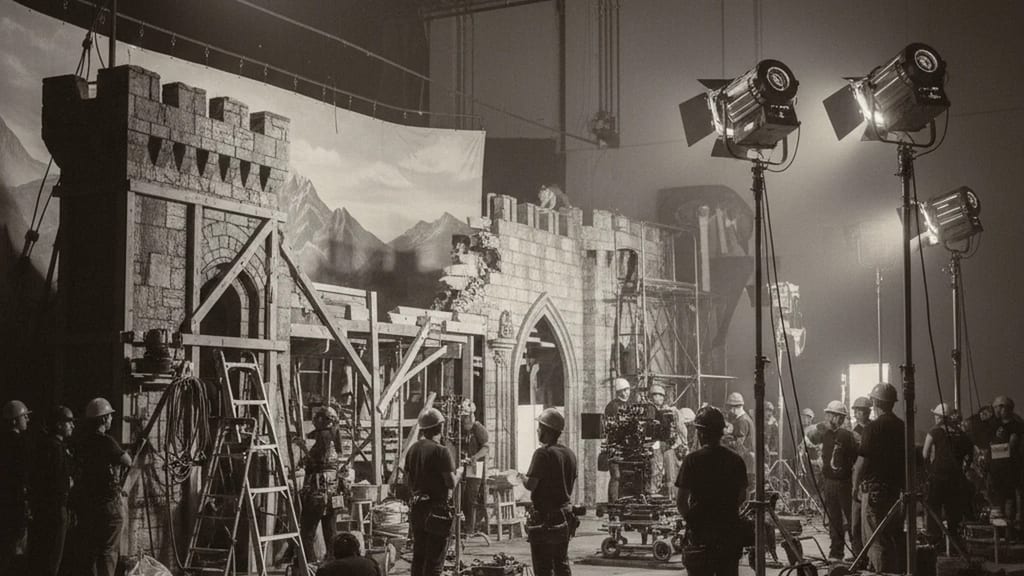
Advanced stage technology using hydraulic platforms (up to 50t), LED walls (up to 6000 nits), and rigging systems for real-time backgrounds, replacing traditional green-screen.

Technical Details

Modern stagecraft installations utilize hydraulic stage elements capable of supporting up to 50 tons and positioning with a precision of ±2mm. LED wall systems achieve pixel densities of 1.2-2.8mm and brightness levels up to 6000 nits with 16-bit color depth. Mechanical rigging systems employ motor hoists with load capacities ranging from 250kg to 2t per point, operating at speeds of 0.1-2 m/s. Stage floor modules made of steel or aluminum come in standard dimensions of 2x1m or 2x2m with integrated mounting points on a 50cm grid. Special revolving stages can reach diameters of up to 30m with infinitely variable speeds from 0.1-10 rpm.

History & Development

Stage technology began to develop in European opera houses around 1640 with mechanical trapdoors and pulley systems. In 1881, the Asphaleia system introduced hydraulically operated stage elements at the Budapest Opera House. The first motorized revolving stage was created in 1896 at the Munich Residenztheater. Hollywood began adopting theatrical techniques for large productions from the 1920s onwards. In 2019, Disney revolutionized the industry with "The Mandalorian" through stagecraft technology from Industrial Light & Magic: 270° LED volumes with a footprint of 75x20 feet and a ceiling height of 20 feet, controlled by Unreal Engine 4 in real-time.

Practical Application in Film

"Dune" (2021) combined practical desert sets with 12m high LED walls for sky projection. "Thor: Love and Thunder" (2022) used 360° LED volumes with a 24m diameter for Asgard sequences. Traditional stagecraft is evident in Christopher Nolan's "Tenet" with practical aircraft hangar sets measuring 60m in length. Production time is reduced by 30-40% due to the elimination of location scouting and weather delays. Disadvantages include investment costs of $15-30 million USD per LED volume studio, and limited freedom of movement in 360° shots due to camera tracking systems.

Comparison & Alternatives

Stagecraft differs from pure green screen through immediate visualization and accurate light reflections on objects and actors. Virtual Production is increasingly replacing traditional matte paintings and rear projection. Practical stagecraft remains indispensable for close-ups and interaction scenes, while LED volumes are revolutionizing wide-angle establishing shots. Location shooting offers an authentic atmosphere but requires 200-300% higher logistical costs and weather-related delays. Hybrid approaches combine 40% practical sets, 35% LED volume, and 25% post-production VFX for optimal cost-benefit ratios.

From the crafts

Perspectives

Cinematographer

Ich nutze LED-Volumes für natürliche Lichtführung, da die 6000 Nits ausreichend Grundlicht liefern und Farbtemperatur-Shifts in Echtzeit möglich sind. Die Herausforderung liegt im Moiré-Pattern bei falschen Shutter-Winkeln – ich arbeite mit 172,8° statt 180° bei 24fps. Praktische Sets geben mir mehr Flexibilität bei extremen Kamerabewegungen und Weitwinkel-Objektiven unter 18mm.

Director

Ich kann mit Stagecraft die Tageszeit und Atmosphäre während der Szene ändern, was Schauspielern hilft, emotional zu reagieren statt vor grünen Wänden zu agieren. Die Echtzeit-Umgebung ermöglicht spontane kreative Entscheidungen am Set. Allerdings bin ich bei der Bildkomposition an die LED-Resolution gebunden und muss Kamerabewegungen präzise vorplanen für das Tracking-System.

Producer

Ich kalkuliere 180.000-350.000 USD Tagesrate für LED-Volume-Studios versus 50.000 USD für traditionelle Stages, spare aber 60% bei Crew-Reisekosten und Location-Fees. Die Break-Even-Rechnung funktioniert ab 25 Drehtagen mit VFX-lastigen Szenen. Risikominimierung durch wetterunabhängige Drehpläne rechtfertigt die Mehrkosten bei Großproduktionen über 80 Millionen USD Budget.

More in the lexikon

Related terms

Test your knowledge

Quiz

1. Was beschreibt „Stagecraft" am besten?

2. Zu welchem Department gehört „Stagecraft"?

3. Wie viele verschiedene Fachperspektiven bietet dieser Eintrag?

Report an error
From the Filmfarm ecosystem

Understand visual language, budget productions, connect crew.

The Lexikon is part of the Filmfarm ecosystem — alongside budgeting (FilmBalance), an industry magazine (FilmCircus) and crew networking (FilmCall, CrewMesh). One shared vocabulary for the whole production.

FilmFarm FilmRadarComing soonFilmPulseComing soonFilmNumbersComing soonFilmCapitalComing soonFilmLabComing soonFilmBalanceComing soonFilmCircusComing soon