Filmlexikon.
Support
Source Music
Sound · Terms

Source Music

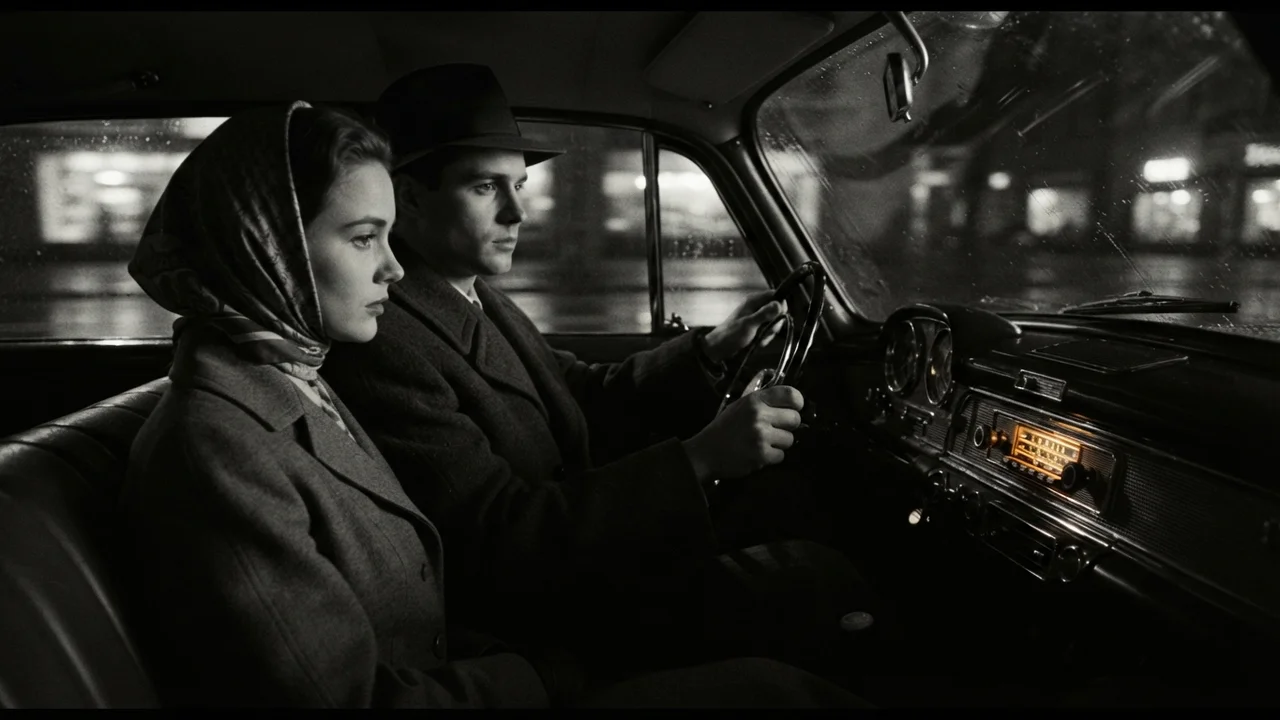
Murnau AI illustration
original score production music originalton signature sound original sound sync sound hors son off sound

Music originating from a visible or implied source within the film's narrative—radio, jukebox, or live performance—that characters hear diegetically.

Technical Details

Source music is typically mixed at -12 to -18 dB below dialogue level and receives characteristic frequency filtering depending on the source: radio music is limited to 300-3000 Hz, while live orchestras utilize the full frequency range of 20-20000 Hz. When recording on set, playback is usually done via small Bluetooth speakers with 5-15 watts of power to create natural room reflections. In post-production, reverb algorithms such as Lexicon 480L or modern plugins are used to recreate the acoustic properties of the recording space.

History & Development

The term established itself in the 1930s with the advent of sound film. Fritz Lang's "M" (1931) was the first to systematically use source music for characterization – the song "Ein Männlein steht im Walde" identifies the child murderer. In the 1970s, Robert Altman revolutionized the technique with overlapping source music layers in "Nashville" (1975). Since the 1990s, digital workstations like Pro Tools have enabled precise synchronization between picture and multiple music sources with frame-accurate positioning.

Practical Application in Film

Scorsese's "Goodfellas" (1990) uses 47 source music tracks that chronologically mark the time periods of 1955-1980 and are played via jukebox, radio, or live performances. Tarantino's "Pulp Fiction" (1994) uses Chuck Berry's "You Never Can Tell" both as source music in the Jack Rabbit Slim's scene and for the transition to the next sequence. During filming, playback is often played at 120-130% of the original speed to ensure flexibility for editing rhythm in post-production.

Comparison & Alternatives

Source music fundamentally differs from the non-diegetic score by being audible to the film characters. Meta-diegetic music forms an intermediate category – music from the characters' memories or dreams. Modern series like "Stranger Things" use hybrid source-score approaches, where source music seamlessly transitions into orchestral film music. Temp tracks in pre-production are often replaced by licensed source music, as original composition costs 50,000-200,000 Euros, while song licenses are often under 10,000 Euros.
From the crafts

Perspectives

Cinematographer

Ich muss bei Quellenmusik-Szenen die Tonquelle visuell etablieren - ein Radio braucht eine Großaufnahme, eine Band erfordert Totale mit allen Instrumenten sichtbar. Bei Playback-Szenen filme ich oft 25% langsamer, damit in der Post das Tempo angepasst werden kann ohne Lippensynchron-Probleme. Die Kameraführung muss den Rhythmus der Musik aufnehmen, besonders bei Tanz- oder Konzertszenen.

Director

Quellenmusik gibt mir die Möglichkeit, Stimmungen zu erzeugen ohne die vierte Wand zu durchbrechen - ein melancholisches Lied aus dem Autoradio wirkt authentischer als Orchestermusik. Ich nutze sie oft als Brücke zwischen Szenen oder um Zeitsprünge zu markieren. Bei emotionalen Wendepunkten kann ich Charaktere bewusst die Musik ausschalten lassen, was stärker wirkt als ein langsames Ausblenden des Scores.

Producer

Quellenmusik bedeutet Lizenzkosten von 2.000-50.000 Euro pro Titel je nach Bekanntheit und Nutzungsumfang, plus GEMA-Gebühren von 0,5-2% der Produktionskosten. Bei internationaler Auswertung brauche ich weltweite Rechte, was bei bekannten Songs schnell 100.000+ Euro kostet. Dafür spare ich Komponisten- und Orchesterhonorare. Am Set benötige ich Playback-Equipment und muss Drehzeiten für Musikszenen großzügiger kalkulieren.

More in the lexikon

Related terms

Test your knowledge

Quiz

1. Was beschreibt „Quellenmusik" am besten?

2. Zu welchem Department gehört „Quellenmusik"?

3. Wie viele verschiedene Fachperspektiven bietet dieser Eintrag?

Report an error
From the Filmfarm ecosystem

Understand visual language, budget productions, connect crew.

The Lexikon is part of the Filmfarm ecosystem — alongside budgeting (FilmBalance), an industry magazine (FilmCircus) and crew networking (FilmCall, CrewMesh). One shared vocabulary for the whole production.

FilmFarm FilmRadarComing soonFilmPulseComing soonFilmNumbersComing soonFilmCapitalComing soonFilmLabComing soonFilmBalanceComing soonFilmCircusComing soon