Filmlexikon.
Support
Soft Sticks
Production · Terms

Soft Sticks

Murnau AI illustration
production shooting in house production film production principal photography shooting production

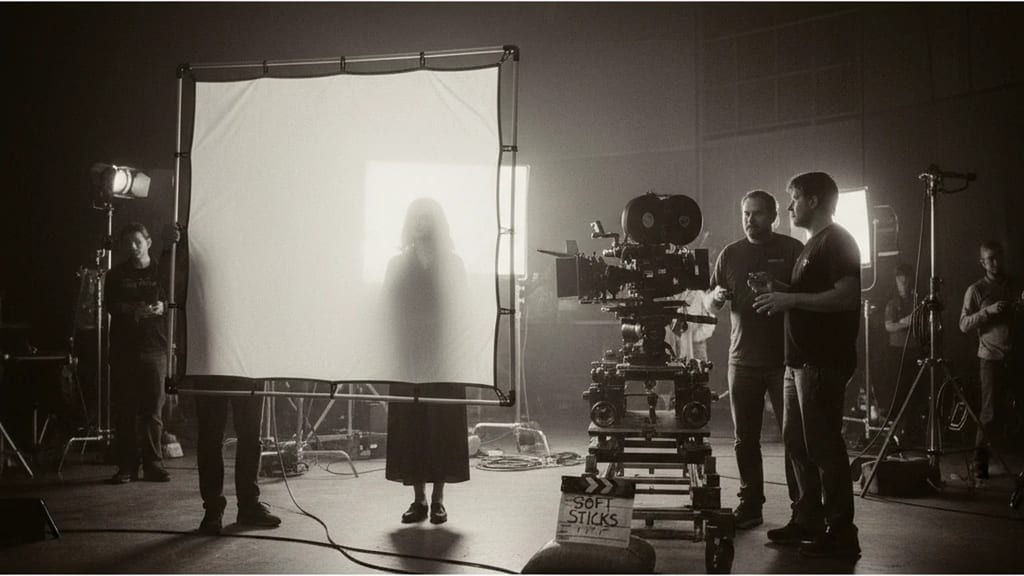
Clapper board with soft foam or rubber-padded striking edge for silent operation during live-action takes, minimizing actor interruption.

Technical Details

The standard version is based on a conventional acrylic slate (30 x 25 cm), with the clapper edge covered with 3-5 mm thick foam rubber or velour. Professional models from Denecke or Ambient Recording use interchangeable damping strips made of closed-cell foam. The clapper speed is reduced from 180°/second to approximately 120°/second to precisely time the dampened sound. Digital variants generate the sync signal electronically via LED flash instead of a mechanical clap.

History & Development

In 1963, French camera assistant Marcel Dubois developed the first soft stick for Nouvelle Vague productions, which often worked in confined spaces with direct sound. Neher-Werke in Munich brought the first series-produced model to the German market in 1967. With the introduction of Crystal Sync technology in the late 1970s, the soft stick gained importance, as precise synchronization with minimal noise generation became possible. Since 2010, electronic systems with timecode integration have dominated.

Practical Use in Film

In Dardenne brothers productions like "Rosetta" (1999), the soft stick enabled naturalistic handheld direct sound without disturbing interruptions to the acting direction. Dogme 95 films exclusively used dampened slates to maintain authenticity. In music films, it is used during playback scenes to avoid contaminating the original recording. The disadvantage lies in its reduced audibility for larger crews – the signal only reaches a range of 5-8 meters instead of the usual 15 meters.

Comparison & Alternatives

In contrast to the standard slate, the soft version is not suitable for exterior shots with wind noise, as the dampened signal gets lost. Silent sticks work purely optically without sound, while Smart Slates combine electronic timecode with a dampened clap. For low-budget productions, makeshift solutions are often used: tape over the clapper edge or folded fingers in front of the camera. Modern alternatives include Bluetooth sync apps, which turn the smartphone into a silent sync source.
From the crafts

Perspectives

Cinematographer

Ich verwende leise Klappen hauptsächlich bei Available-Light-Situationen mit hoher ISO, wo jedes Nebengeräusch die Tonaufnahme kontaminiert. Die gedämpfte Klappe lässt sich präziser im Bild positionieren, ohne dass Schauspieler zusammenzucken oder aus der emotionalen Szene gerissen werden. Bei Close-Ups kann ich sie dichter ans Objektiv bringen, ohne akustische Störungen zu riskieren.

Director

Die leise Klappe ermöglicht mir spontane, authentische Takes ohne die emotionale Unterbrechung einer lauten Standard-Klappe. Besonders bei Kindern oder bei intimen Szenen kann ich die Kontinuität wahren und mehrere Anläufe ohne Stimmungsbruch fahren. Sie wird zum unsichtbaren Werkzeug, das die Performance nicht beeinflusst, sondern die natürliche Dynamik zwischen den Schauspielern erhält.

Producer

Leise Klappen kosten 15-20% mehr als Standardausführungen, amortisieren sich aber durch weniger Wiederholungen bei geräuschsensiblen Szenen. Die reduzierte Reichweite erfordert präzisere Crew-Koordination und zusätzliche Handzeichen-Kommunikation. Bei Direktton-lastigen Produktionen spare ich etwa 10% der Postproduktionskosten, da weniger ADR-Sessions und Geräusch-Cleaning nötig werden.

More in the lexikon

Related terms

Test your knowledge

Quiz

1. Was beschreibt „Leise Klappe" am besten?

2. Zu welchem Department gehört „Leise Klappe"?

3. Wie viele verschiedene Fachperspektiven bietet dieser Eintrag?

Report an error
From the Filmfarm ecosystem

Understand visual language, budget productions, connect crew.

The Lexikon is part of the Filmfarm ecosystem — alongside budgeting (FilmBalance), an industry magazine (FilmCircus) and crew networking (FilmCall, CrewMesh). One shared vocabulary for the whole production.

FilmFarm FilmRadarComing soonFilmPulseComing soonFilmNumbersComing soonFilmCapitalComing soonFilmLabComing soonFilmBalanceComing soonFilmCircusComing soon