Technical Details
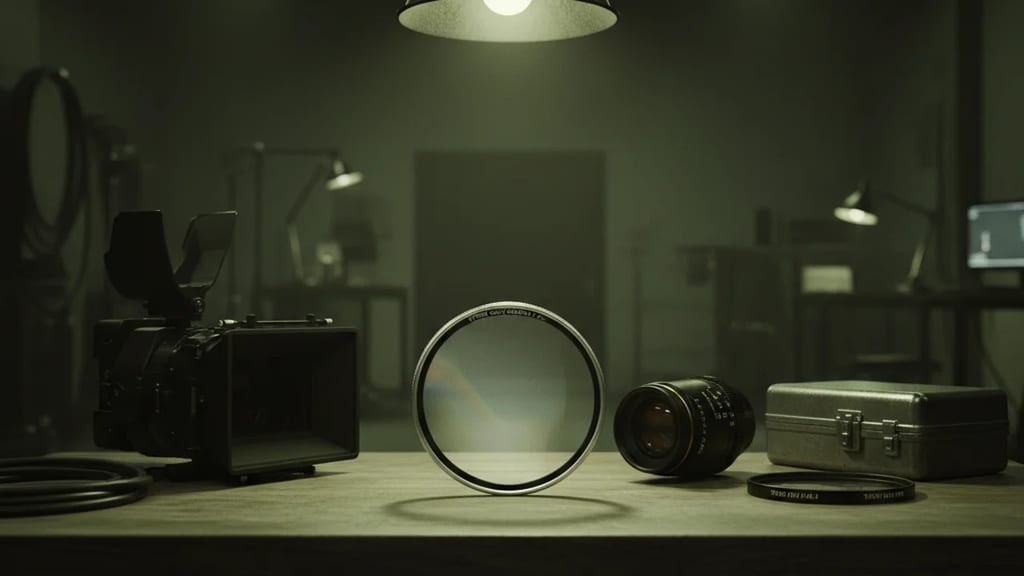
Soft contrast filters consist of optical glass with a vapor-deposited coating or embedded microparticles that selectively scatter light. Tiffen offers the series in strengths 1/8, 1/4, 1/2, 1, 2, and 3, with strength 1/2 reducing contrast by approximately 20-30%. Schneider-Kreuznach produces comparable optics under the designation "Classic Soft," while Formatt-Hitech offers the "Soft FX" series. The filters are wavelength-selective – blue light is scattered more strongly than red light, leading to a slight color temperature shift of about 100-200K towards warmer tones.
History & Development
In 1974, Tiffen developed the first commercial soft contrast filter in response to cinematographers' requests for more subtle contrast reduction than diffusion filters offered. Cinematographer Gordon Willis first systematically employed it in "The Parallax View" (1974). In the 1980s, the filter became established in the music video sector, particularly through cinematographer Daniel Pearl's work on Madonna videos. Digital color correction in the 1990s reduced demand but led to the development of stronger variants for the "film look" in the HD era.
Practical Application in Film
Roger Deakins used 1/2 soft contrast filters for the prison scenes in "The Shawshank Redemption" (1994) to optimize skin tones under harsh artificial light. Janusz Kamiński used them in "Saving Private Ryan" (1998) for flashbacks, combined with 85-polarizing filters. Emmanuel Lubezki utilized them in "The Revenant" (2015) in available light situations to compensate for the high contrast of digital sensors. The filter reduces post-production effort, as less digital contrast adjustment is required. Disadvantage: loss of approximately 1/3 stop of light transmission.
Comparison & Alternatives
Distinction from Pro-Mist filters: Soft contrast does not create visible halation, whereas Pro-Mist produces noticeable light scattering. Ultra contrast filters have a stronger effect and create pronounced glowing. Digital alternatives like ARRI's "Soft FX" LUT or RED's "Vintage" processing emulate the look but do not achieve the optical light scattering. Modern LED panels with soft contrast modes (Aputure 600d Pro) offer hardware-based alternatives. For extreme contrast reduction, the optical filter remains irreplaceable, as digital post-processing cannot reconstruct already clipped highlights.