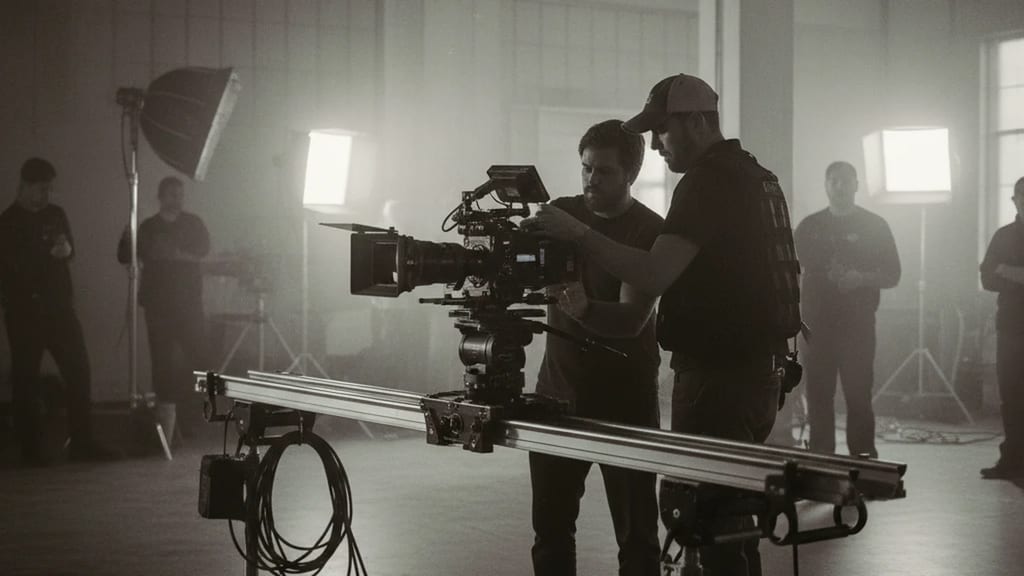
Technical Details
Standard lengths range from 0.6 to 3 meters, with modular systems reaching up to 6 meters. Professional sliders can carry loads between 10 and 50 kilograms with a tare weight of 3 to 15 kilograms. Carbon fiber rails weigh approximately 2.8 kilograms at a length of 1.2 meters and allow speeds from 0.1 to 50 cm/s. Motorized variants use stepper motors (400-1600 steps/revolution) for repeatable movements. Ball-bearing systems achieve friction coefficients below 0.001, while plain bearing constructions are more cost-effective but less precise.
History & Development
Kessler Crane developed the first film-ready sliders in 1999 for digital cameras. The CineSlider established the standard for 15mm rod systems in 2003. With the RED ONE (2007) and the DSLR video boom (2008/2009), sales figures exploded. Rhino Camera Gear revolutionized the market in 2010 with the ROV (Robot of Venice), the first affordable motorized system. Today, manufacturers like Edelkrone, Dynamic Perception, and MYT Works dominate with app-controlled, programmable systems.
Practical Use in Film
Christopher Nolan used 6-meter precision sliders for the time-splitting sequences in "Tenet" (2020). In "1917" (2019), mini-sliders from Movietech enabled precise transitions between Steadicam shots. Typical applications include product shots, interviews with subtle movement, and establishing shots. Motorized sliders allow for time-lapse sequences with smooth motion over several hours. Limitations become apparent for moves over 3 meters in length, where rail flex causes visible vibrations.
Comparison & Alternatives
Sliders replace classic dollies in compact productions but do not achieve their stability with heavy cameras over 25 kilograms. Gimbals offer more axes of motion but less precise repeatability. Jib arms enable vertical movements that sliders can only achieve with additional adapters. Modern robotic systems like the Bolt combine slider precision with multi-axis movement but cost from 500,000 Euros upwards, compared to 2,000 to 15,000 Euros for professional slider systems.