Filmlexikon.
Support
Set Piece
Art Department · Terms

Set Piece

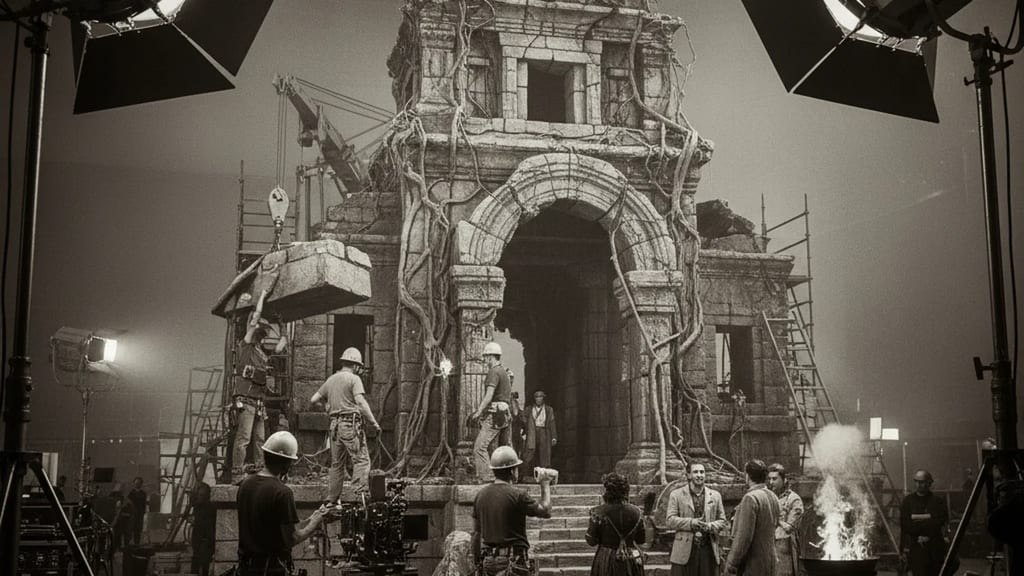
Murnau AI illustration
setbau set decoration set dressing set piece

Modular studio construction from 2.40 m high wooden frames with plywood facing, combinable and reconfigurable in minutes.

Technical Details

Standard set pieces are constructed from 2.40 m high wooden frames (flats) made of 5 cm x 10 cm lumber, clad with 12 mm plywood or MDF panels. Load-bearing walls reach thicknesses of 15-20 cm, while non-load-bearing partition walls suffice with 8-12 cm. Modular systems use standardized connectors like C-clamps or Penn-Elcom connectors for quick assembly. Wild walls run on track systems with ball bearings and can be removed within 10-15 minutes. Ceiling constructions support loads up to 150 kg/m² for lighting and rigging equipment.

History & Development

The first film-specific set pieces originated in 1897 in Georges Méliès' glass studio in Montreuil, where he constructed three-dimensional fairytale castles from papier-mâché. Cecil B. DeMille standardized modular wooden constructions for Western towns at Paramount in 1915. In 1930, MGM Studios introduced the grid system: standard panels measuring 3.60 m x 2.40 m, which could be combined as desired. William Cameron Menzies first developed true-to-scale miniature previs models for "Gone with the Wind" in 1939. Since the 1990s, CAD programs like VectorWorks have enabled precise pre-planning and CNC-milled connectors.

Practical Application in Film

Kubrick's "2001" (1968) used a rotating 11 m diameter set for the Discovery centrifuge, allowing camera positions in every spatial axis. Fincher's "Panic Room" (2002) utilized a four-story brownstone set with completely removable exterior walls for continuous camera moves between floors. Nolan prefers practical set pieces over green screen: the rotating corridor in "Inception" (2010) measured 30 m in length and rotated at 3 rpm. Typical construction takes 3-5 weeks, dismantling 1-2 weeks.

Comparison & Alternatives

Set pieces differ from location shoots through complete controllability of light, sound, and weather. Compared to virtual production, they offer tactile authenticity for actors but require 40-60% longer lead times. Modular systems cost 800-1,200 Euros/m², while custom-built constructions reach 1,500-3,000 Euros/m². LED volume stages, as seen in "The Mandalorian," are increasingly replacing traditional set pieces, but often combine both techniques for foreground elements.
From the crafts

Perspectives

Cinematographer

Als DoP schätze ich Set-Stücke für die absolute Lichtkontrolle – jede Wand kann zur Beleuchtung geöffnet oder mit eingebauten Prakticals versehen werden. Wild Walls ermöglichen mir unmögliche Kamerafahrten durch Räume, ohne dass Continuity-Probleme entstehen. Die Grid-Deckenkonstruktion trägt schwere Technocrane-Systeme und ich kann 360-Grad-Lighting-Setups realisieren, die in echten Locations undenkbar wären.

Director

Set-Stücke geben mir absolute narrative Kontrolle über den Raum – ich kann Proportionen dramaturgisch anpassen und Räume schaffen, die emotional genau das transportieren, was die Szene braucht. Während der Dreharbeiten kann ich spontan Wände versetzen oder Durchgänge schaffen, um die Inszenierung zu optimieren. Die Schauspieler bewegen sich in einer vollständig kontrollierten Umgebung, was ihre Konzentration auf die Performance erhöht.

Producer

Ein durchschnittliches Wohnzimmer-Set kostet mich 80.000-120.000 Euro, amortisiert sich aber bei mehr als 8 Drehtagen gegenüber Location-Miete plus Umbauten. Ich spare 30% der Beleuchtungs-Zeit und eliminiere Wetterrisiken, Genehmigungsprobleme und Anwohner-Beschwerden. Die Lagerfähigkeit erlaubt Reshoots auch Monate später, und erfolgreiche Sets kann ich für Sequels oder andere Produktionen wiederverwenden.

More in the lexikon

Related terms

Test your knowledge

Quiz

1. Zu welchem Department gehört „Set-Stück"?

2. Wie viele verschiedene Fachperspektiven bietet dieser Eintrag?

Report an error
From the Filmfarm ecosystem

Understand visual language, budget productions, connect crew.

The Lexikon is part of the Filmfarm ecosystem — alongside budgeting (FilmBalance), an industry magazine (FilmCircus) and crew networking (FilmCall, CrewMesh). One shared vocabulary for the whole production.

FilmFarm FilmRadarComing soonFilmPulseComing soonFilmNumbersComing soonFilmCapitalComing soonFilmLabComing soonFilmBalanceComing soonFilmCircusComing soon