Filmlexikon.
Support
Second Act Turn
Theory · Terms

Second Act Turn

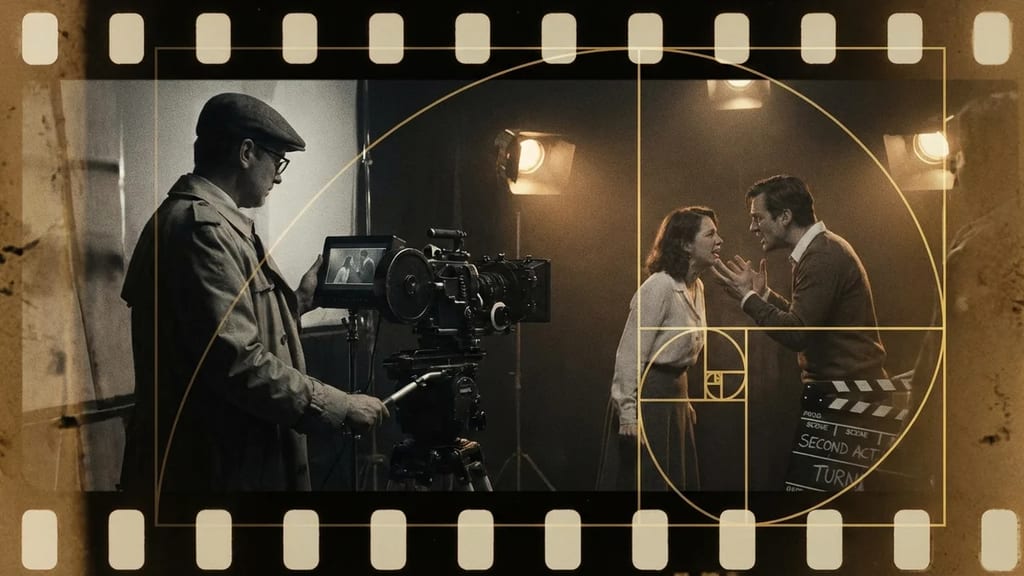
Murnau AI illustration
15lb sandbag 20 c stand 216 diffusion 250 diffusion 251 diffusion 25lb sandbag 35lb sandbag 40 c stand

Midpoint turning point (min. 67–75 in 90-min film) where the protagonist gains critical insight and prepares for the final confrontation.

Technical Details

The Second Act Turn follows precise structural parameters: in a 90-minute film, it is positioned between minutes 67-75, and in 150-minute productions, between minutes 112-125. Dramaturgically, three main variants are distinguished: the Epiphany Turn (protagonist sees through the antagonist), the Strategy Turn (a new approach is developed), and the Alliance Turn (crucial allies are gained). The intensity curve reaches 70-80% of its maximum here before rising to 100% for the climax.

History & Development

In 1979, Syd Field codified the term Second Act Turn in "Screenplay" as a fixed component of Hollywood dramaturgy. Aristotle's "Poetics" had already described the concept as part of peripeteia, but modern terminology only emerged through Field's screenplay theory. In 1997, Robert McKee refined the definition in "Story," distinguishing for the first time between Crisis (second act turn) and Climax (peak of the third act). Since the 2000s, Christopher Vogler and Blake Snyder have expanded the theory with psychological and mythological components.

Practical Application in Film

In "Die Hard" (1988), the Second Act Turn occurs at minute 81 when John McClane realizes Hans Gruber has seen through him and will kill the hostages. "The Dark Knight" (2008) places it at minute 126 when Batman decides to take the blame for Dent's crimes. In comedies like "Groundhog Day" (1993), it functions at minute 75 as an emotional turning point, not an action sequence. Documentaries use it less frequently, as their structure follows dramatic laws less stringently.

Comparison & Alternatives

The Second Act Turn differs from the Point of No Return (minutes 60-75) by its proximity to the finale and from the All is Lost Moment by its forward-driving rather than despairing energy. Freytag's Five-Act Structure positions the Retarding Moment here, while Vogler's Hero's Journey places the Approach to the Inmost Cave. Serial formats instead use Season Arcs with multiple equivalent turning points per episode.
From the crafts

Perspectives

Cinematographer

Ich plane den Zweiten Wendepunkt als visuellen Bruch – oft wechsle ich hier von handheld zu statischen Einstellungen oder umgekehrt, um die neue Protagonist-Dynamik zu unterstreichen. Die Lichtführung wird ab diesem Punkt gezielter, da die finale Konfrontation emotionale Klarheit braucht statt der Unsicherheit aus Akt zwei.

Director

Ich nutze den Zweiten Wendepunkt als letzten Moment echter Charakterentwicklung – hier muss mein Protagonist zur Person werden, die das Finale bewältigen kann. Schauspieler bekommen hier oft ihre intensivste Szene, weil sich innere und äußere Konflikte synchronisieren und die emotionale Wahrheit des Films kristallisiert.

Producer

Der Zweite Wendepunkt bestimmt maßgeblich meine Postproduktions-Timeline, da hier Test-Screenings entscheiden, ob das Publikum bis zum Ende mitgeht. Schwache Wendepunkte erfordern kostspielige Nachdrehs, daher budgetiere ich 10-15% Reserve für eventuelle Anpassungen in diesem kritischen Segment.

More in the lexikon

Related terms

Test your knowledge

Quiz

1. Was beschreibt „Zweiter Wendepunkt" am besten?

2. Zu welchem Department gehört „Zweiter Wendepunkt"?

3. Wie viele verschiedene Fachperspektiven bietet dieser Eintrag?

Report an error
From the Filmfarm ecosystem

Understand visual language, budget productions, connect crew.

The Lexikon is part of the Filmfarm ecosystem — alongside budgeting (FilmBalance), an industry magazine (FilmCircus) and crew networking (FilmCall, CrewMesh). One shared vocabulary for the whole production.

FilmFarm FilmRadarComing soonFilmPulseComing soonFilmNumbersComing soonFilmCapitalComing soonFilmLabComing soonFilmBalanceComing soonFilmCircusComing soon