Cinematographer
Rubber Glass sieht auf Kamera überzeugend aus, wenn richtig beleuchtet. Die Herausforderung ist, die Lichtreflexionen natürlich wirken zu lassen – echtes Glas verhält sich anders.
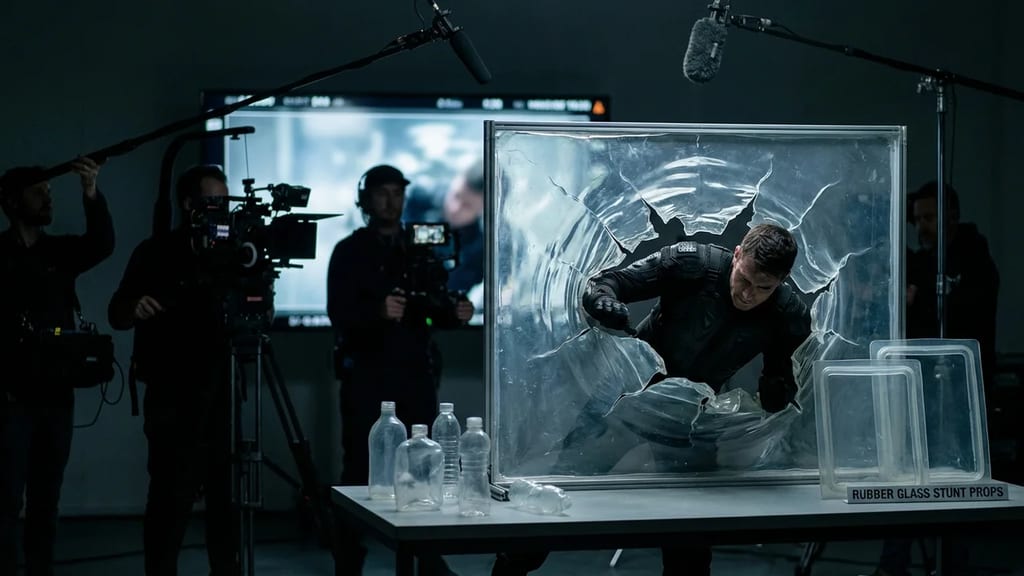
Flexible silicone or rubber material molded to replicate glass windows, bottles, and objects for safe stunt work – allows performers to break through or be struck by 'glass' without risk of cuts, complementing traditional sugar glass with durability and reusability in action sequences.
Rubber Glass is a flexible silicone or rubber material molded into glass-like objects for safe stunt work. It allows performers to break through "glass" or be hit with it without the risk of injury from sharp edges.
| Aspect | Description |
|---|---|
| Material | Silicone/Rubber |
| Purpose | Safe stunts |
| Property | Flexible, shatterproof |
| Appearance | Glass-like |
| Type | Properties |
|---|---|
| Silicone | Transparent, flexible |
| Rubber | Durable, more opaque |
| Hybrid | Combined |
| Foam | For debris |
| Use | Description |
|---|---|
| Windows | Breaking through |
| Bottles | Impact props |
| Eyeglasses | Close proximity to face |
| Displays | Screen stunts |
| Aspect | Rubber Glass | Sugar Glass |
|---|---|---|
| Breakage Behavior | Bends, tears | Shatters |
| Reusable | Yes | No |
| Cost | Higher initial | Cheaper |
| Cutting Hazard | None | Minimal |
| Step | Description |
|---|---|
| Mold | Create mold |
| Casting | Pour silicone |
| Curing | Harden |
| Finishing | Adjust appearance |
| Property | Optimization |
|---|---|
| Transparency | Clear silicone |
| Reflection | Surface treatment |
| Thickness | Make realistic |
| Coloring | If needed |
| Scenario | Use |
|---|---|
| Window Crash | Body through window |
| Bottle Hit | Bottle impact |
| Car Crash | Windshield |
| Fights | Glass props |
| Material | Combination |
|---|---|
| Sugar Glass | For break detail |
| Candy Glass | Shard effect |
| Resin | Frames |
| Rubber Debris | Fragments |
| Advantage | Description |
|---|---|
| No Splinters | No sharp edges |
| Flexible | Absorbs impact |
| Predictable | Controlled behavior |
| Repeatable | Multiple takes |
| Limitation | Description |
|---|---|
| Breakage Look | Less realistic |
| Splinters | No real ones |
| Sound | Different from glass |
| Light | Different reflection |
| Aspect | Solution |
|---|---|
| On-Set | Quieter than glass |
| Foley | Add glass sounds |
| Sync | In post |
| Layering | Multiple sounds |
| Technique | Description |
|---|---|
| Angle | Control reflections |
| Diffusion | Soften appearance |
| Backlighting | Show transparency |
| Practicals | Credibility |
| Factor | Impact |
|---|---|
| Custom Mold | Initial costs |
| Reuse | Amortization |
| Quantity | Unit price decreases |
| Complexity | Design effort |
| Practice | Reason |
|---|---|
| Testing | Before shooting |
| Backup Props | For damage |
| Lighting Check | Test on camera |
| Sound Planning | Post-production |
Rubber Glass is a technique for stunt coordinators that complements traditional Sugar Glass. The combination of both materials – Rubber Glass for safety, Sugar Glass for an authentic break look – enables convincing and safe glass-break sequences. VFX enhancement can add additional shards if needed.
Rubber Glass sieht auf Kamera überzeugend aus, wenn richtig beleuchtet. Die Herausforderung ist, die Lichtreflexionen natürlich wirken zu lassen – echtes Glas verhält sich anders.
Rubber Glass gibt mir Sicherheit bei Stunt-Sequenzen. Im Gegensatz zu Zuckerglas kann ich mehrere Takes machen, ohne ständig neue Props zu brauchen, was kreative Freiheit ermöglicht.
Rubber Glass ist teurer in der Herstellung als Zuckerglas, aber die Wiederverwendbarkeit und erhöhte Sicherheit rechtfertigen die Investition bei aufwendigen Stunt-Sequenzen.
1. Zu welchem Department gehört „Gummi-Glas / Stunt-Glas / Silikon-Glas"?
2. Wie viele verschiedene Fachperspektiven bietet dieser Eintrag?
The Lexikon is part of the Filmfarm ecosystem — alongside budgeting (FilmBalance), an industry magazine (FilmCircus) and crew networking (FilmCall, CrewMesh). One shared vocabulary for the whole production.