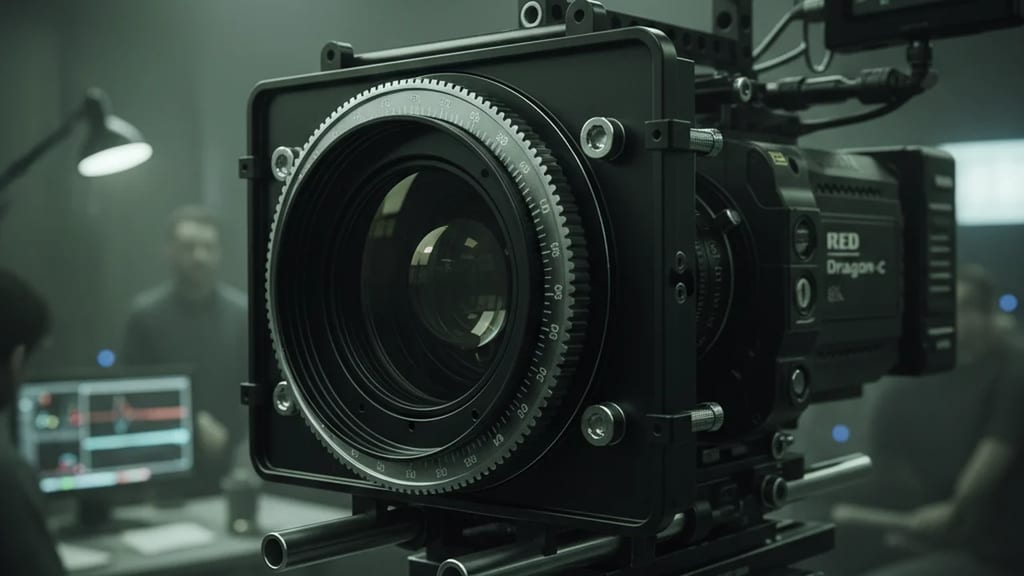
Technical Details
Rotating filter stages use stepper motors with 200-400 steps per revolution for precise filter positioning. The Arri MMB-2, for example, utilizes 8 filter positions at 45° each, while Chrosziel systems accommodate up to 12 filters in 30° increments. Encoder feedback ensures positional accuracy of ±0.1°. Power consumption is 12V/2A during rotation, and less than 100mA when stationary. High-quality systems offer soft start/stop functions with configurable acceleration curves.
Two main design types exist: internal rotor systems with a centrally mounted filter disc and external rotor variants with a rotating filter ring. The latter allow for larger filter diameters in a more compact design.
History & Development
Panavision developed the first motorized filter system in 1983 for "Brainstorm" to achieve complex effect shots without interruption. Arri followed in 1987 with the MMB-1, which for the first time offered preset positions and remote control via a 25-pin D-sub connection.
In 1994, Chrosziel revolutionized the market with CAN-bus controlled systems, enabling synchronization with focus and zoom motors. RED integrated rotating filter stages directly into camera bodies in 2008. Current systems like the Arri Signature Primes use wireless control and GPS synchronization for multi-camera setups.
Practical Use in Film
On "Mad Max: Fury Road" (2015), rotating filter stages enabled seamless transitions between ND filters during chase sequences without exposure jumps. "Blade Runner 2049" used programmed filter sequences for atmospheric color gradients in its exterior scenes.
Typical loads include Clear, ND 0.6/0.9/1.2, polarizing filters, and Pro-Mist 1/4. Control is handled via Preston MDR-3 or RT Motion systems. Vibrations during filter changes are critical – modern systems compensate through counter-mass technology.
Comparison & Alternatives
Compared to manual matte box filter stages, rotating systems reduce shooting interruptions by 60-80%. Linear filter slides offer more filter positions but require larger matte box housings.
Electronic variable ND filters are increasingly replacing mechanical ND stages, but only achieve 6-7 stops compared to 8+ for glass filters. Rotating systems remain the standard for demanding productions with complex filter changes, while simple drama shoots often work with static filter stages.