Filmlexikon.
Support
Filter Tray
Camera · Equipment

Filter Tray

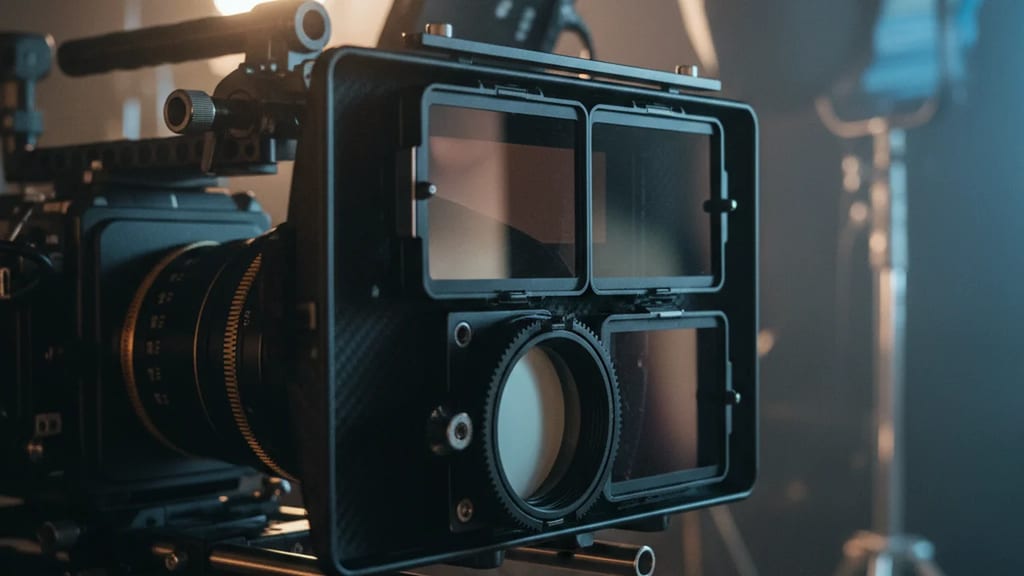
Murnau AI illustration
15lb sandbag 20 c stand 216 diffusion 250 diffusion 251 diffusion 25lb sandbag 35lb sandbag 40 c stand

Filter Tray is a technique of professional camera work.

Technical Details

Standard filter trays use adapter rings from 49mm to 112mm in diameter and accommodate filters with thicknesses of 2-3mm. The Cokin P-System (84mm wide) became established in the 1970s for smaller productions, while the A-System (67mm) was designed for the consumer market and the X-Pro System (130mm) for large format. Professional systems like LEE or Hitech use 100mm width with up to four filter slots stacked. The trays rotate 360° for aligning graduated filters and feature bellows mounts for stray light reduction.

History & Development

In 1973, Cokin revolutionized filter photography with the first modular resin insert filter system. Previously, filters were permanently attached to lens threads or improvised in front of the lens. In 1979, the professional LEE system from England followed, featuring optically higher quality polyester filters. Tiffen introduced waterproof seals in 1985, and NiSi developed magnetic quick-change systems for 67mm filters in 2010.

Practical Use in Film

In "Mad Max: Fury Road" (2015), DoP John Seale used LEE filter trays with orange 85C filters for the desert scenes. "Blade Runner 2049" (2017) combined Schneider True-Cut IR filters with ND graduated filters in the filter tray for exterior shots. The tray allows for quick filter changes without lens disassembly and precise positioning of graduated filters along the horizon. Vignetting with wide-angle lenses below 24mm and reflections between stacked filters are problematic.

Comparison & Alternatives

Round screw-in filters offer better sealing but require different diameters per lens. Matte box systems with 4x4" filters (138x138mm) dominate high-end productions due to superior stray light baffling and larger filter surfaces. Drop-in filters in telephoto lenses from 300mm focal length are changed internally within the camera. For extreme wide angles below 16mm, built-in ND filters on the camera are often the only vignette-free solution.

From the crafts

Perspectives

Cinematographer

Ich verwende Filterhalter hauptsächlich für ND-Verlaufsfilter bei Available Light, da ich den Horizont millimetergenau positionieren muss. Bei Anamorphic-Linsen unter 35mm wird's kritisch wegen Vignettierung – dann weiche ich auf die interne ND der ALEXA aus. Der schnelle Wechsel zwischen 0.6er und 1.2er ND rettet mir oft den Dreh bei wechselnden Lichtverhältnissen.

Director

Filterhalter geben mir die Flexibilität, den Look spontan am Set anzupassen, ohne in die Post verschieben zu müssen. Wenn ich eine Szene wärmer oder den Himmel dramatischer brauche, kann der Kameramann sofort reagieren. Die organische Qualität von Glasfiltern vor der Linse erzeugt eine andere Stimmung als digitale Correction – besonders bei Hautfarben spüre ich den Unterschied.

Producer

Ein Filterhalter-Set kostet 800-1500 Euro, spart aber Stunden in der Color-Correction bei 400 Euro pro Stunde. Das Investment rechnet sich ab dem zweiten Drehtag. Kritisch wird's bei Objektivwechseln – verschiedene Filtergrößen bedeuten mehrfache Sets oder zeitraubende Adapter-Wechsel. Bei Low-Budget-Produktionen plane ich lieber weniger Objektive mit einheitlichen 82mm-Gewinden.

More in the lexikon

Related terms

Test your knowledge

Quiz

1. Was beschreibt „Filterhalter" am besten?

2. Zu welchem Department gehört „Filterhalter"?

3. Wie viele verschiedene Fachperspektiven bietet dieser Eintrag?

Report an error
From the Filmfarm ecosystem

Understand visual language, budget productions, connect crew.

The Lexikon is part of the Filmfarm ecosystem — alongside budgeting (FilmBalance), an industry magazine (FilmCircus) and crew networking (FilmCall, CrewMesh). One shared vocabulary for the whole production.

FilmFarm FilmRadarComing soonFilmPulseComing soonFilmNumbersComing soonFilmCapitalComing soonFilmLabComing soonFilmBalanceComing soonFilmCircusComing soon