Technical Details
The lens features six elements in four groups with a Double Gauss construction. The minimum focus distance is 0.45 meters, and the filter diameter is 55mm. The aperture blades (originally six, later eight) create a characteristic star-shaped bokeh when stopped down. The weight varies between 280g (early MC version) and 320g (later MD version) depending on the variant. The close-focus variant reduces the minimum focus distance to 0.35 meters.
Production variants include the Auto Rokkor-PF (1958-1966), MC Rokkor-PG (1966-1973) with multi-layer coating, MC Rokkor-X (1973-1977), and MD Rokkor-X (1977-1985) with an improved optical formula.
History & Development
Minolta introduced the first Rokkor 50mm f/1.4 in 1958 as the Auto Rokkor-PF, concurrently with the SR-2 camera system. The 1966 MC version received Minolta's new "Multi-Coating" anti-reflective coating, which reduced reflections by 98%. In 1973, the revised X-series followed with a new optical design and improved edge sharpness. The 1977 MD version eliminated the mechanical aperture ring for the program auto mode of the XD-11.
The lens was considered a benchmark for standard lenses and competed directly with the Zeiss Planar 50mm f/1.4 and Canon FD 50mm f/1.4.
Practical Use in Film
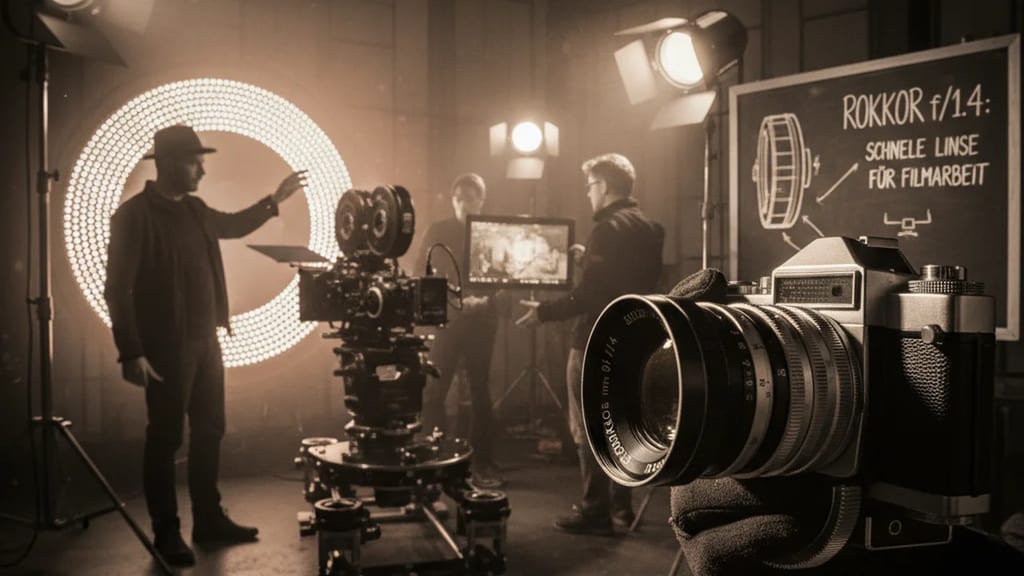
Cinematographers appreciate the Rokkor 50mm f/1.4 for its soft, creamy bokeh and characteristic color rendition with a slight magenta cast. The gentle fall-off in sharpness makes it ideal for portraits and dramatic scenes. It can be adapted to modern digital cinema cameras using lens adapters, with the crop factor needing to be considered.
The MC Rokkor-PG version is particularly valued for its analog aesthetic, while the later X versions render sharper but with less character. At wide apertures, the lens exhibits slight chromatic aberration, which is correctable digitally.
Comparison & Alternatives
Compared to the Zeiss Planar 50mm f/1.4, the Rokkor offers softer bokeh with slightly lower contrast performance. The Canon FD 50mm f/1.4 SSC is sharper but less characterful. Modern alternatives such as the Sigma 50mm f/1.4 Art surpass it technically but do not achieve the organic image quality.
For a vintage look in digital productions, the MC Rokkor-PG remains a top choice, while for maximum sharpness, modern designs are preferable. The SR mount limits compatibility to adapter solutions.