Overview
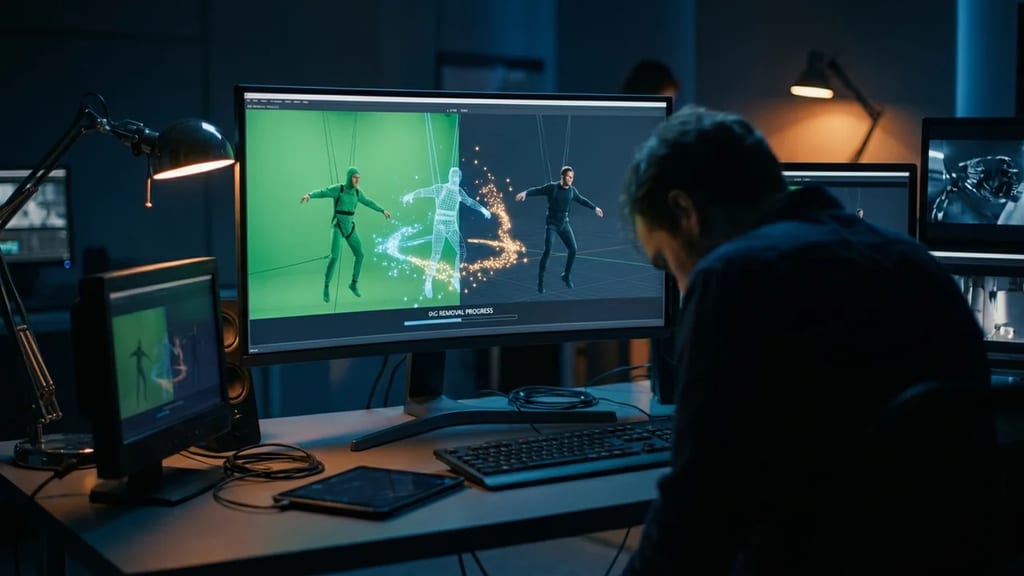
Rig removal (also known as wire removal) refers to a visual effects (VFX) technique where auxiliary constructions necessary on set but undesirable in the final image are digitally removed in post-production. This includes safety wires and flying cables (e.g., in flying, jumping, or levitation scenes), greenscreen tripods, crane and jib arms, stunt rigs, pyrotechnic devices, suction cup mounts for camera movements on vehicles, and other supports and apparatus.
The term belongs to the compositing and paint areas of VFX post-production. It is not a device or a lighting component, but a processing technique that is typically performed frame-by-frame. Industrial Light & Magic is considered one of the pioneers of modern wire removal methods, with early applications in films such as Hook (1991) and Cliffhanger (1993).
Technique and Workflow
The goal is to credibly reconstruct the image area obscured or disrupted by the rig without visible seams, differing grain, or missing motion blur. Common workflow components include:
- Clean Plate: A shot or single frame of the same background without the disturbing element, serving as a clean image source.
- Rotoscoping / Rotomatting: Creating masks (mattes) using splines to isolate the area to be processed from the rest of the image.
- Tracking / Matchmoving: Following camera and object movement so that applied patches precisely follow the motion. Planar trackers (e.g., Mocha) allow a patch to move perspectivally.
- Paint: Manual or semi-automatic painting, cloning, and stamping to fill the rig area with surrounding image material.
- Keying: In greenscreen shoots, wires can be partially removed automatically via keying before the background is composited.
Software
Rig removal is typically performed in compositing and paint programs. Frequently mentioned tools include:
- Foundry Nuke (Compositing, Paint, Tracking)
- Adobe After Effects
- Boris FX Silhouette
- Adobe Photoshop (for static clean plates and single-frame retouching)
- Boris FX Mocha (Planar Tracking)
On-Set Implementation
Rig removal begins during on-set preparation, not just in post-production. To ensure successful later cleanup, camera, grip, and VFX departments ensure that the rig is placed against a background that is as uniform as possible, that a separate clean plate shot of the empty scene is taken, and that tracking markers or reference points are present. Wires are often held in a color that is favorable for removal or positioned against greenscreen. Clean set preparation significantly reduces the effort and cost of subsequent digital removal.