Cinematographer
Aus DoP-Perspektive ist dieses Element essentiell für die visuelle Gestaltung. Es ermöglicht mir die gewünschte Farbstimmung und das ästhetische Bild konsistent umzusetzen.
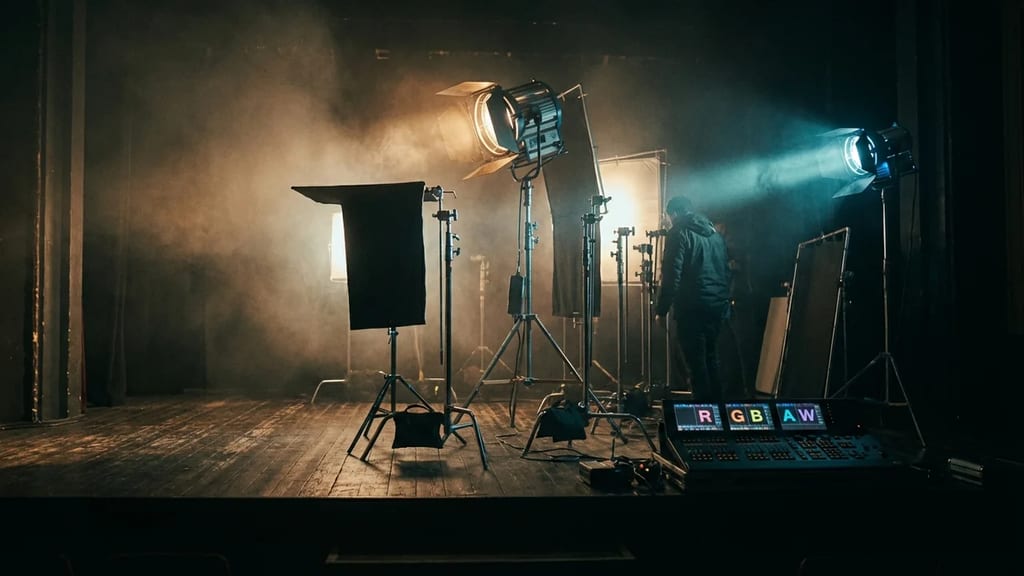
Five-color LED mixing system combining red, green, blue, amber, and white for richer color saturation and more natural white light than RGB alone.
RGBAW (also written RGBWA) does not refer to a single device, but to a color mixing method for LED fixtures. The abbreviation stands for the five diode colors Red, Green, Blue, Amber, and White. These five emitters are either seated as separate individual diodes in the housing or bundled in a multi-chip package (often marketed as "5-in-1" LEDs). Through additive color mixing, the output color and – depending on the control – also the color temperature of the white light can be generated from these.
RGBAW is the extension of the simpler schemes RGB, RGBW (with additional white), and RGBA (with additional amber). It combines both additional colors in one system. A further expansion stage is RGBAW-UV (six colors, with an additional UV diode).
Pure RGB systems have weaknesses in warm tones and clean white: There are gaps in the spectrum between the narrow-band primary colors, especially in the cyan, yellow, and orange ranges. This makes a well-rendering, neutral white and convincing pastel or skin tones difficult.
By combining both additional colors, RGBAW covers a larger color space (gamut) than RGB or RGBW alone and facilitates white balancing over a wide range from warm to cool.
RGBAW mixing is primarily found in color-controllable LED devices such as LED pars, wash lights, tubes/pixel bars, and panels, which are controlled via DMX/RDM. In film and TV, the method is attractive because effect colors and definable white light are combined in one device.
Practical Notes:
Aus DoP-Perspektive ist dieses Element essentiell für die visuelle Gestaltung. Es ermöglicht mir die gewünschte Farbstimmung und das ästhetische Bild konsistent umzusetzen.
Diese professionelle Lösung erhöht die Produktionseffizienz und reduziert Post-Production-Anforderungen. Sie ermöglicht flexible, schnelle Anpassungen während des Drehs.
Als Gaffer ist dies ein unverzichtbares Werkzeug meines täglichen Handwerkszeugs. Es ermöglicht mir professionelle Lichtkontrolle und schnelle Anpassungen auf Set, was Zeit spart und Qualität sichert.
1. Zu welchem Department gehört „RGBAW"?
2. Wie viele verschiedene Fachperspektiven bietet dieser Eintrag?
The Lexikon is part of the Filmfarm ecosystem — alongside budgeting (FilmBalance), an industry magazine (FilmCircus) and crew networking (FilmCall, CrewMesh). One shared vocabulary for the whole production.