Filmlexikon.
Support
Remote Head
Grip · Equipment

Remote Head

Murnau AI illustration
arri stabilized remote head fluid head geared head gobo head grip head head related transfer function head slate head

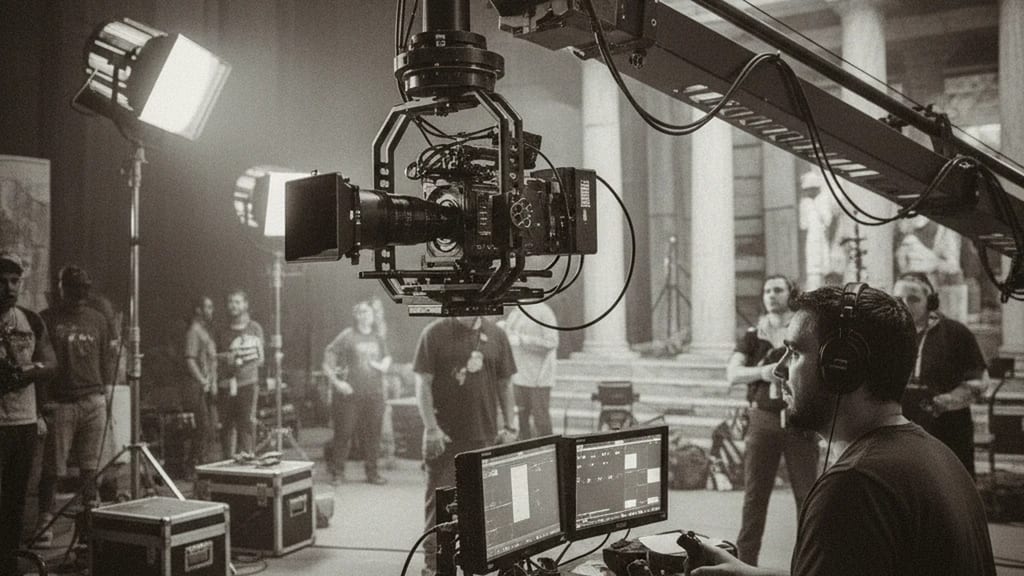
Remotely operated camera head with three axes of rotation (pan/tilt/roll) for filming in inaccessible or hazardous locations. Payload capacity 15–150 kg with brushless servo motors.

Technical Details

Current remote heads carry payloads of 15-150 kg and feature brushless servo motors with encoder feedback. The Libra Head V, for example, carries up to 27 kg with a tare weight of 18 kg. The three axes of rotation offer movement ranges of 360° (Pan), ±180° (Tilt), and ±270° (Roll). High-quality models integrate gyro stabilization and can be synchronized with motion control systems. Power is supplied via 12-48V DC with power consumption between 50-200 watts.

History & Development

The first commercially successful remote head was developed in 1985 by Libra Head Systems, after camera technicians sought solutions for hazardous shooting locations. In 1992, Hot Head introduced blimp-free technology, which eliminated motor noise. The breakthrough came in 2001 with Technocrane's integration into crane systems. Since 2010, digital encoders and CAN bus communication have enabled programmable camera movements with millimeter accuracy.

Practical Use in Film

Remote heads allow for shots in inaccessible areas: explosion scenes, underwater housing setups, or extreme crane positions. In "Mad Max: Fury Road" (2015), Russian Arm-mounted remote heads were used for dynamic chase sequences. A typical workflow: the camera assistant monitors focus remotely, while a second operator controls the head movements. In studio shoots, they significantly reduce crew size and ambient noise on set.

Comparison & Alternatives

Unlike gimbals, remote heads operate with greater mechanical precision but are less mobile. Fluid heads offer direct tactile feedback, while remote heads can program repeatable movements. Motion control systems enhance remote heads with repeatability for VFX shots. Modern alternatives such as the Bolt Cinebot combine robotic arm technology with remote head precision for more complex motion sequences.
From the crafts

Perspectives

Cinematographer

Als DoP nutze ich Remoteheads vor allem für extrem gefährliche oder beengte Positionen, wo ich nicht physisch präsent sein kann. Die Herausforderung liegt darin, ohne direkten Blick durch den Sucher die Bildkomposition zu beurteilen – hier sind hochwertige Monitore und Funkstrecken entscheidend. Bei komplexen Kamerafahrten programmiere ich Bewegungsabläufe vorab, um während der Aufnahme reproduzierbare Ergebnisse zu garantieren.

Director

Für mich eröffnen Remoteheads narrative Möglichkeiten, die mit konventioneller Kameraführung unmöglich wären – extreme Vogelperspektiven ohne Hubschrauber oder intime Nahaufnahmen in explosiven Actionszenen. Die größte kreative Herausforderung ist die fehlende Spontaneität: Jede Bewegung muss durchdacht und oft programmiert werden, was improvisierten Schauspieler-Reaktionen entgegenwirkt. Bei Stunt-Sequenzen kann ich jedoch viel näher an die Action heran, ohne Crew zu gefährden.

Producer

Ein Remotehead-Rental kostet 800-2500€ pro Tag, plus spezialisierter Operator (600-1200€). Die Investition rechnet sich bei gefährlichen Szenen durch reduzierte Versicherungskosten und wegfallende Sicherheitsmaßnahmen für Crew-Mitglieder. Zeitersparnis entsteht durch programmierbare Wiederholungen bei VFX-Shots – keine manuellen Angleichungsversuche mehr. Setup-Zeit beträgt allerdings 2-3 Stunden zusätzlich, was bei straffen Drehplänen eingeplant werden muss.

More in the lexikon

Related terms

Test your knowledge

Quiz

1. Was beschreibt „Remotehead" am besten?

2. Zu welchem Department gehört „Remotehead"?

3. Wie viele verschiedene Fachperspektiven bietet dieser Eintrag?

Report an error
From the Filmfarm ecosystem

Understand visual language, budget productions, connect crew.

The Lexikon is part of the Filmfarm ecosystem — alongside budgeting (FilmBalance), an industry magazine (FilmCircus) and crew networking (FilmCall, CrewMesh). One shared vocabulary for the whole production.

FilmFarm FilmRadarComing soonFilmPulseComing soonFilmNumbersComing soonFilmCapitalComing soonFilmLabComing soonFilmBalanceComing soonFilmCircusComing soon