Technical Details
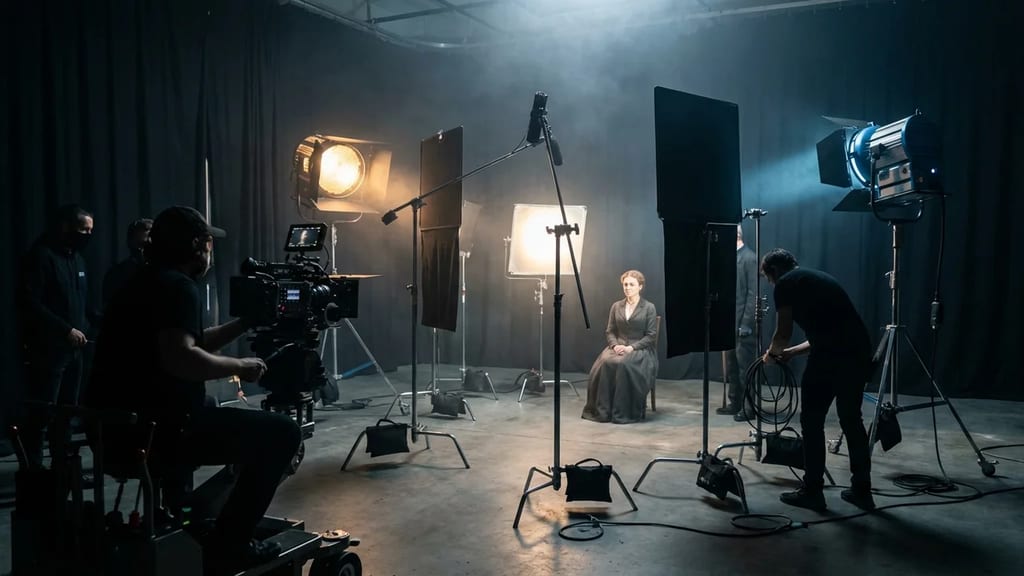
The light source is positioned precisely 45 degrees laterally from the camera-subject axis, at a height of 30-45 degrees above the subject's eye line. The resulting shadow-side light triangle ideally measures no more than the width of the eye and does not extend beyond the tip of the nose. Fresnel spotlights or LED panels are typically used, with a color temperature of 3200K or 5600K, depending on the desired color mood. Diffusion through softboxes or silk reduces hard shadow edges and creates softer transitions.
History & Development
The technique was established in the 1920s within the Hollywood studio system, after cinematographers like Karl Freund and Gregg Toland adapted Baroque painting techniques for the medium of film. Cecil B. DeMille consciously employed directed artificial light from 1915 onwards, developing dramatic lighting concepts. In the 1940s, Rembrandt lighting became a standard repertoire of the film noir aesthetic. Modern LED technology has enabled more precise control over intensity and color temperature since the 2000s, with simultaneously reduced power consumption.
Practical Application in Film
A classic application can be found in Orson Welles' "Citizen Kane" (1941), where Gregg Toland used Rembrandt lighting for portrait shots. Roger Deakins employed the technique in "Blade Runner 2049" (2017) for more intimate character moments. The setup is particularly suitable for single portraits, close-ups, and dialogue scenes. The setup requires at least one main light source and optionally fill light for shadow illumination. Disadvantages arise with rapid camera movements, as the precise light triangle only functions within a narrow angle range.
Comparison & Alternatives
Unlike split lighting, Rembrandt lighting does not completely divide the face into light and shadow, but intentionally leaves a patch of light on the shadow side. Butterfly lighting (beauty lighting) comes frontally from above, while side lighting is positioned completely laterally. Loop lighting creates a curved nose shadow without a light triangle on the cheek. For difficult facial shapes or deep-set eyes, butterfly or loop lighting is more suitable. For group setups, broader, less directed light is more practical.