Filmlexikon.
Support
Rehoused Lens
Camera · Equipment

Rehoused Lens

Murnau AI illustration
anamorphic lens anamorphic projection lens angenieux optimo prime arri master prime arri signature prime arri ultra prime arri zeiss variable prime atlas lens co

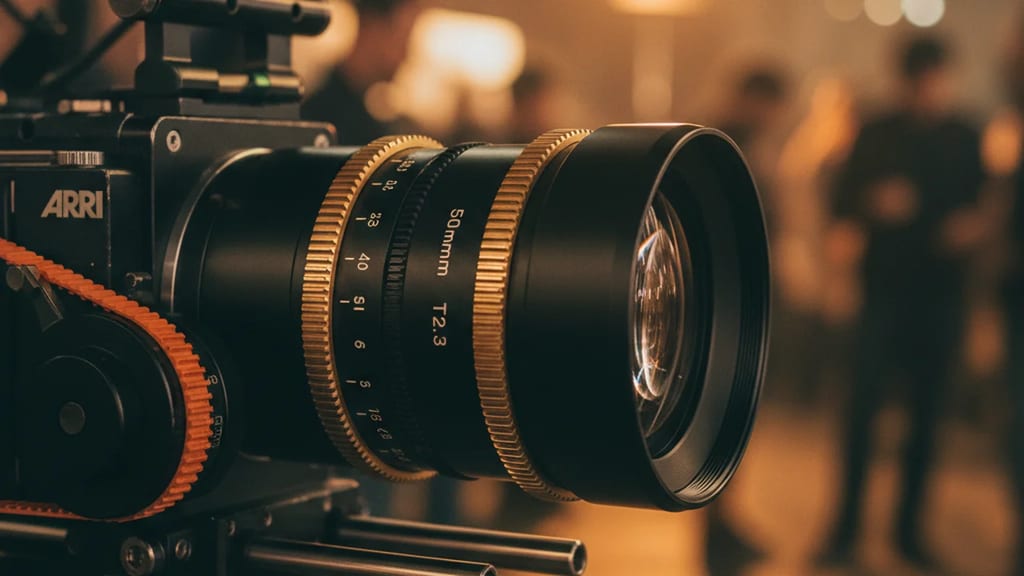
Complete mechanical rebuild of photographic lenses with original glass elements retained, featuring standardized focus and iris rings for film production.

Technical Details

The rehousing involves the complete reconstruction of the mechanical housing while retaining the original glass elements. Standardized focus rings have a rotation angle between 180° and 270°, while aperture rings allow for stepless transitions (declicked). The housings are typically made from CNC-milled aluminum alloys and weigh between 1.5kg and 3.2kg depending on the focal length. Typical adjustments include front diameters of 95mm or 114mm for matte box compatibility, as well as precise flange focal distances for various camera systems.

History & Development

Rehousing emerged around 2008 as a response to the boom in DSLR filmmaking, when cinematographers wanted to use high-quality photo lenses from Zeiss, Leica, or Canon for video work. Pioneers like Duclos Lenses and GL Optics developed the first professional rehousing services. In 2010, Zeiss established the first manufacturer standard for photo-to-cine adaptations with the Compact Prime CP.2 lenses, followed by Sigma with the Cine series in 2016.

Practical Use in Film

Rehoused Zeiss Contax lenses shaped the look of films like "Her" (2013) and "Carol" (2015) by combining characteristic vintage aesthetics with modern handling standards. Leica R-rehouses, in particular, are valued for their warm color rendition and smooth bokeh, while Canon FD-rehouses are popular for their sharpness in low-budget productions. The workflow requires precise calibration of focus markings and regular maintenance of mechanical components.

Comparison & Alternatives

Rehoused lenses differ from native cine lenses by potentially having lower mechanical precision and limited focus markings. Modern alternatives like Sigma Cine or Samyang XEEN offer built-in cine features at similar prices. However, vintage rehouses remain indispensable for specific optical characteristics that cannot be replicated in modern designs. Native cine lenses, on the other hand, offer better color matching within a series and greater durability under production conditions.
From the crafts

Perspectives

Cinematographer

Ich schätze Rehoused-Objektive für ihre einzigartigen optischen Charakteristiken – ein Zeiss Contax 85mm gibt mir diese cremige Hauttöne, die moderne Objektive nicht erreichen. Die präzisen Fokusringe ermöglichen mir exakte Schärfeverlagerungen, auch wenn ich bei der Farbabstimmung zwischen verschiedenen Vintage-Serien mehr Aufwand in der Postproduktion einkalkulieren muss.

Director

Rehoused Vintage-Objektive geben mir emotionale Bildsprachen, die perfekt zu Charakterstudien passen – das weiche Bokeh und die warmen Hauttöne unterstützen intime Momente ohne technische Perfektion zu demonstrieren. Ich wähle sie bewusst für Projekte, wo der nostalgische Look die Erzählung verstärkt, während ich für Action-Szenen auf die Schärfe moderner Cine-Objektive setze.

Producer

Rehoused-Sets kosten zwischen 15.000€ und 45.000€ und bieten damit einen Mittelweg zwischen Consumer-Objektiven und High-End Cine-Serien, die 150.000€+ kosten können. Die längeren Lieferzeiten von 4-8 Wochen für Custom-Rehousing erfordern frühe Planung, aber die Investition zahlt sich durch den einzigartigen Look und bessere Wiederverkaufswerte aus.

More in the lexikon

Related terms

Test your knowledge

Quiz

1. Was beschreibt „Rehoused-Objektiv" am besten?

2. Zu welchem Department gehört „Rehoused-Objektiv"?

3. Wie viele verschiedene Fachperspektiven bietet dieser Eintrag?

Report an error
From the Filmfarm ecosystem

Understand visual language, budget productions, connect crew.

The Lexikon is part of the Filmfarm ecosystem — alongside budgeting (FilmBalance), an industry magazine (FilmCircus) and crew networking (FilmCall, CrewMesh). One shared vocabulary for the whole production.

FilmFarm FilmRadarComing soonFilmPulseComing soonFilmNumbersComing soonFilmCapitalComing soonFilmLabComing soonFilmBalanceComing soonFilmCircusComing soon