Filmlexikon.
Support
Radioactive Lens
Camera · Equipment

Radioactive Lens

Murnau AI illustration
anamorphic lens anamorphic projection lens angenieux optimo prime arri master prime arri signature prime arri ultra prime arri zeiss variable prime atlas lens co

Lens made with thorium oxide glass (1943–1982) for enhanced light transmission and refractive index; avoided today due to radioactivity.

Technical Details

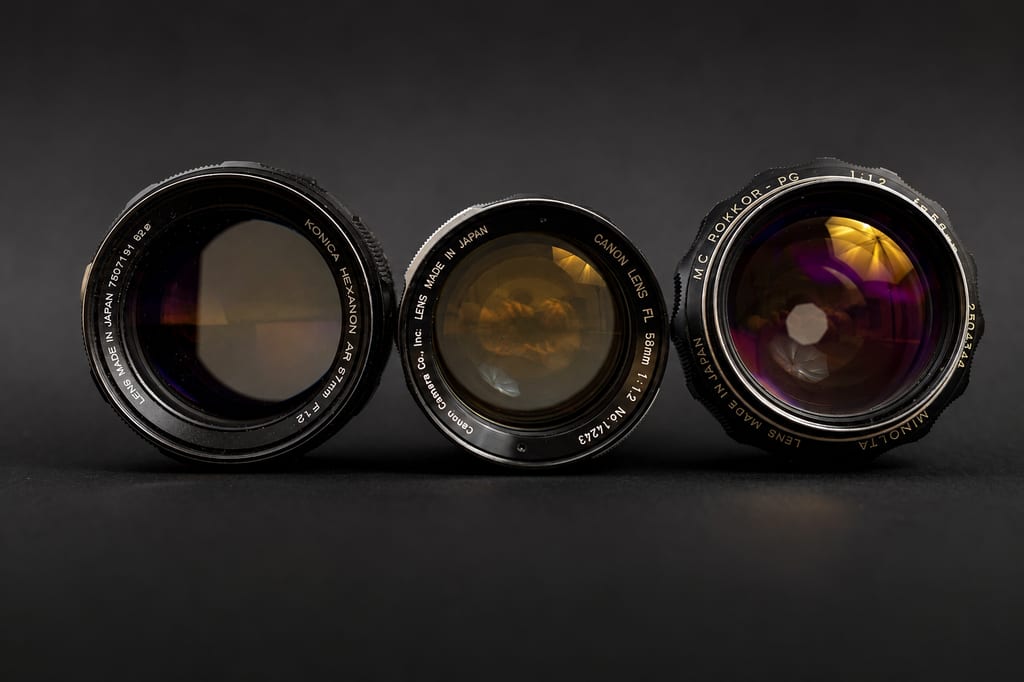
Thorium oxide was used as a glass additive to increase the refractive index to values between 1.7-1.9 and optimize the Abbe number. This primarily affects lenses with complex optical formulas: Zeiss Planar 50mm f/0.7, Canon FD 55mm f/1.2 S.S.C., Pentax Super-Takumar 55mm f/1.8, and various Leica Summicron variants. The radioactive elements are usually located in the front or rear lens groups. Modern Geiger counters measure the highest values at the rear of the lens, as the thorium elements are often concentrated there.

History & Development

The first radioactive lenses were developed in 1943 by Zeiss for military applications. Kodak introduced thorium glass into consumer lenses in 1947, followed by Canon (1959), Pentax (1962), and other manufacturers. The peak was between 1960-1975, when over 200 lens models used thorium glass. In 1978, most manufacturers ceased production after health concerns and stricter radiation protection regulations made their use unprofitable. Pentax was the last major manufacturer to fully switch to thorium-free glasses in 1982.

Practical Use in Film

Stanley Kubrick used modified Zeiss Planar 50mm f/0.7 lenses (originally for NASA moon missions) for the candlelight scenes in "Barry Lyndon" (1975). Many documentary filmmakers of the 1970s valued the high speed of radioactive Takumar lenses for available-light shooting. The lenses develop a characteristic yellow tint due to the radiation, which produces warm skin tones but reduces UV transmission. Modern film productions avoid them due to insurance regulations and occupational safety rules.

Comparison & Alternatives

Radioactive lenses deliver similar optical performance to modern ED (Extra-low Dispersion) glasses or fluorite elements, but without the health risks. The radiation exposure is equivalent to approximately a two-hour transatlantic flight per workday with the lens. Collectors today pay premiums of 300-800% for un-yellowed examples. Professional users replace them with modern Zeiss Otus, Canon L-series, or Cooke S4/i lenses, which offer comparable sharpness without radioactive components.
From the crafts

Perspectives

Cinematographer

Ich schätze die einzigartige Abbildungsleistung alter Takumar- oder Zeiss-Objektive, führe aber Dosimeter-Messungen durch und begrenze die Expositionszeit auf maximal 4 Stunden täglich. Die warme Farbwiedergabe durch die leichte Vergilbung kann durchaus erwünscht sein, erfordert aber präzises Color-Grading und UV-Filter-Kompensation in der Post-Production.

Director

Für Period-Pieces nutze ich bewusst die organische Bildwirkung radioaktiver Vintage-Objektive, um eine authentische 70er-Jahre-Ästhetik zu erzielen, die digitale Emulation nicht erreicht. Die natürliche Erwärmung der Hauttöne und der spezielle Bokeh-Charakter unterstützen nostalgische Erzählformen, erfordern jedoch vorab Absprachen mit Versicherung und Arbeitsschutz.

Producer

Radioaktive Objektive bedeuten 20-30% Mehrkosten durch Strahlenschutz-Audits, spezielle Versicherungspolicen und begrenzte Einsatzzeiten der Crew. Ich kalkuliere zusätzlich Ausrüstungs-Alternativen und Gesundheitsmonitoring ein, da viele Verleiher diese Objektive inzwischen aus dem Portfolio genommen haben oder Aufschläge von 40-60% verlangen.

More in the lexikon

Related terms

Test your knowledge

Quiz

1. Was beschreibt „Radioaktives Objektiv" am besten?

2. Zu welchem Department gehört „Radioaktives Objektiv"?

3. Wie viele verschiedene Fachperspektiven bietet dieser Eintrag?

Report an error
From the Filmfarm ecosystem

Understand visual language, budget productions, connect crew.

The Lexikon is part of the Filmfarm ecosystem — alongside budgeting (FilmBalance), an industry magazine (FilmCircus) and crew networking (FilmCall, CrewMesh). One shared vocabulary for the whole production.

FilmFarm FilmRadarComing soonFilmPulseComing soonFilmNumbersComing soonFilmCapitalComing soonFilmLabComing soonFilmBalanceComing soonFilmCircusComing soon