Filmlexikon.
Support
Quasar Double Rainbow
Lighting · Equipment

Quasar Double Rainbow

Murnau AI illustration
color temperature flow roll take

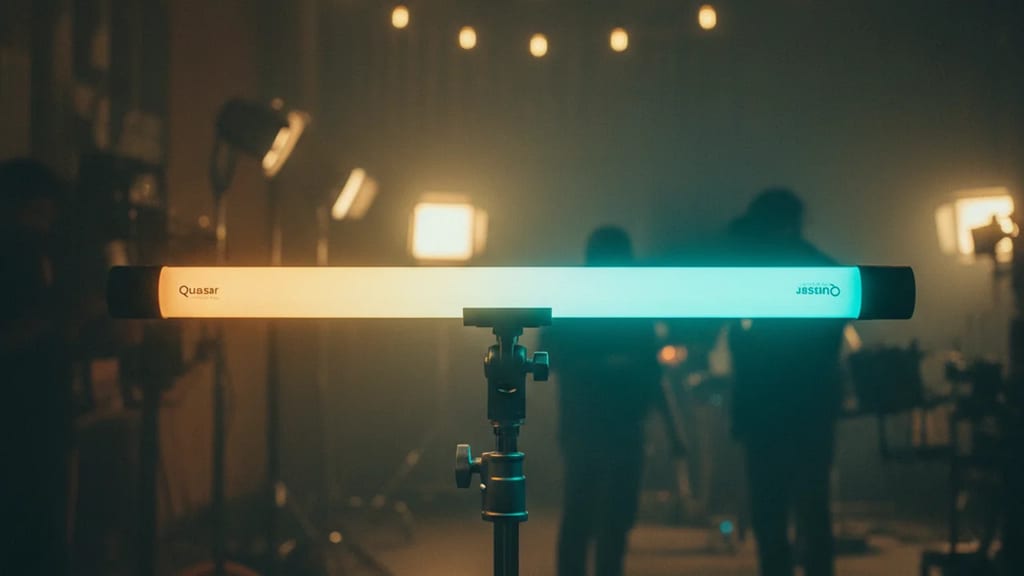
Quasar Science LED panel featuring dual independent arrays (warm white 2000K–3200K, cool white 4500K–6000K) for seamless color temperature adjustment without filters.

Technical Details

The system is based on two parallel LED strips, each with 288 individual diodes per square foot. The lower strip contains warm white LEDs (2000K-3200K), and the upper strip contains cool white LEDs (4500K-6000K). Power consumption is a maximum of 200 watts at full intensity of both arrays. The panel achieves a CRI value of 95+ and a TLCI value of 98. Available sizes range from 1x1 foot to 4x4 feet, with larger variants being assembled from modular 2x1 foot units. Control is via DMX512 or the proprietary QuasarLink app via Bluetooth.

History & Development

Quasar Science introduced the Double Rainbow System in 2018 as an evolution of their Q-LED series. The initial concept came from DoP Shane Hurlbut, who was looking for more flexible color temperature solutions for "The Ruins" (2008). In 2019, the Rainbow series followed with RGBX functionality, and in 2021, the current generation with improved color rendering and reduced flicker at 120fps footage. The integration of Bluetooth control came in 2020 in response to COVID-19 related social distancing rules on set.

Practical Use in Film

Christopher Nolan utilized Quasar Double Rainbow panels for practical lighting effects in "Tenet" (2020), particularly for the time reversal sequences. The stepless color temperature adjustment allowed for seamless transitions between daylight and night light without filter changes. Typical applications include car rigs, where the slim profile (2.5 cm depth) is critical, as well as a book light behind diffusion for portraits. The panels are particularly suitable for mixed lighting situations where existing daylight (5600K) needs to be balanced with artificial light (3200K).

Comparison & Alternatives

Compared to conventional bi-color LEDs like the Arri SkyPanel, the Double Rainbow System offers more precise control over light distribution and color mixing through its physically separated LED arrays. The ARRI Orbiter with a bi-color module achieves higher light output but is significantly heavier and more expensive. For pure color effects, RGBWW systems like the Astera Titan Tube surpass its capabilities, while for maximum light output, traditional HMI lights with color gels remain superior. The Double Rainbow System positions itself in the niche between flexibility and light output.
From the crafts

Perspectives

Cinematographer

Die physisch getrennten LED-Arrays geben mir präzise Kontrolle über die Lichtrichtung und ermöglichen es, warmes Fülllicht von unten und kaltes Führungslicht von oben zu setzen, ohne zwei separate Scheinwerfer positionieren zu müssen. Bei Zeitraffer-Aufnahmen kann ich die Farbtemperatur über den Tag hinweg automatisiert anpassen und dabei natürliche Lichtwechsel simulieren. Die flache Bauform macht das Panel ideal für versteckte Platzierungen in engen Sets oder als unsichtbare Lichtquelle hinter Requisiten.

Director

Das Double Rainbow System erlaubt mir, emotionale Stimmungswechsel durch subtile Farbtemperaturverschiebungen zu erzählen, ohne dass die Kamera schwenken oder Schauspieler ihre Position ändern müssen. In Dialogszenen kann ich die Farbtemperatur eines Charakters während des Gesprächs verändern und so dessen emotionalen Zustand visuell unterstützen. Besonders effektiv ist dies in Erinnerungssequenzen, wo der Übergang von kaltem Gegenwartslicht zu warmem Vergangenheitslicht die narrative Ebene verstärkt.

Producer

Ein 2×2-Fuß-Panel kostet etwa 3.200 Euro, was sich durch eingesparte Grip-Zeit und reduzierte Transportkosten amortisiert, da weniger separate Scheinwerfer und Stative benötigt werden. Die Bluetooth-Steuerung reduziert die Kabellänge und damit Stolperfallen, was Versicherungskosten senkt. Der geringe Stromverbrauch von 200W pro Panel ermöglicht längere Drehtage mit Akkubetrieb und reduziert Generatorkosten bei Location-Drehs.

More in the lexikon

Related terms

Test your knowledge

Quiz

1. Zu welchem Department gehört „Quasar Double Rainbow"?

2. Wie viele verschiedene Fachperspektiven bietet dieser Eintrag?

Report an error
From the Filmfarm ecosystem

Understand visual language, budget productions, connect crew.

The Lexikon is part of the Filmfarm ecosystem — alongside budgeting (FilmBalance), an industry magazine (FilmCircus) and crew networking (FilmCall, CrewMesh). One shared vocabulary for the whole production.

FilmFarm FilmRadarComing soonFilmPulseComing soonFilmNumbersComing soonFilmCapitalComing soonFilmLabComing soonFilmBalanceComing soonFilmCircusComing soon