Filmlexikon.
Support
Pull Focus
Camera · Terms

Pull Focus

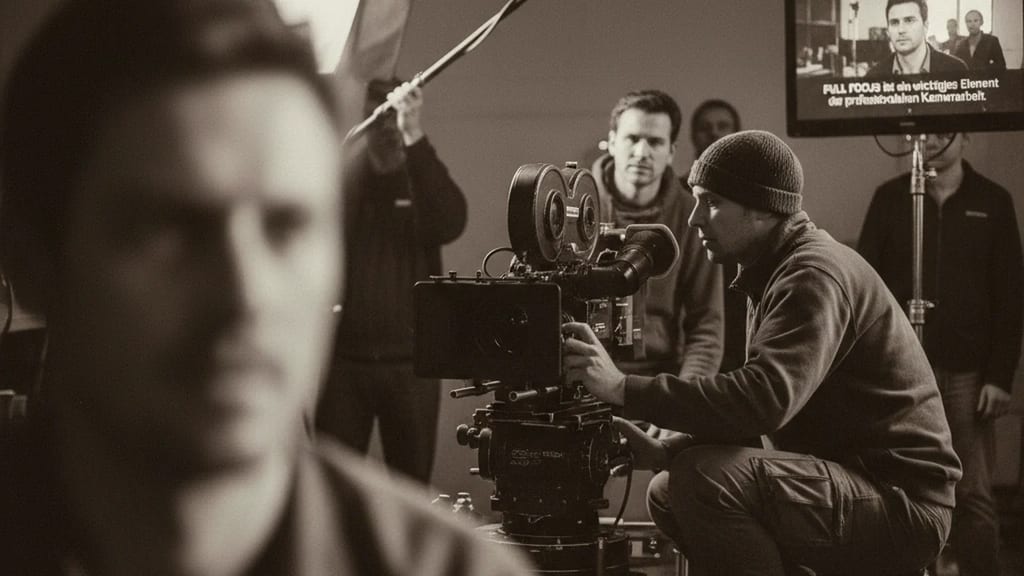
Murnau AI illustration
flow focus para roll take

Focus shift during recording from foreground to background or vice versa, executed by the 1st AC using follow-focus systems with 300° rotation travel.

Technical Details

Professional cine lenses feature a focus ring with a 300° rotation and linear scaling, unlike photographic lenses with a 90-180° range. Follow focus systems transfer rotational movement via gears (0.8 module) from an external focus wheel to the lens. Motorized systems like Preston FIZ or RT Motion operate with stepper motors, achieving accuracies of ±0.02 mm focus travel. Wireless systems operate on 2.4 GHz with latency below 40ms. The critical depth of field at T2.8 and 50mm focal length is approximately 15cm at a distance of 3m.

History & Development

The systematic application of focus shifts developed in the 1940s with Orson Welles' "Citizen Kane" (1941), where Gregg Toland combined extreme depth of field with selective focus pulls. The term "rack focus" became established in Hollywood in the 1960s. The introduction of the Follow Focus by Arriflex in 1968 professionalized the technique. Digital systems emerged from 2005 with Preston Cinema Systems' HF2 series. Today, systems like cforce mini RF enable focus pulls over distances exceeding 100m with sub-frame accuracy.

Practical Application in Film

In "The Graduate" (1967), Hal Ashby executes focus pulls from Benjamin's head in the foreground to Mrs. Robinson in the background to visualize emotional tension. "Jaws" (1975) uses focus shifts during the "dolly zoom" on the beach. The 1st Assistant Camera (Focus Puller) marks focus points with colored tape on the follow focus and works with tape measure readings. For Steadicam shots, wireless control is used via remote systems. Modern productions increasingly utilize wireless systems with up to three axes (focus/iris/zoom).

Comparison & Alternatives

Pull focus differs from "breathing" (unintended change in field of view during focusing) and "soft focus" (consistently soft image). Alternative methods of directing attention include camera movement, lighting, or composition. Autofocus systems like Dual Pixel AF achieve high speed but offer no creative control over the timing and speed of focus shifts. Deep focus photography deliberately foregoes focus plays in favor of consistent image sharpness.

From the crafts

Perspectives

Cinematographer

Ich plane Schärfefahrten bereits beim Blocking und markiere alle Fokuspunkte mit Maßband – bei T1.4 und 85mm bleibt mir nur ein Spielraum von 5cm pro Schärfenebene. Mein Focus Puller und ich entwickeln ein System aus Handzeichen für spontane Änderungen, besonders bei Steadicam-Shots wo ich die Markierungen am Follow-Focus nicht sehe. Wireless-Follow-Focus ist Standard geworden, aber ich verlasse mich nie ausschließlich darauf – Backup-Kabel liegt immer bereit.

Director

Ich nutze Schärfeverlagerungen als narrative Interpunktion – der Moment des Umziehens kann eine Gedankenwendung der Figur markieren oder enthüllen, was sie wirklich sieht. In Dialogszenen ersetze ich damit oft Schnitte und halte die emotionale Kontinuität aufrecht. Besonders wirksam: von scharfem Vordergrund auf unscharfen Hintergrund ziehen, dann eine Figur ins Bild treten lassen und scharf ziehen – das erzeugt Überraschung ohne Schnitt.

Producer

Komplexe Fokusfahrten kosten mich durchschnittlich 3-4 zusätzliche Takes pro Setup, was bei 12 Setups am Tag schnell zwei Stunden Mehrzeit bedeutet. Ein erfahrener Focus Puller mit eigenem Preston-System kostet 200€ mehr pro Tag, spart aber Drehtage ein. Bei Low-Budget-Produktionen setze ich auf moderne Autofokus-Kameras oder plane bewusst mit größerer Schärfentiefe ab T4.0, um Fokus-Risiken zu minimieren.

More in the lexikon

Related terms

Test your knowledge

Quiz

1. Was beschreibt „Schärfeziehen" am besten?

2. Zu welchem Department gehört „Schärfeziehen"?

3. Wie viele verschiedene Fachperspektiven bietet dieser Eintrag?

Report an error
From the Filmfarm ecosystem

Understand visual language, budget productions, connect crew.

The Lexikon is part of the Filmfarm ecosystem — alongside budgeting (FilmBalance), an industry magazine (FilmCircus) and crew networking (FilmCall, CrewMesh). One shared vocabulary for the whole production.

FilmFarm FilmRadarComing soonFilmPulseComing soonFilmNumbersComing soonFilmCapitalComing soonFilmLabComing soonFilmBalanceComing soonFilmCircusComing soon