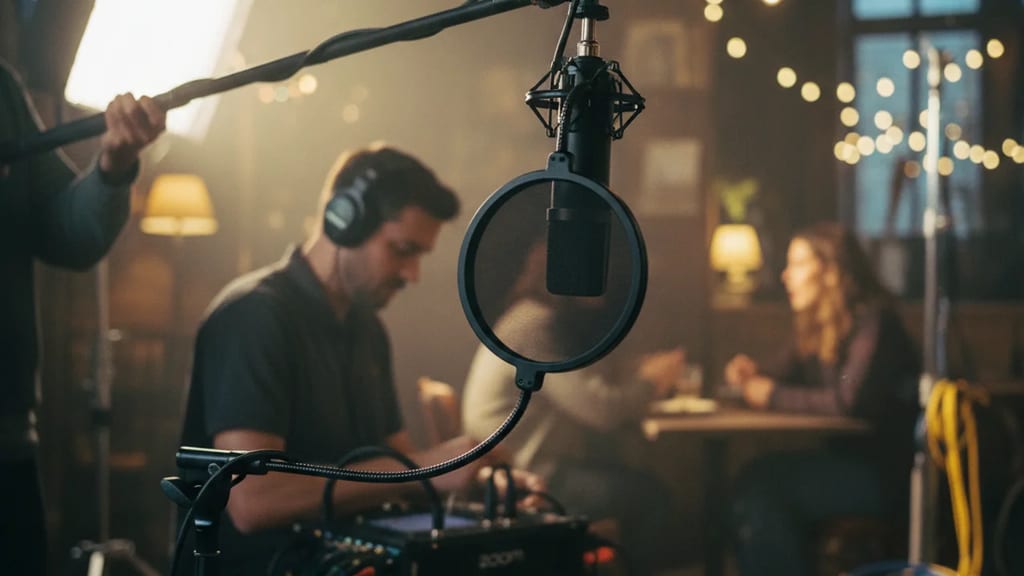
Foam or mesh screen in front of mic — absorbs plosives and wind noise without dampening tone. Essential for dialogue and voiceover.
Anyone who has ever led a VO session with open ears knows the problem: the 'P' in "perspective" hits the microphone like a gust of wind, the 'B' in "balance" creates a dull plosive burst that can't be easily removed in editing. The pop filter sits precisely between the speaker and the capsule for this purpose — a seemingly simple but indispensable tool that makes the difference between usable and unusable, noisy material.
The mechanics are straightforward: plosives are created by bursts of air that occur when pronouncing certain consonants (P, B, T, D, K). These hit the diaphragm unimpeded and create a non-linear peak in the signal — often inaudible to the voice itself, but devastatingly visible in editing. The pop filter — whether as a dense foam windscreen or a double-layered mesh screen — breaks down these air bursts into several smaller components and distributes them spatially. The result: the plosive is softened, not eliminated, and sits much more naturally in the mix later. For outdoor recordings, it additionally serves against real wind and ambient noise, even though a proper blimp system works more precisely here.
In practice, the choice of material depends on the setup. For stationary VO booth recordings, a fine-mesh screen model (often on a gooseneck arm) that barely attenuates highs is sufficient. For live recordings and reporter interviews with handheld microphones, foam is more commonly used — better against wind, but with some loss of low frequencies. The distance is crucial: too close to the microphone creates reflections again, too far away is ineffective. A distance of about a fist's width has proven effective.
A tip from daily work: a pop filter is not the same as a windscreen (see also windjammer, blimp). A mesh screen helps little against real wind from outside, and a thick foam windscreen cuts off highs at high frequencies. Some sound engineers use two systems combined — first the mesh screen, then over it a damp foam for outdoor shoots. And: a dirty or damaged pop filter becomes a sound trap. Regular cleaning or replacement is not a luxury, but craftsmanship.
Related terms
Quiz
1. Was beschreibt „Popschutz" am besten?
2. Zu welchem Department gehört „Popschutz"?