Overview
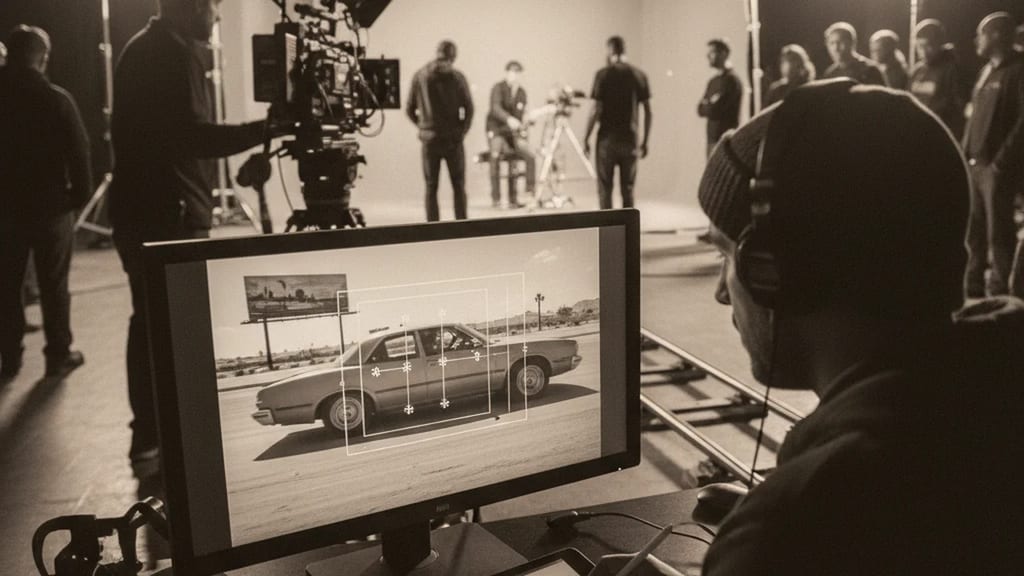
Planar Tracking (German for "planar" or surface-based tracking) is a motion tracking technique used in digital post-production and visual effects. Instead of tracking individual, high-contrast points (corners, markers) as in classic Point Tracking, a Planar Tracker analyzes the pixel pattern of a contiguous, largely flat surface – such as a wall, a sign, packaging, or a screen – and tracks its position across frames.
From this surface movement, the method derives a transformation for each image: translation (position), rotation, scaling, and perspective distortion or shear. This allows for tracking surfaces that rotate, tilt, or change perspective, and the tracking often remains stable even if part of the surface is temporarily occluded or moves out of frame.
How it Works and Differentiation
The prerequisite is that the tracked region lies approximately in a plane (most pixels share the same surface). The user draws a rough mask or region over the surface to be tracked; the tracker calculates the frame-by-frame transformation from this. Compared to Point Tracking:
- Point Tracking follows individual features and is primarily suitable for simple, linear movements (translation, zoom). It requires clearly defined tracking points.
- Planar Tracking utilizes the entire texture of a surface, does not require dedicated markers, and handles more complex movements like rotation, perspective shifts, and distortion more robustly.
Planar Tracking does not replace full 3D camera tracking (Camera Solving), but it often provides the foundation for it and is significantly faster and more stable to set up for surface-based tasks.
Software and Use in Post-Production
The term is closely associated with Boris FX Mocha (originally from Imagineer Systems), whose planar tracking engine popularized the technique in the industry. Native planar trackers are also found in Foundry Nuke (PlanarTracker) and via the Mocha AE plugin in Adobe After Effects. Typical applications include:
- Rotoscoping (drawing masks over moving surfaces)
- Screen Replacement / Screen Insert (replacing screen and monitor content)
- Object, wire, and rig removal, as well as removal of tracking markers
- Match Move (inserting graphics or logos onto moving surfaces)
- Image stabilization and digital makeup
In February 2013, Imagineer Systems was honored with a Scientific and Technical Award by the Academy of Motion Picture Arts and Sciences for Mocha and its underlying planar tracking technology (Recipients: Philip McLauchlan, Allan Jaenicke, John-Paul Smith, Ross Shain).
On-Set Context
Planar Tracking is a pure post-production technique and not lighting or grip equipment. However, it is relevant for camera and VFX preparation on set: Clean, continuous surfaces (e.g., well-lit greenscreens, monitors, or marked areas) facilitate later screen replacement and removal. Tracking markers are less essential for Planar Tracking than for Point Tracking, but a high-contrast, evenly lit surface remains the best prerequisite for a stable result.