Overview
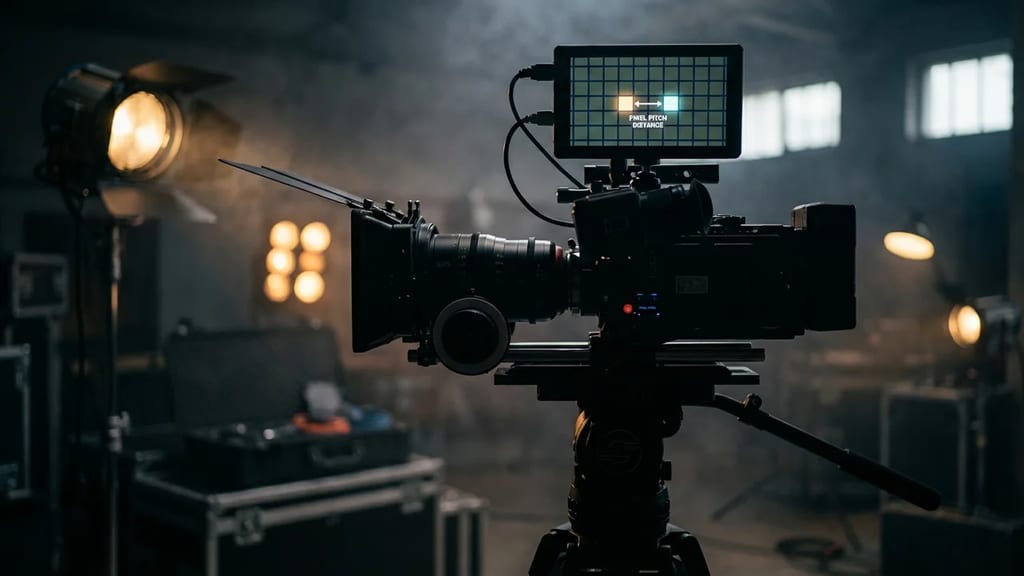
Pixel Pitch (also pixel spacing or dot density) refers to the distance from the center of one LED to the center of an adjacent LED on an LED panel or LED wall. It is specified in millimeters and is usually abbreviated with the prefix "P": a wall with a 2.6 mm pixel pitch is therefore designated P2.6, and one with 1.5 mm is P1.5.
This is not a single device or manufacturer, but a technical parameter that describes the resolution density of an LED surface. The general rule: the smaller the number, the closer the LEDs are spaced, the higher the physical resolution per unit area – and generally, the more expensive the panel. Larger pixel pitches (e.g., P4 and above) are found on large outdoor and stage walls with a high viewing distance, while small pitches (well below 2 mm) are used for indoor areas viewed up close by cameras.
Significance in Film and TV
In film and TV production, pixel pitch is particularly crucial for LED walls used in Virtual Production (LED volumes) and for camera-visible studio/broadcast walls. Several factors are directly dependent on the pitch:
- Minimum distance between camera/subject and the wall: The pitch, among other factors, determines how close the camera and actors can get to the wall before the individual LEDs become visible and the focus point shifts to the grid instead of the subject.
- Moiré: A finer LED grid (smaller pitch) generally reduces the risk of interference patterns between the LED grid and the camera sensor at typical studio distances. However, moiré is not solely a pitch issue – lens choice, focus, distance, image content, and the panel's refresh rate also play a role.
- Resolution in the image: For a given wall area, a smaller pitch provides more displayable pixels, resulting in sharper backgrounds that appear as a seamless image to the camera.
Important distinction: Pixel pitch is a characteristic of the panel, not the camera. For clean filming, camera-compatible high refresh rates are an additional, independent factor.
Typical Values and Selection
The following guide summarizes common application areas. Specific suitability always depends on the volume size, camera/subject distance, desired brightness, and budget.
| Application Area | Pixel Pitch Range (Guideline) |
|---|
| Virtual Production / LED Volume (Background) | often in the range of 2.3–2.8 mm; ~2.8 mm is considered a common minimum standard |
| Very Close Camera Shots / Foreground Elements | finer, well below 2 mm |
| Stage/Outdoor Walls with Large Viewing Distance | coarser, larger mm values |
A common rule of thumb for moiré avoidance suggests a minimum distance between the focused object and the LED wall that scales with the pixel pitch value; however, it does not replace a camera test before shooting begins. Since brightness per panel tends to decrease and costs increase with smaller pitches, the choice of pitch is always a compromise between image quality, desired camera distance, brightness, and budget.