Filmlexikon.
Support
Picture in Picture
Editing · Terms

Picture in Picture

Murnau AI illustration
split screen 2 pied picture lock

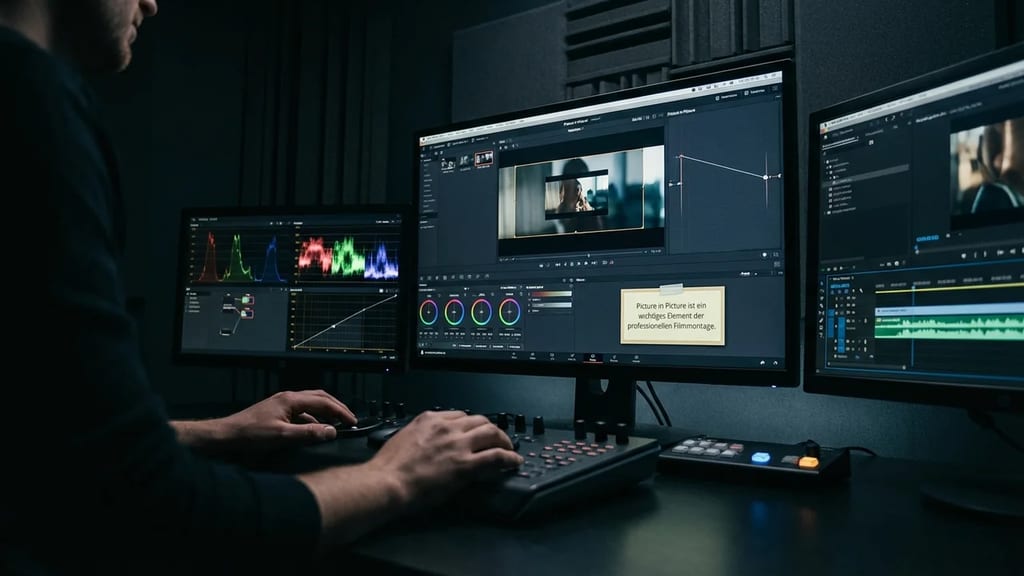
Picture in Picture (PiP) – a smaller video image (15–25% of frame area) layered over the main image, typically positioned in a corner, allowing simultaneous display of two narrative threads without cutting.

Technical Details

The overlaid window typically occupies 15-25% of the total screen area and is positioned by default in one of the four corners of the frame. In digital post-production, both video tracks are treated as separate layers, with the Picture-in-Picture element maintaining 100% alpha transparency and being animatable via keyframes. Modern NLE systems such as Avid Media Composer or Adobe Premiere support up to 32 simultaneous video layers for complex multi-image compositions. The resolution of the embedded image is usually reduced to 480x270 pixels (for 1080p footage) or 640x360 pixels to optimize render times.

History & Development

The first commercial application occurred in 1976 by Sony with the Trinitron television KV-1201, which had two tuners for simultaneous program display. Brian De Palma established its cinematographic use in 1973 with "Sisters" through split-screen montages with overlapping image elements. The digital revolution of the 1990s enabled more precise control: James Cameron first used computer-generated Picture-in-Picture effects in 1991 in "Terminator 2" for the Terminator's HUD display. Since 2010, streaming platforms like Netflix have integrated the technique for "X-Ray" features and bonus material overlays.

Practical Use in Film

Brian De Palma perfected the technique in "Carrie" (1976) and "Dressed to Kill" (1980) for simultaneous plotlines. Quentin Tarantino used it in "Kill Bill Vol. 1" (2003) for anime sequences within live-action scenes. In the thriller genre, it enables phone conversations without cuts between the speakers, as seen in "Phone Booth" (2002). The workflow requires exact timecode synchronization of both sources and separate color correction for optimal image balance. Disadvantages arise from reduced image sharpness of the embedded material and potential audience attention distribution.

Comparison & Alternatives

Unlike split-screen, Picture-in-Picture does not share a common dividing line between image elements but rather overlaps them spatially. Multi-cam editing uses similar principles but switches between sources instead of combining them. Modern VR productions use "Floating Windows" as a three-dimensional evolution. Green-screen compositing offers more flexible design possibilities but requires more complex pre-production. For documentary formats, Picture-in-Picture remains standard, while narrative films increasingly rely on seamless compositing techniques.

From the crafts

Perspectives

Cinematographer

Ich plane bei Bild-in-Bild-Aufnahmen die Beleuchtung beider Bildquellen separat, da unterschiedliche Farbtemperaturen später in der Postproduktion schwer angleichbar sind. Die Hauptbildkomposition muss Raum für das eingebettete Element lassen, weshalb ich den Goldenen Schnitt bewusst verletze und wichtige Bildinformationen vom geplanten PiP-Bereich fernhalte. Beide Kameras synchronisiere ich über Timecode, um Lippensynchronität zu gewährleisten.

Director

Ich setze Picture-in-Picture strategisch ein, um Subtext zu verstärken – etwa wenn die Reaktion einer Person wichtiger ist als die Haupthandlung oder um Erinnerungen visuell zu verankern. Die Technik durchbricht bewusst die filmische Illusion und schafft eine Meta-Ebene, die ich für unreliable narrator-Konstruktionen oder Überwachungsszenarien nutze. Timing ist entscheidend: Das zweite Bild darf nie länger als 8-12 Sekunden sichtbar bleiben, um Verwirrung zu vermeiden.

Producer

Picture-in-Picture verdoppelt faktisch die benötigte Kamerazeit und erfordert zusätzliche Postproduktions-Pässe für Farbkorrektur und Compositing, was 15-20% mehr Schnittzeit bedeutet. Bei TV-Produktionen spare ich durch simultane Aufzeichnung beider Feeds Drehtage, bei Kinofilmen entstehen jedoch Mehrkosten durch komplexere DI-Workflows. Rechtlich muss ich bei Stock-Footage oder Archivmaterial separate Lizenzen für die Bild-in-Bild-Nutzung klären, da diese oft nicht von Standard-Lizenzverträgen abgedeckt wird.

More in the lexikon

Related terms

Test your knowledge

Quiz

1. Zu welchem Department gehört „Bild-in-Bild"?

2. Wie viele verschiedene Fachperspektiven bietet dieser Eintrag?

Report an error
From the Filmfarm ecosystem

Understand visual language, budget productions, connect crew.

The Lexikon is part of the Filmfarm ecosystem — alongside budgeting (FilmBalance), an industry magazine (FilmCircus) and crew networking (FilmCall, CrewMesh). One shared vocabulary for the whole production.

FilmFarm FilmRadarComing soonFilmPulseComing soonFilmNumbersComing soonFilmCapitalComing soonFilmLabComing soonFilmBalanceComing soonFilmCircusComing soon