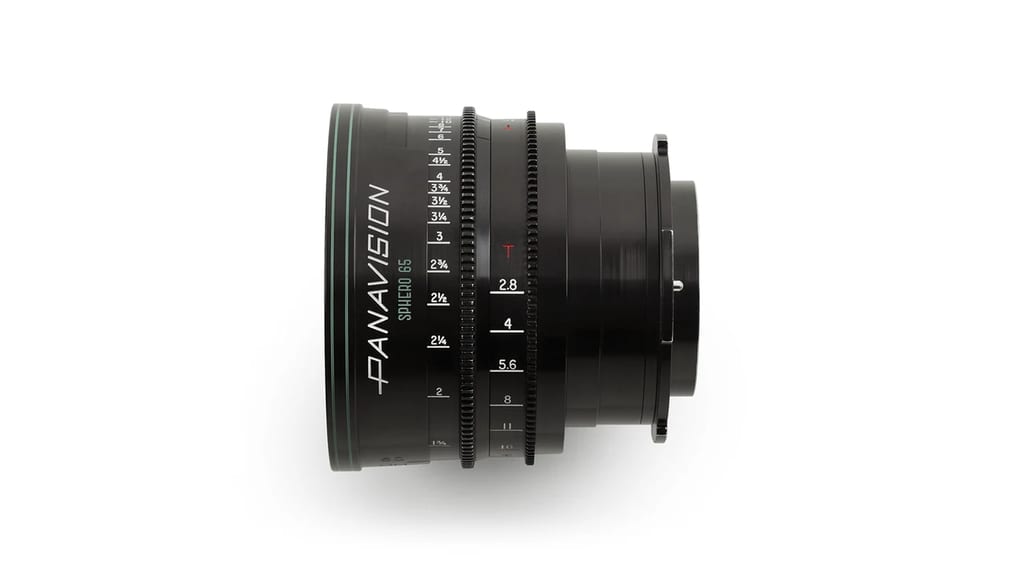
Technical Details
The Sphero 65 system comprises focal lengths from 40mm to 200mm, optimized for the 65mm negative format. The lenses operate with an image circle of at least 70mm in diameter and achieve apertures between T/2.8 and T/4.0. The optical design is based on 8-12 lens elements in 6-8 groups, with special ED glasses minimizing chromatic aberration. The lenses weigh between 2.8 and 6.2 kg and use a 95mm filter thread.
Three main variants existed: the Standard Sphero 65 (1955-1965), the Super Sphero 65 with improved contrast performance (1965-1972), and the Ultra Sphero 65 with multi-layer coating (1972-1978).
History & Development
Panavision developed the Sphero 65 lenses in 1955 in response to the emerging 65mm format, which was conceived as a competitor to CinemaScope. The first commercial application was in 1956 for "Around the World in 80 Days." Robert Gottschalk, Panavision founder, collaborated with Zeiss engineers to maximize optical performance.
In 1965, the Super Sphero 65 generation followed, with improved resolution exceeding 100 line pairs per millimeter. The final development, the Ultra Sphero 65 (1972), introduced multi-layer coatings that reduced reflections by 85%.
Practical Use in Film
Classic 65mm productions such as "Lawrence of Arabia" (1962), "2001: A Space Odyssey" (1968), and "Ben-Hur" (1959) utilized Sphero 65 lenses for landscape shots and wide establishing shots. The lenses enabled 70mm format projections with a resolution that only modern 4K systems can achieve.
The workflow required special 65mm cameras like the Panavision Super 70 or Todd-AO cameras. The higher weight and film consumption of 270 feet per minute limited their use to selected sequences. The depth of field at wide open aperture for a 50mm focal length at a distance of 3 meters is only 15cm.
Comparison & Alternatives
Sphero 65 differs from anamorphic 65mm systems through its undistorted image rendition and a 2.2:1 aspect ratio compared to the 2.76:1 of Ultra Panavision. Modern alternatives include Arri 65mm lenses for the Alexa 65 or Panavision's own System 65 lenses.
IMAX cameras use 70mm film horizontally, creating different optical requirements. Digital large-format sensors like the Alexa LF approximate the 65mm format but do not achieve the resolution of analog 65mm systems.