Filmlexikon.
Support
Orchestrator
Sound · Terms

Orchestrator

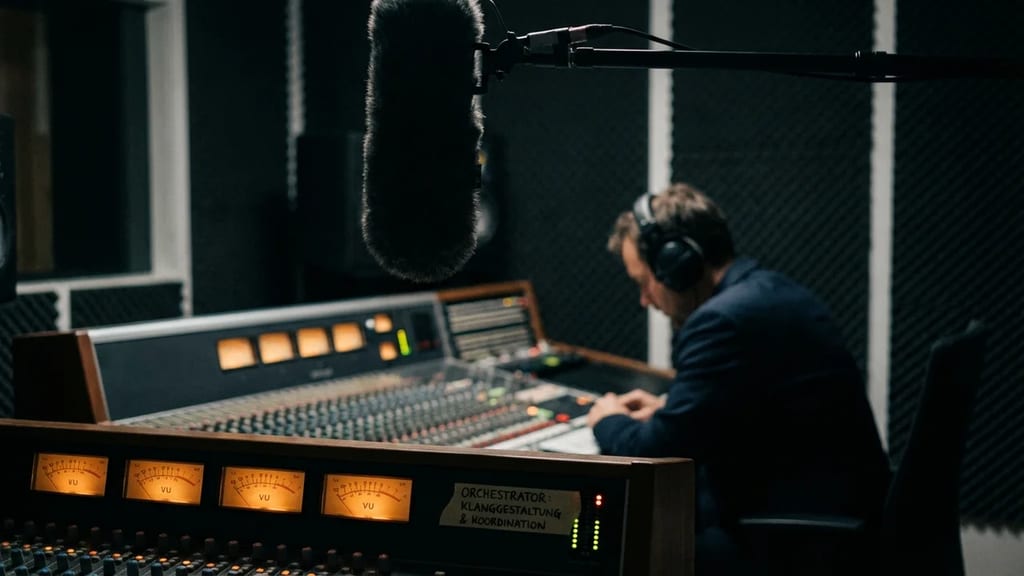
Murnau AI illustration
scoring engineer sound recorder synthesizer

Transcribes film music compositions into performable orchestral scores for 20–40 instrument groups, accounting for vocal ranges from 16 Hz to 4.186 Hz.

Technical Details

A film orchestrator works with scores of 20-40 staves simultaneously, considering pitch ranges from 16.35 Hz (double bass) to 4,186 Hz (piccolo). Modern orchestrators use software like Sibelius or Finale, which automatically create transposed parts for wind instruments – for example, B-flat clarinets (sounding a whole tone lower) or F horns (a fifth lower). The score includes precise dynamic markings from ppp (-40 dB) to fff (+20 dB) as well as articulation marks for playing techniques such as tremolo, pizzicato, or glissando.

History & Development

In 1933, Max Steiner first introduced systematic orchestration to Hollywood with "King Kong," composing and orchestrating himself. From the 1940s onwards, the division of labor between composer and orchestrator became established due to time constraints – John Williams has continuously collaborated with orchestrator Herbert Spencer since 1974. Danny Elfman has collaborated with Steve Bartek since 1985, who translates Elfman's often unconventional instrument combinations into playable scores. Digitization since 2000 now enables mock-ups with sample libraries like Vienna Symphonic Library, which convey precise sonic ideas to orchestrators.

Practical Application in Film

For "Star Wars" (1977), Herbert Spencer orchestrated John Williams' piano sketches for the London Symphony Orchestra in just three weeks. Thomas Newman composes electronic demos that his orchestrator William Ross translates into hybrid scores for orchestra plus synthesizers, as in "1917" (2019). Hans Zimmer works differently: he programs complete electronic versions that orchestrators like Bruce Fowler convert into orchestral notation, with often only 30-50% actually being played by an orchestra.

Comparison & Alternatives

The arranger adapts existing music for new ensembles, while the orchestrator instruments original compositions. MIDI orchestration with software like NotePerformer is increasingly replacing simple orchestration tasks but does not achieve the nuance of human expertise in complex passages. Hybrid scores combine sample-based elements with live orchestras, with the orchestrator deciding which instruments are played live – usually strings and wind solos, while percussion often remains digital.
From the crafts

Perspectives

Cinematographer

Ich kenne die orchestrierte Musik meist erst am Mischplatz, aber sie beeinflusst retrospektiv meine Wahrnehmung der gedrehten Szenen erheblich. Wenn der Orchestrator die Streicher in hohen Lagen ansiedelt, verstärkt das die Intimität von Nahaufnahmen, während tiefe Blechbläser meine Weitwinkel-Einstellungen monumentaler wirken lassen. Bei Actionsequenzen achte ich darauf, ob rhythmische Orchestrierung meine Kamerabewegungen unterstützt oder konterkariert.

Director

Der Orchestrator übersetzt meine emotionalen Intentionen in konkrete Klangfarben, die das Publikum unbewusst lenken. Wenn ich subtile Charakterentwicklung zeigen will, bitte ich um kammermusikalische Besetzung statt Tutti-Orchester. Bei "The Dark Knight" verstärkte die unkonventionelle Orchestrierung mit verzerrten Celli meine Vision von Gothams Düsternis erheblich mehr als eine traditionelle Filmmusik-Orchestrierung es getan hätte.

Producer

Ein erfahrener Orchestrator spart mir 15-25% der Studiokosten, weil er spieltechnische Probleme vorab löst und Nachaufnahmen vermeidet. Die Orchestrierung bestimmt die Orchestergröße: 45 Musiker kosten in Abbey Road Studios £8.000/Tag, 80 Musiker £14.000/Tag. Gute Orchestratoren liefern fehlerfreie Stimmauszüge, wodurch ich teure Studiozeit für kreative Arbeit statt Korrekturlesen nutzen kann.

More in the lexikon

Related terms

Test your knowledge

Quiz

1. Zu welchem Department gehört „Orchestrator"?

2. Wie viele verschiedene Fachperspektiven bietet dieser Eintrag?

Report an error
From the Filmfarm ecosystem

Understand visual language, budget productions, connect crew.

The Lexikon is part of the Filmfarm ecosystem — alongside budgeting (FilmBalance), an industry magazine (FilmCircus) and crew networking (FilmCall, CrewMesh). One shared vocabulary for the whole production.

FilmFarm FilmRadarComing soonFilmPulseComing soonFilmNumbersComing soonFilmCapitalComing soonFilmLabComing soonFilmBalanceComing soonFilmCircusComing soon