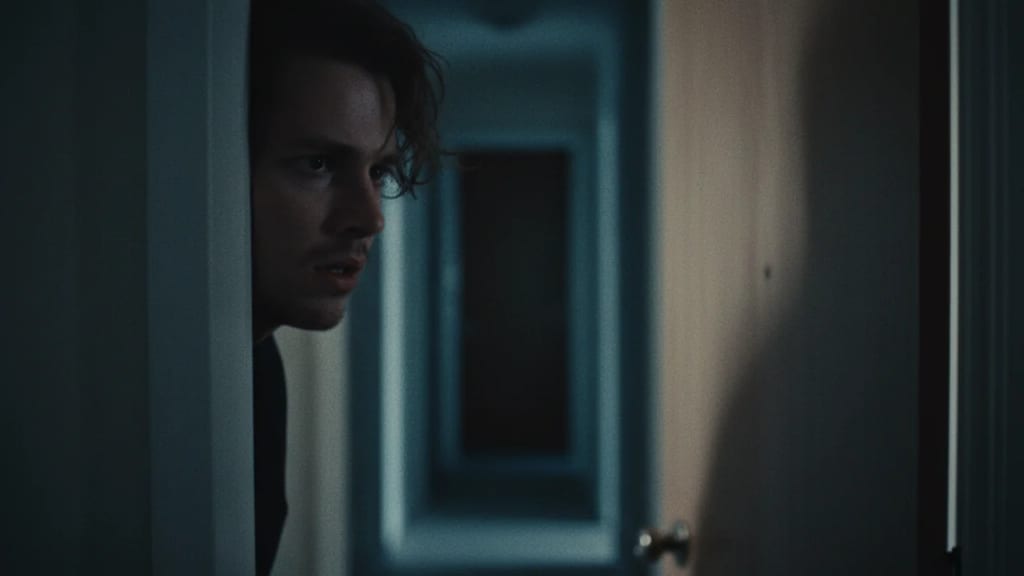
Actor or object partially outside frame boundary — increases visual tension and avoids flatness. Key tool for psychological unease.
In an off-frame cut, a character or object deliberately leaves the visible picture frame — partially or completely. This is not sloppiness, but dramatic calculation. The viewer sees the hand, the shoulder, the head within the frame, the rest exists off-frame. This asymmetry creates an unconscious unease because our eye constantly has to complete what lies outside.
On set, it works like this: The actor does not position themselves centrally in the framed area — the camera deliberately cuts them off. In editing, this incompleteness is used to create pace or to psychologically isolate a person. An off-frame cut of the face in a close-up can convey more intimacy and distress than a full head-shot. If you're shooting a negotiation scene and only see the negotiator's eyes and forehead — the mouth remains off-frame — it creates a tension that a full facial expression would never achieve. The viewer lives with the incompleteness.
Practically, we also use off-frame cuts for spatial resolution. A hand at the edge of the frame holding a cup tells us that someone is sitting in the off-frame space — without us having to see the person. This saves time, creates continuity, and prevents the boredom of complete, centered compositions. In a TV interview, for example: The moderator is partially framed on the left, their counterpart fills the rest. This is not a mistake, but intentional hierarchy.
To be confused with the cut-in (where the cut line runs through body parts), the off-frame cut is a deliberate dramatic decision. It works particularly well in horror films and psychological thrillers, where the suggestion of the off-frame space multiplies the tension. In a commercial, on the other hand, we often avoid it because the product must be fully present. Off-frame cut is a directorial tool — use it when the story needs incompleteness, not as a default.
Related terms
Quiz
1. Zu welchem Department gehört „Anschnitt"?