Cinematographer
Aus DoP-Perspektive ist dieses Element essentiell für die visuelle Gestaltung. Es ermöglicht mir die gewünschte Farbstimmung und das ästhetische Bild konsistent umzusetzen.
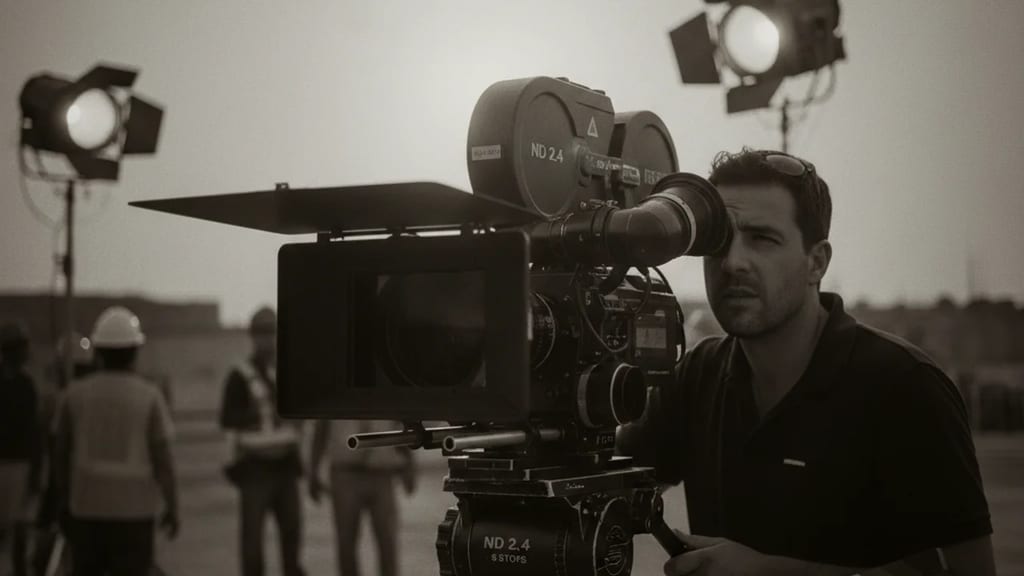
ND 2.4: Neutral density filter with optical density 2.4, reducing incident light by 8 stops (transmission ~0.4%).
ND 2.4 refers to a Neutral Density (ND) filter with an optical density of 2.4. The designation follows the logarithmic density scale, where optical density represents the decimal logarithm of the attenuation factor. ND 2.4 reduces the transmitted light by 8 stops, allowing only about 0.4% of the incident light to pass through – making it one of the strongest ND values commonly used in camera work.
The filter is "neutral" because it ideally attenuates all visible wavelengths equally, thus leaving the color temperature and color balance of the image unchanged. Unlike effect or conversion filters, ND is used solely for brightness reduction, not for color or creative influence.
The conversion follows a fixed logic: for every 0.3 of optical density, the amount of light is halved, which corresponds exactly to one stop. For ND 2.4, this means 2.4 ÷ 0.3 = 8 stops. To put this in perspective with more common ND values:
| Optical Density | Stops | Transmission |
|---|---|---|
| 0.3 | 1 | 50 % |
| 0.6 | 2 | 25 % |
| 0.9 | 3 | 12.5 % |
| 1.2 | 4 | 6.25 % |
| 1.8 | 6 | approx. 1.6 % |
| 2.4 | 8 | approx. 0.4 % |
Transmission is calculated as 10 raised to the power of minus the density: 10-2.4 ≈ 0.398%. Some manufacturers specify the filter factor instead of the density – ND 2.4 corresponds to a factor of 256× (28).
In motion pictures, a strong ND filter like ND 2.4 is primarily used to maintain desired exposure parameters despite bright lighting conditions. Due to the 180-degree shutter rule, the shutter speed is coupled to the frame rate and cannot be arbitrarily shortened; instead of stopping down the aperture significantly (and thus changing the depth of field), excess light is intercepted by the ND filter. This allows for an open aperture and consequently shallow depth of field even in direct sunlight.
Examples of real products with this value include the Schneider 4×5.65" Platinum IRND 2.4 (8 Stops) and comparable filters from Tiffen and Lindsey Optics.
Aus DoP-Perspektive ist dieses Element essentiell für die visuelle Gestaltung. Es ermöglicht mir die gewünschte Farbstimmung und das ästhetische Bild konsistent umzusetzen.
Diese professionelle Lösung erhöht die Produktionseffizienz und reduziert Post-Production-Anforderungen. Sie ermöglicht flexible, schnelle Anpassungen während des Drehs.
Als Gaffer ist dies ein unverzichtbares Werkzeug meines täglichen Handwerkszeugs. Es ermöglicht mir professionelle Lichtkontrolle und schnelle Anpassungen auf Set, was Zeit spart und Qualität sichert.
1. Was beschreibt „ND 2.4 (8 Stops)" am besten?
2. Zu welchem Department gehört „ND 2.4 (8 Stops)"?
3. Wie viele verschiedene Fachperspektiven bietet dieser Eintrag?
The Lexikon is part of the Filmfarm ecosystem — alongside budgeting (FilmBalance), an industry magazine (FilmCircus) and crew networking (FilmCall, CrewMesh). One shared vocabulary for the whole production.