Filmlexikon.
Support
Micro Four Thirds
Camera · Technique

Micro Four Thirds

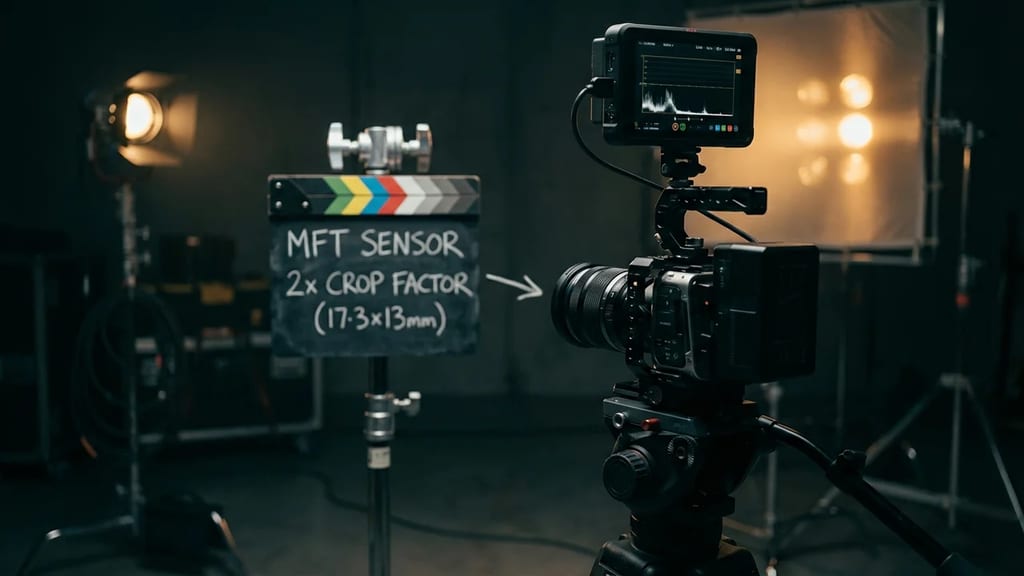
Murnau AI illustration
mft mount third stop three perf

Standard for mirrorless camera sensor format and lens mount introduced by Olympus and Panasonic in 2008, featuring approximately 17.3 × 13 mm sensor and 2.0× crop factor.

Overview

Micro Four Thirds (MFT, also M4/3 or M43) is an open standard for sensor format and lens mount for mirrorless interchangeable-lens cameras. It was introduced in 2008 by Olympus and Panasonic and is derived from the older Four Thirds system for DSLR cameras. Since MFT eliminates the mirror box, the flange distance is significantly shorter, allowing for more compact bodies and broad lens compatibility via adapters. In film and video production, MFT is particularly prevalent in cameras from Blackmagic Design (Pocket Cinema Camera), Panasonic (Lumix GH series), JVC, and drone/gimbal systems from DJI.

Technical Specifications

FeatureValue
Usable Sensor Areaapprox. 17.3 mm × 13.0 mm (diagonal approx. 21.6 mm)
Native Aspect Ratio4:3
Crop Factor (to Full Frame/35mm)2.0×
Flange Focal Distance19.25 mm
MountBayonet mount with electronic contact strip
Introduction2008 (Olympus / Panasonic)

The 2.0× crop factor means that the focal length of a lens appears doubled compared to full frame: a 25mm lens provides a field of view equivalent to approximately a 50mm lens on full frame.

On-Set Usage

The short flange distance makes MFT particularly adaptable: lenses with PL, EF, F, or other mounts can be attached via mechanical adapters, allowing the use of existing cine optics. The compact size and low weight of the bodies are advantageous for use on gimbals, drones, sliders, and in confined setups. It should be noted that manufacturer-specific sensor sizes may deviate from the standard measurement: for example, Blackmagic uses a sensor with a different area and a crop factor of around 1.9× in the Pocket Cinema Camera 4K, so the resulting field of view deviates from the pure MFT nominal value depending on the model.

From the crafts

Perspectives

Cinematographer

Als DoP schätze ich an MFT die kompakte Bauweise für Handheld-Sequenzen und die natürliche Tiefenschärfe bei Dokumentaraufnahmen. Der 2x-Crop-Faktor gibt mir mehr Brennweite bei Teleobjektiven, macht aber Weitwinkel-Einstellungen teurer. Die In-Body-Stabilisierung der aktuellen Modelle erspart mir oft das Stativ bei Available-Light-Situationen.

Director

Ich nutze MFT-Kameras gerne für intimate Charakterszenen, da die Schauspieler weniger von der kompakten Technik abgelenkt werden. Die längeren Brennweiten durch den Crop-Faktor helfen mir bei Portrait-Aufnahmen, auch mit günstigen Objektiven eine natürliche Perspektive zu erreichen. Für emotionale Close-ups in beengten Räumen ist das System unschlagbar diskret.

Producer

MFT reduziert meine Equipment-Kosten um 30-40% gegenüber Vollformat-Systemen bei vergleichbarer Bildqualität für Online-Content. Die geringeren Transport- und Versicherungskosten durch das kompakte System amortisieren sich bei längeren Drehs. Netflix-Compliance mit der GH5S macht MFT für meine Streaming-Produktionen budgettauglich ohne Qualitätsverlust.

More in the lexikon

Related terms

Test your knowledge

Quiz

1. Zu welchem Department gehört „Micro Four Thirds"?

2. Wie viele verschiedene Fachperspektiven bietet dieser Eintrag?

Report an error
From the Filmfarm ecosystem

Understand visual language, budget productions, connect crew.

The Lexikon is part of the Filmfarm ecosystem — alongside budgeting (FilmBalance), an industry magazine (FilmCircus) and crew networking (FilmCall, CrewMesh). One shared vocabulary for the whole production.

FilmFarm FilmRadarComing soonFilmPulseComing soonFilmNumbersComing soonFilmCapitalComing soonFilmLabComing soonFilmBalanceComing soonFilmCircusComing soon