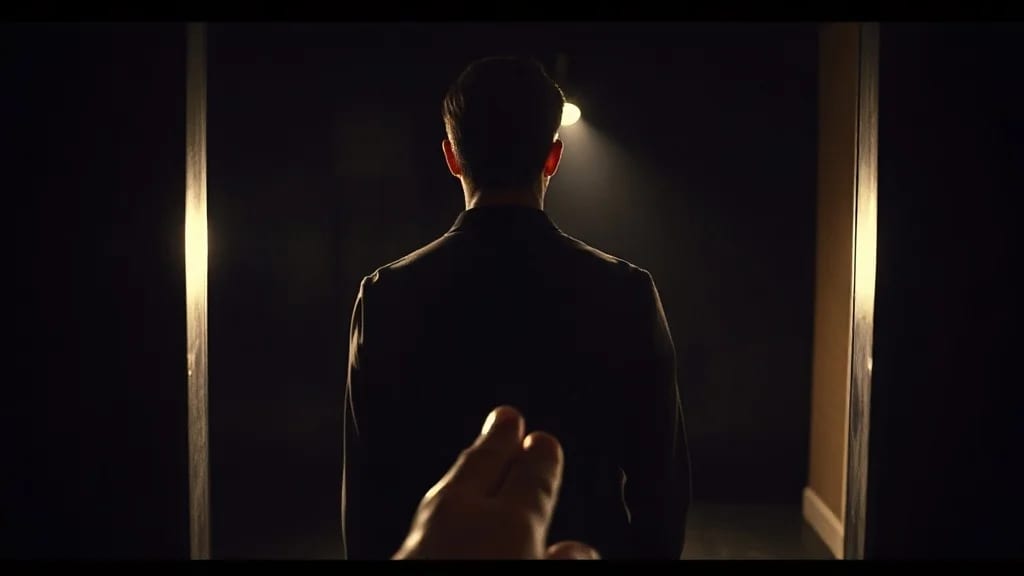
Narrator or character breaches narrative levels — addresses camera, rewrites plot from outside diegesis. Shatters fourth wall. Self-aware metafiction.
Metalepsis
When a character suddenly knows they are in a film and communicates this to the audience – that is metalepsis. The protagonist leaves the narrative level on which they are supposed to be trapped and enters another: they speak to the camera, comment on the script, manipulate the editing logic, or directly address the viewer. This is not simply eye contact or a direct address in the classic sense. Metalepsis means that the boundary between the fictional world and the level of narration itself crumbles.
On set, you usually only truly notice this during editing. An actor looks into the camera and says, "That was far too long for the next scene." Or they intervene in the montage, reversing the scene because it works better that way – not as a character, but as an entity guiding the film material itself. Deadpool does this systematically: the character constantly breaks the fourth wall, comments on their own script, is aware of plot holes, and uses them as a gag. This works because metalepsis becomes the film's tonality here, not a disruption.
Practically, it becomes complicated when you want to use metalepsis as a dramatic tool – not just as a gimmick. The character must appear believable in both worlds: in their fictional role and as an awareness of the artificiality surrounding them. This requires very conscious staging and a clear decision about the film's language itself. If you do it half-heartedly, it will seem embarrassing. If you carry it through consistently, it becomes a meta-level that permeates the entire film – as in films that play with their own unreality (compare: Breaking the Fourth Wall, but one level deeper).
For practice: Metalepsis requires courage and clarity. Decide beforehand whether the film lives by it or only uses it sporadically. The sound design must play along, the editing must support it, and the actor must be able to handle the double meaning. Otherwise, it remains mere play.
Related terms
Quiz
1. Was beschreibt „Metalepse" am besten?
2. Zu welchem Department gehört „Metalepse"?