Filmlexikon.
Support
Man vs. Man
Theory · Terms

Man vs. Man

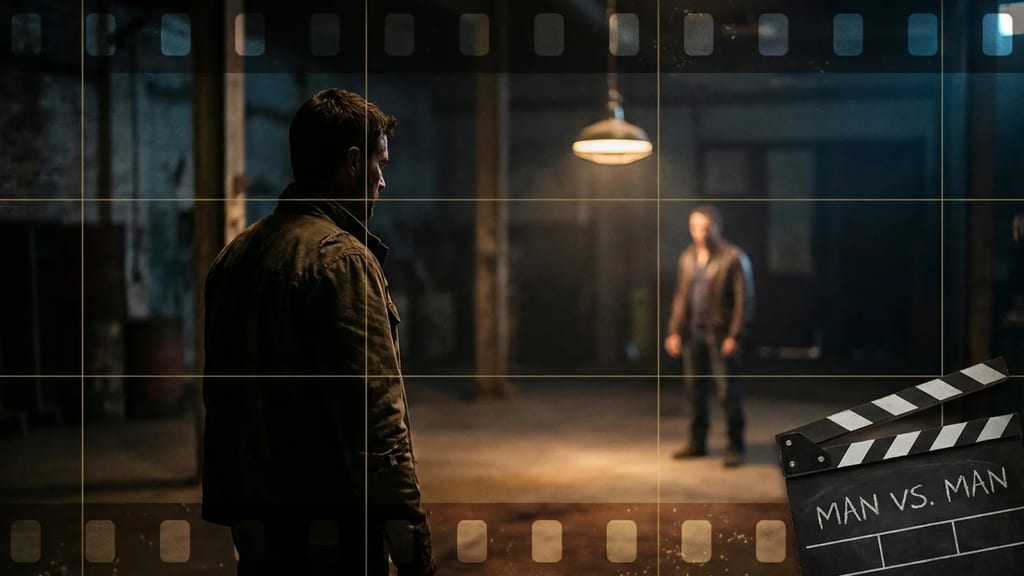
Murnau AI illustration
man vs society man vs self man vs nature

Classic dramatic conflict between protagonist and antagonist escalating through three stages over 90–120 minutes, structured in five acts with rises every 22–25 minutes.

Technical Details

The conflict is structured across three escalation stages: establishment of the opposition (first 15-20 minutes), intensification through obstacles (middle 60 minutes), and final confrontation (last 15-20 minutes). Classic variants include dualism (two equally strong opponents), the overpowering constellation (David vs. Goliath), and the betrayal conflict (former allies become enemies). The tension curve follows the five-act structure with an increase every 22-25 minutes in 90-120-minute feature films.

History & Development

Systematic application began in 1915 with D.W. Griffith's "The Birth of a Nation," which first consciously pitted personalized antagonists against the hero. In 1936, Frank Capra established the Hollywood standard schema of the lone fighter against corrupt institutions with "Mr. Deeds Goes to Town." The Nouvelle Vague broke with clear good-vs.-evil attributions starting in 1959, while the New Hollywood era introduced morally ambivalent conflicts from 1967 onwards.

Practical Application in Film

"The Dark Knight" (2008) exemplifies perfect execution: Batman and the Joker embody diametrically opposed worldviews in 17 direct confrontation scenes. Hitchcock used the parallel character technique in "Strangers on a Train" (1951), where the protagonist and antagonist possess mirrored traits. Modern action films rely on 4-6 physical confrontations with escalating intensity, while thrillers focus on psychological duels.

Comparison & Alternatives

Distinction from "Man vs. Nature" through the conscious intentionality of the opponent and from "Man vs. Self" through the external source of conflict. "Man vs. Society" expands the individual antagonist to an institution. Modern series like "Breaking Bad" hybridize all conflict types: Walter White fights against rivals (Man vs. Man), the law (Man vs. Society), and his own morality (Man vs. Self). This multi-layeredness has dominated premium TV productions since 2010.
From the crafts

Perspectives

Cinematographer

Ich arbeite mit Schuss-Gegenschuss-Prinzipien in 1,85:1 oder 2,39:1, um die Gegnerschaft visuell zu verstärken. Für Konfrontationen nutze ich 50mm-Objektive bei Augenhöhe für Gleichwertigkeit oder 24mm aus der Untersicht für Machtgefälle. Die Beleuchtung folgt dem High-Key/Low-Key-Kontrast zwischen den Charakteren.

Director

Ich entwickle gespiegelte Charakterbögen, bei denen sich Held und Schurke in entscheidenden Eigenschaften unterscheiden, aber gemeinsame Grundmotive teilen. Die Szenenstruktur folgt einem Ping-Pong-Rhythmus mit abwechselnden Siegen beider Seiten. Besonders wichtig ist mir die finale Konfrontation als philosophische Debatte, nicht nur als Action-Sequenz.

Producer

Ich kalkuliere für A-List-Antagonisten 15-20% des Gesamtbudgets zusätzlich, da Starbesetzung hier entscheidend ist. Die Drehplanung konzentriert Konfrontationsszenen in 3-4 Blöcke, um teure Hauptdarsteller-Tage zu minimieren. Internationale Vermarktung profitiert von klaren Gut-Böse-Strukturen, die kulturübergreifend funktionieren.

More in the lexikon

Related terms

Test your knowledge

Quiz

1. Zu welchem Department gehört „Mensch gegen Mensch"?

2. Wie viele verschiedene Fachperspektiven bietet dieser Eintrag?

Report an error
From the Filmfarm ecosystem

Understand visual language, budget productions, connect crew.

The Lexikon is part of the Filmfarm ecosystem — alongside budgeting (FilmBalance), an industry magazine (FilmCircus) and crew networking (FilmCall, CrewMesh). One shared vocabulary for the whole production.

FilmFarm FilmRadarComing soonFilmPulseComing soonFilmNumbersComing soonFilmCapitalComing soonFilmLabComing soonFilmBalanceComing soonFilmCircusComing soon