Filmlexikon.
Support
M39 Mount
Camera · Terms

M39 Mount

Murnau AI illustration
flow para roll take

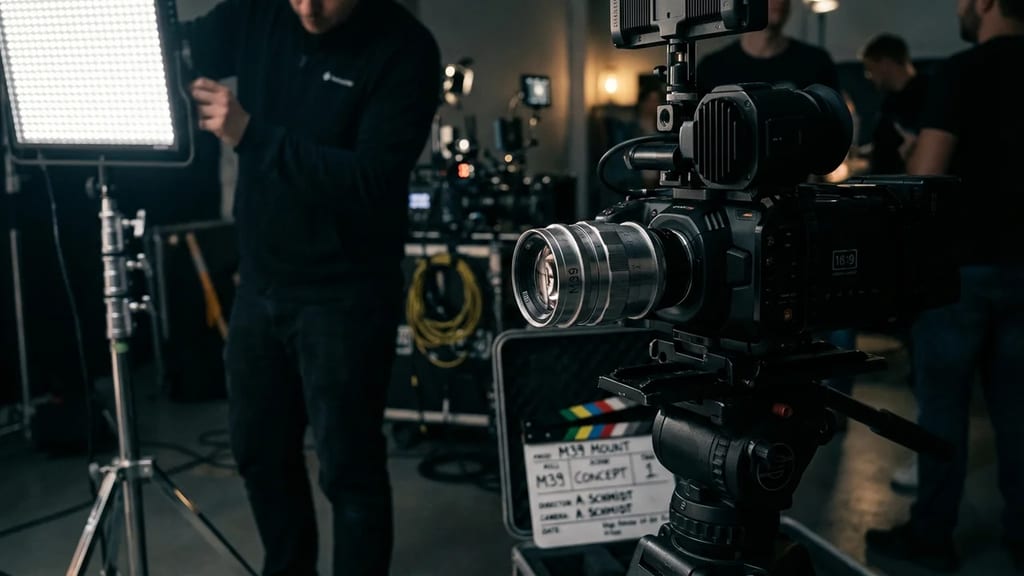
M39 Mount: Leica screw-thread lens mount (1930) with 39mm diameter and 28.8mm back focal distance; mechanical optics without electronics for rangefinder cameras.

Technical Details

The M39 mount features an outer diameter of exactly 39.0mm and a pitch of 1.0mm. The flange focal distance for 35mm cameras is 28.8mm. Lenses are screwed into the body by turning clockwise, with focusing achieved via the entire lens. M39 lenses do not have automatic aperture control or electronic data transfer. Focal length is indicated mechanically via coupled rangefinders or scale focus.

History & Development

Ernst Leitz introduced the M39 mount for the Leica II in 1930, establishing the standard for high-quality 35mm cameras. Canon adopted the system in 1933 for the Kwanon prototypes and produced M39 cameras until the 1960s. Soviet manufacturers like FED and Zorki produced over 15 million M39 cameras from 1934 to 1996. Leica replaced the screw mount with the M bayonet mount in 1954, while other manufacturers continued to use M39 until the late 1970s.

Practical Use in Film

M39 lenses are used in low-budget productions and documentaries where their compact design and characteristic image aesthetic are desired. Stanley Kubrick used modified M39 lenses for available-light shots. The manual focusing is suitable for precise focus shifts in close-ups. Adapters allow their use on digital cinema cameras like RED or ARRI ALEXA, with the short flange focal distance enabling straightforward adaptation.

Comparison & Alternatives

In contrast to the M42 screw mount (42mm, flange focal distance 45.5mm) for SLR cameras, M39 is exclusively designed for rangefinder cameras. The Leica M-Mount replaced M39 with a faster bayonet system offering shorter setting times. Modern alternatives like Sony E-Mount or Micro Four Thirds offer electronic communication and image stabilization. M39 remains relevant for vintage looks and special applications where mechanical reliability and minimal electronics are required.

From the crafts

Perspectives

Cinematographer

Ich schätze M39-Objektive für ihre präzise manuelle Fokussierung und den charakteristischen Bokeh-Verlauf klassischer Rechnungen wie dem Zeiss Sonnar 50mm f/1.5. Die mechanische Kopplung gibt mir direktes haptisches Feedback, besonders bei kritischen Nahaufnahmen oder wenn ich bewusst mit Unschärfe arbeite.

Director

M39-Objektive verleihen meinen Bildern eine nostalgische Bildsprache mit weichem Kontrast und organischen Verzerrungen, die perfekt zu Charakterstudien oder Periodenfilmen passt. Die Notwendigkeit manueller Bedienung zwingt mein Team zur bewussten Bildgestaltung und verhindert technische Automatismen, die der narrativen Intention schaden könnten.

Producer

M39-Objektive biete ich als kostengünstige Alternative zu modernen Cine-Optiken an - hochwertige Exemplare kosten 200-800€ statt 5.000-15.000€ pro Brennweite. Die robusten mechanischen Systeme reduzieren Ausfallrisiken am Set, allerdings verlängert die manuelle Bedienung die Drehzeit um etwa 15-20% gegenüber elektronischen Systemen.

More in the lexikon

Related terms

Test your knowledge

Quiz

1. Zu welchem Department gehört „M39-Mount"?

2. Wie viele verschiedene Fachperspektiven bietet dieser Eintrag?

Report an error
From the Filmfarm ecosystem

Understand visual language, budget productions, connect crew.

The Lexikon is part of the Filmfarm ecosystem — alongside budgeting (FilmBalance), an industry magazine (FilmCircus) and crew networking (FilmCall, CrewMesh). One shared vocabulary for the whole production.

FilmFarm FilmRadarComing soonFilmPulseComing soonFilmNumbersComing soonFilmCapitalComing soonFilmLabComing soonFilmBalanceComing soonFilmCircusComing soon