Cinematographer
Aus DoP-Perspektive ist dieses Element essentiell für die visuelle Gestaltung. Es ermöglicht mir die gewünschte Farbstimmung und das ästhetische Bild konsistent umzusetzen.
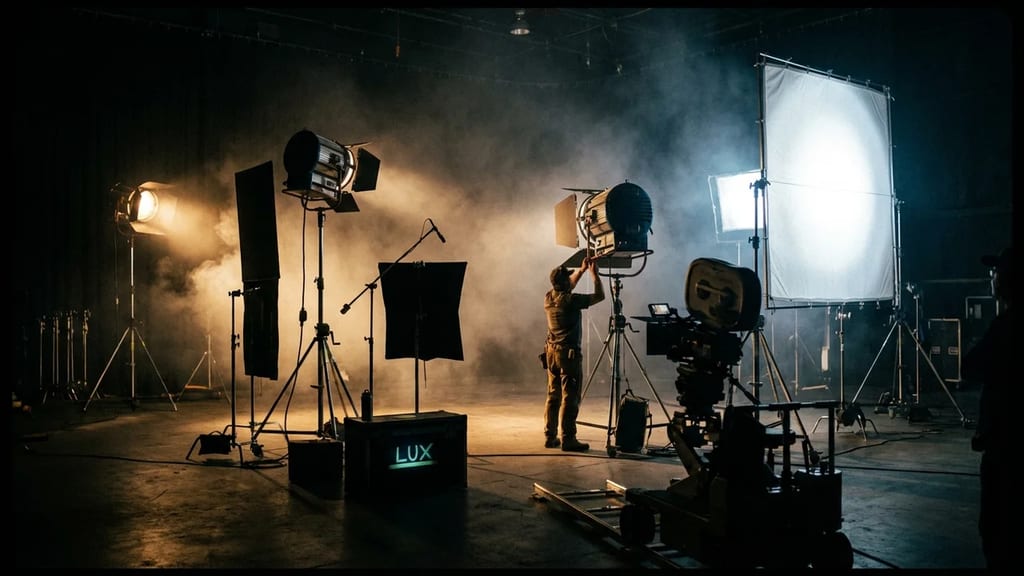
Lux (lx) is the SI unit of illuminance, measuring the luminous flux (lumens) incident on one square meter of surface.
Lux (symbol lx) is the SI unit of illuminance. It describes how much luminous flux falls on a specific area: one lux equals one lumen per square meter (1 lx = 1 lm/m²). Therefore, lux does not measure the total amount of light emitted by a lamp (which would be lumens), but rather how brightly a specific spot in the room or on the subject is actually illuminated.
On set, lux is the central metric when it comes to how much light a spotlight throws onto the subject at a specific distance. Manufacturers of film lights often specify the light output of their devices as a lux value at a defined distance (e.g., 1 m or 3 m) and with a particular spot or flood angle, allowing for direct comparison of the equipment.
Photometric units are often confused in everyday language. A clear distinction is important:
| Quantity | Unit | Description |
|---|---|---|
| Luminous Flux | Lumen (lm) | Total amount of light emitted by the light source |
| Luminous Intensity | Candela (cd) | Luminous flux in a specific direction |
| Illuminance | Lux (lx) | Light falling on an area (lm/m²) |
| Luminance | cd/m² | Brightness of an area/source perceived by the eye |
In the US-American camera environment, illuminance is traditionally measured in Footcandle (fc), the imperial equivalent (lumens per square foot). The conversion is: 1 Footcandle ≈ 10.764 Lux. As a rule of thumb in daily set work, the factor of 10 is often used (Footcandle × 10 ≈ Lux).
Illuminance is measured with an exposure meter or lux meter. On set, a handheld incident light meter with a dome is typically used to measure incoming light and calculate the appropriate aperture (f-stop) based on ISO and frame rate. Many professional exposure meters can display lux, footcandle, and f-stop values simultaneously.
Lux values also help in setting contrast ratios between key light, fill light, and background, and in estimating the necessary light output for a desired working aperture. For context on typical orders of magnitude:
Since illuminance decreases with the square of the distance (inverse square law), the lux value does not halve at double the distance but drops to a quarter – a crucial point when positioning lights on set.
Aus DoP-Perspektive ist dieses Element essentiell für die visuelle Gestaltung. Es ermöglicht mir die gewünschte Farbstimmung und das ästhetische Bild konsistent umzusetzen.
Diese professionelle Lösung erhöht die Produktionseffizienz und reduziert Post-Production-Anforderungen. Sie ermöglicht flexible, schnelle Anpassungen während des Drehs.
Als Gaffer ist dies ein unverzichtbares Werkzeug meines täglichen Handwerkszeugs. Es ermöglicht mir professionelle Lichtkontrolle und schnelle Anpassungen auf Set, was Zeit spart und Qualität sichert.
1. Zu welchem Department gehört „Lux"?
2. Wie viele verschiedene Fachperspektiven bietet dieser Eintrag?
The Lexikon is part of the Filmfarm ecosystem — alongside budgeting (FilmBalance), an industry magazine (FilmCircus) and crew networking (FilmCall, CrewMesh). One shared vocabulary for the whole production.