Filmlexikon.
Support
Lunch
Production · Terms

Lunch

Murnau AI illustration
walking lunch abigail breakfast

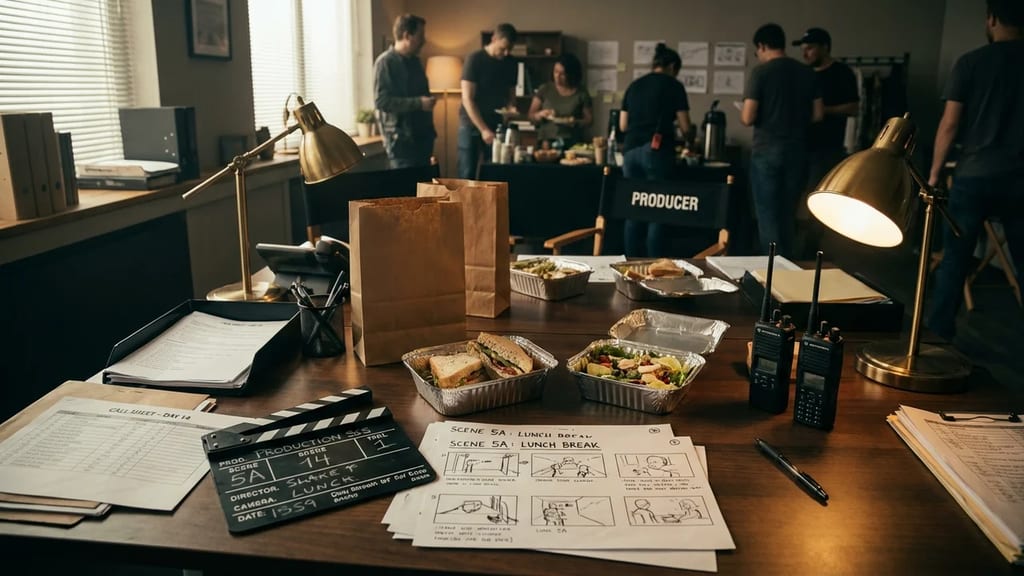
Legally mandated 30–60 minute meal break on set, interrupting the shoot day and scheduled as a fixed block in the production strip board.

Technical Details

The standard lunch break lasts 60 minutes on German productions, and 30 minutes for low-budget shoots under 500,000 Euros. For night shoots, the break is shifted accordingly by 12 hours. Catering must be available no later than 15 minutes after the break begins. Equipment is not dismantled during the break but secured under the supervision of a set runner. For exterior shoots, meals are provided via mobile catering trucks or nearby restaurants within a maximum walking distance of 10 minutes.

History & Development

In 1918, UFA was the first German film studio to introduce regulated breaks, initially only 20 minutes long. In 1952, the first collective bargaining agreement for film professionals established a 45-minute lunch break. Since 1974, the 60-minute rule has been the standard. The introduction of catering services revolutionized break organization in 1980 – prior to this, crew members brought their own food or sought out external eateries.

Practical Application in Film

On "Das Boot" (1981), Wolfgang Petersen organized 45-minute breaks in the cramped Bavaria Studios to maintain the claustrophobic atmosphere even during breaks. Tom Tykwer shortened breaks to 30 minutes for "Run Lola Run" (1998) to keep the crew's energy levels consistent. International co-productions must coordinate different break regulations – French crews insist on 90-minute breaks, while American teams often work with two 15-minute snack breaks instead of one long break.

Comparison & Alternatives

Unlike continuous catering (craft service), the lunch break actively interrupts the shooting process. Short drink breaks (5-10 minutes) do not legally replace it. For live broadcasts or time-critical shoots, staggered breaks are used, where teams take breaks in rotation. The American "working lunch" on set is not permitted in Germany due to working hour regulations.
From the crafts

Perspectives

Cinematographer

Ich nutze die Mittagspause zur Kontrolle meiner Ausrüstung und zum Laden der Akkus – 60 Minuten reichen genau für einen kompletten Batteriewechsel. Bei Außendrehs checke ich die Wetterprognose für den Nachmittag und justiere gegebenenfalls die Filterausstattung. Die Pause ist auch ideal, um mit dem Gaffer die Lichtsetups für die nachmittäglichen Einstellungen zu besprechen.

Director

Die Mittagspause gebe ich den Schauspielern zur mentalen Vorbereitung auf emotional schwierige Szenen am Nachmittag. Ich nutze die Zeit für kurze Einzelgespräche mit den Darstellern oder zur Anpassung des Drehplans, falls wir am Vormittag hinter dem Zeitplan lagen. Bei komplexen Sequenzen schaue ich mir das gedrehte Material vom Vormittag auf dem Monitor an.

Producer

Eine 60-minütige Mittagspause kostet bei einer 50-köpfigen Crew circa 3.000 Euro pro Tag an reiner Arbeitszeit plus 8-12 Euro Catering pro Person. Ich plane grundsätzlich 90 Minuten ein, um Verzögerungen aufzufangen und Overtime zu vermeiden. Bei Locationwechseln kombiniere ich die Pause strategisch mit dem Transport, um Doppelkosten zu vermeiden.

More in the lexikon

Related terms

Test your knowledge

Quiz

1. Zu welchem Department gehört „Mittagspause"?

2. Wie viele verschiedene Fachperspektiven bietet dieser Eintrag?

Report an error
From the Filmfarm ecosystem

Understand visual language, budget productions, connect crew.

The Lexikon is part of the Filmfarm ecosystem — alongside budgeting (FilmBalance), an industry magazine (FilmCircus) and crew networking (FilmCall, CrewMesh). One shared vocabulary for the whole production.

FilmFarm FilmRadarComing soonFilmPulseComing soonFilmNumbersComing soonFilmCapitalComing soonFilmLabComing soonFilmBalanceComing soonFilmCircusComing soon