Technical Details
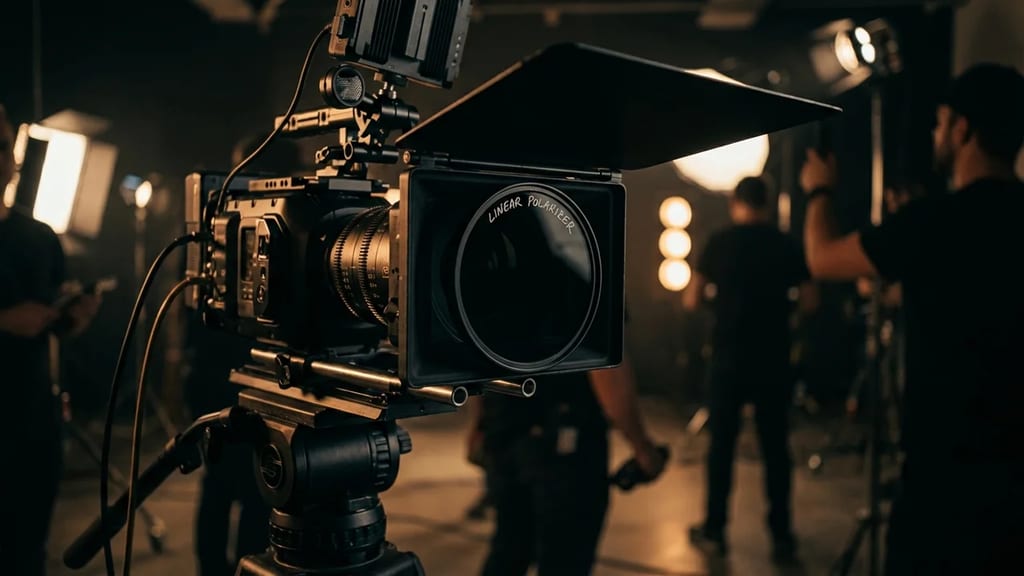
Linear polarizers consist of a polarizing film between two glass panes with a thickness of 2-4mm. The transmission is typically 38-42% of the incident light, corresponding to a reduction of 1.3-1.7 f-stops. The polarization angle can be continuously adjusted by rotating the filter 360°. Standard thread sizes are 52mm, 58mm, 67mm, 72mm, 77mm, and 82mm. For matte box systems, 4x4" and 4x5.65" versions exist. Optical quality is divided into classes, with professional filters exhibiting wavefront distortion below λ/4.
History & Development
Edwin Land developed the first synthetic polarizing filter in 1928 using his Polaroid process. It found use in cinematography starting in the 1930s, initially mainly for sky dramatization in black-and-white productions. With the advent of color film technology in the 1950s, color saturation through reflection reduction became more important. Since the 1980s, linear polarizers have been increasingly replaced by circular polarizers, as modern autofocus and exposure metering systems can interfere with linear polarization.
Practical Use in Film
Cinematographers primarily use linear polarizers to control reflections on water, glass, or wet surfaces. In Terrence Malick's "Days of Heaven" (1978), Néstor Almendros systematically used polarizers for the golden wheat field sequences to eliminate reflections and increase color saturation. In automotive shots, they reduce windshield reflections, while in landscape shots, they enhance sky-to-earth contrast. The filter acts selectively – only reflections at the optimal angle are eliminated, requiring precise camera positioning.
Comparison & Alternatives
Circular polarizers have largely replaced linear ones as they are compatible with modern camera systems. The technical difference lies in an additional λ/4 retardation plate that converts linearly polarized light into circularly polarized light. Variable ND filters with polarization technology combine neutral density with polarization but produce color shifts at extreme settings. In digital post-production, reflections can be partially removed, but without the physical properties of true polarization. Linear polarizers remain relevant for mechanical film cameras and special applications.