Filmlexikon.
Support
Lens Collar
Camera · Equipment

Lens Collar

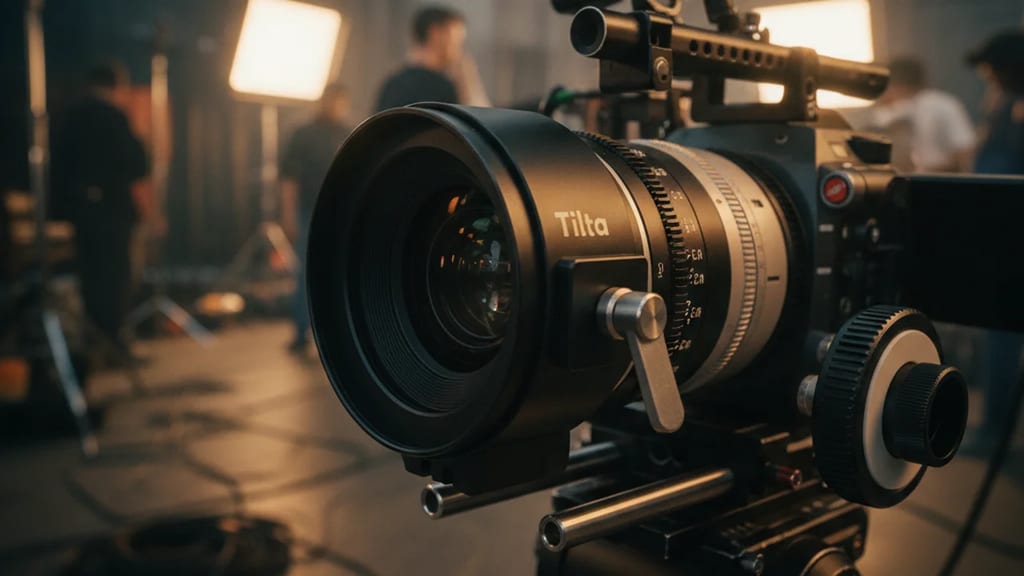
Murnau AI illustration
anamorphic lens anamorphic projection lens angenieux optimo prime arri master prime arri signature prime arri ultra prime arri zeiss variable prime atlas lens co

Metal ring mounted on a lens barrel for direct tripod attachment, transferring the weight of heavy telephoto lenses (300mm+) from the camera body to the tripod.

Technical Details

Standard lens collars feature Arca-Swiss compatible dovetails with a 38mm width or Manfrotto RC2 quick releases. The collar encircles the lens barrel with an inner diameter ranging from 82-142mm depending on the lens. High-quality models like the Canon EF 70-200mm f/2.8L collar weigh 180g and can support loads up to 5kg. A locking lever with a 6-8mm threaded rod secures the position, while a 360° rotation scale is divided into 15° increments. Detachable variants release via quick-release mechanisms or knurled screws.

History & Development

Canon introduced the first modern lens collar in 1987 with the EF 300mm f/2.8L, after Nikon had already established the Tripod Mount Ring system in 1983 with the AI-S 300mm f/2.8. The breakthrough came in 1995 with detachable collars on the Canon EF 70-200mm f/2.8L. Arca-Swiss standardized the now dominant quick-release profiles in 2001. Since 2018, manufacturers like Sigma have been integrating electronic contacts for lens control directly into the collar.

Practical Use in Film

In "Saving Private Ryan" (1998), Cinematographer Janusz Kamiński used Canon EF 600mm lenses with collars for shake-free telephoto shots of the landing scenes. The use of gimbals for heavy cine lenses like the Angenieux Optimo 24-290mm fundamentally requires collar mounting for weight distribution. In the documentary field, collars enable quick transitions between handheld and tripod operation without re-aligning the lens. Wildlife photography benefits from reduced camera vibration with long focal lengths.

Comparison & Alternatives

Lens collars differ from lens support systems by mounting directly to the tripod, rather than using additional support structures. Follow focus rings, on the other hand, are primarily mounted for focus control, not for weight relief. For lenses under 300mm, reinforced camera tripod mounts are usually sufficient. Modern mirrorless systems increasingly use integrated foot designs instead of detachable collars. Cine lenses rely on rail support systems with 15mm rods instead of classic collar mounting.

From the crafts

Perspectives

Cinematographer

Ich montiere grundsätzlich alle Objektive ab 300mm über die Schelle am Stativ, da sich sonst das Bajonett der Kamera verzieht und Unschärfe entsteht. Bei schnellen Schwenks mit dem 70-200mm macht die Schellenmontage den Unterschied zwischen verwackelten und präzisen Bewegungen aus. Die Arca-Swiss-Kompatibilität meiner Schellen spart täglich mindestens 30 Minuten Setup-Zeit.

Director

Für mich bedeutet die Objektivschelle primär flüssigere Kamerabewegungen bei Teleobjektiven, was besonders bei emotionalen Close-ups entscheidend ist. Wenn der Kameramann das schwere 85mm-Cine-Objektiv über die Schelle balanciert, kann er sich auf die Performance konzentrieren statt auf Technik zu kämpfen. Die schnellen Wechsel zwischen verschiedenen Stativhöhen ohne Neuausrichtung halten den Dreh-Rhythmus aufrecht.

Producer

Eine hochwertige Objektivschelle für 280 Euro amortisiert sich bereits nach drei Drehtagen durch gesparte Rigger-Stunden und vermiedene Kamera-Reparaturen. Kaputte Bajonette kosten 800-1.200 Euro Werkstattzeit plus Ausfallzeiten, während Schellen das Risiko um 90% reduzieren. Die Arca-Swiss-Standardisierung unseres Equipment-Parks eliminiert inkompatible Stativsysteme und reduziert das Inventar um 40%.

More in the lexikon

Related terms

Test your knowledge

Quiz

1. Was beschreibt „Objektivschelle" am besten?

2. Zu welchem Department gehört „Objektivschelle"?

3. Wie viele verschiedene Fachperspektiven bietet dieser Eintrag?

Report an error
From the Filmfarm ecosystem

Understand visual language, budget productions, connect crew.

The Lexikon is part of the Filmfarm ecosystem — alongside budgeting (FilmBalance), an industry magazine (FilmCircus) and crew networking (FilmCall, CrewMesh). One shared vocabulary for the whole production.

FilmFarm FilmRadarComing soonFilmPulseComing soonFilmNumbersComing soonFilmCapitalComing soonFilmLabComing soonFilmBalanceComing soonFilmCircusComing soon