Cinematographer
Aus DoP-Perspektive ist dieses Element essentiell für die visuelle Gestaltung. Es ermöglicht mir die gewünschte Farbstimmung und das ästhetische Bild konsistent umzusetzen.
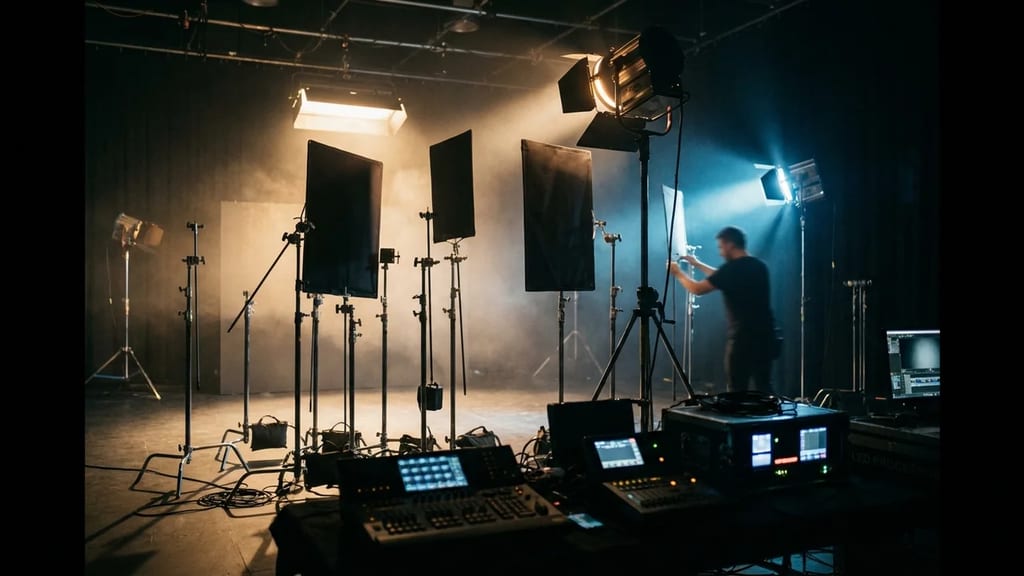
Control unit that processes and outputs video signals to LED panels in a video wall; essential for virtual production and in-camera VFX.
An LED Processor (also known as an LED video processor or LED wall controller) is the control unit that receives, processes, and outputs image sources to the receiver cards of individual LED panels in a video wall. It acts as the link between the image source (e.g., media server or game engine like Unreal Engine) and the physical LED wall, determining how cleanly and color-accurately the wall is reproduced in front of the camera.
In filmmaking, the LED processor is the heart of Virtual Production or In-Camera Visual Effects (ICVFX) on an LED volume: it ensures that the digital background is displayed without artifacts, at the correct frame rate, and in the correct phase relative to the camera. Market-leading devices come from, among others, Brompton Technology (Tessera series, e.g., SX40 and S8), Megapixel VR (HELIOS), and NovaStar (e.g., MX series).
The processor performs several tasks simultaneously:
On an LED volume, the LED processor must be integrated into the set's sync infrastructure (cameras, tracking, render nodes) via Genlock. Low latency and precise synchronization are crucial for the moving background to match the tracked camera perspectively and to avoid banding, flicker, or moiré artifacts in the final image.
In practice, the wall is calibrated with the processor before shooting (color and brightness adjustment of the panels), and functions like ShutterSync or phase offset are set according to the camera used and its shutter speed. For high-speed/slow-motion recordings, the processor must also output high frame rates without artifacts.
Aus DoP-Perspektive ist dieses Element essentiell für die visuelle Gestaltung. Es ermöglicht mir die gewünschte Farbstimmung und das ästhetische Bild konsistent umzusetzen.
Diese professionelle Lösung erhöht die Produktionseffizienz und reduziert Post-Production-Anforderungen. Sie ermöglicht flexible, schnelle Anpassungen während des Drehs.
Als Gaffer ist dies ein unverzichtbares Werkzeug meines täglichen Handwerkszeugs. Es ermöglicht mir professionelle Lichtkontrolle und schnelle Anpassungen auf Set, was Zeit spart und Qualität sichert.
1. Zu welchem Department gehört „LED-Prozessor"?
2. Wie viele verschiedene Fachperspektiven bietet dieser Eintrag?
The Lexikon is part of the Filmfarm ecosystem — alongside budgeting (FilmBalance), an industry magazine (FilmCircus) and crew networking (FilmCall, CrewMesh). One shared vocabulary for the whole production.