Filmlexikon.
Support
Kinoptik Tegea
Camera · Terms

Kinoptik Tegea

Murnau AI illustration
flow kinoptik para roll take

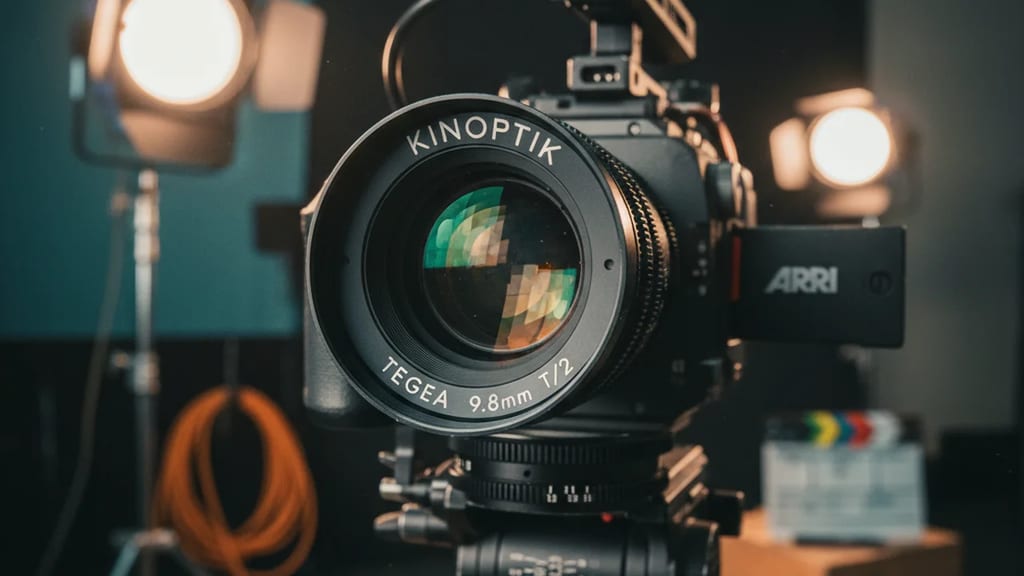
Kinoptik Tegea lens series featuring specialized coatings for high-contrast imagery and warm color rendition.

Technical Details

The Tegea series comprised four focal lengths: 40mm, 50mm, 75mm, and 100mm, all with a maximum aperture of T2.8. The optical design was based on an 8-element system with two special cylindrical front lenses for anamorphic compression. The lenses weighed between 1.8kg (40mm) and 2.4kg (100mm) and used a proprietary Kinoptik bayonet mount. The minimum focus distance was 1.2 meters for all focal lengths. Characteristic features were the pronounced horizontal lens flares and slight distortion in close-ups, which lent a specific aesthetic to the image look.

History & Development

Kinoptik developed the Tegea series in 1954 as a French response to the American Bausch & Lomb Super CinemaScope lenses. Pierre Angénieux, then still working at Kinoptik, led the optical development. The first Tegea lenses were used in Jean Renoir's "French Cancan" in 1955. By 1963, Kinoptik had produced approximately 800 Tegea sets before the series was discontinued in favor of the improved Kinoptik Apochromat line. Today, surviving Tegea lenses are considered sought-after vintage lenses for cinematographers seeking the characteristic 1950s CinemaScope look.

Practical Use in Film

French New Wave directors such as Jean-Luc Godard used Tegea lenses for films like "Breathless" (1960) to achieve widescreen aesthetics despite low budgets. The 75mm focal length established itself as the standard for dialogue scenes, while the 40mm was used for wide shots. A typical workflow required special anamorphic viewfinders and precise focusing, as the shallow depth of field at T2.8 allowed little tolerance. Disadvantages included the high weight and complex focus pulling during camera movements.

Comparison & Alternatives

In contrast to the sharper American Bausch & Lomb lenses, Tegea lenses exhibited softer image rendering and stronger chromatic aberrations. Modern alternatives like Hawk V-Plus or Cooke Anamorphic/i offer significantly better optical correction but do not achieve the specific vintage character of the Tegea series. For productions aiming for an authentic 1950s CinemaScope look, restored Tegea lenses remain the first choice, while contemporary anamorphic lenses are preferred for technically demanding projects.
From the crafts

Perspectives

Cinematographer

Als DoP schätze ich die Tegea-Objektive für ihren unverwechselbaren organischen Look – die horizontalen Flares und die weiche Bildzeichnung geben Porträts eine traumhafte Qualität, die moderne Linsen nicht reproduzieren können. Allerdings erfordert die Arbeit mit diesen Vintage-Objektiven absolute Präzision beim Fokus und eine erfahrene Kamera-Crew, da bereits kleinste Unschärfen durch die T2.8-Blende und das anamorphe System sofort sichtbar werden.

Director

Ich setze Tegea-Objektive gezielt für Periode-Filme oder Projekte ein, die bewusst die Filmsprache der 1950er Jahre zitieren sollen – der charakteristische CinemaScope-Look mit seinen weichen Übergängen und organischen Verzerrungen transportiert sofort eine nostalgische Stimmung. Die horizontalen Lens Flares nutze ich als Stilmittel für emotionale Höhepunkte, da sie weniger technisch-kalt wirken als digitale Effekte oder moderne Anamorphic-Linsen.

Producer

Kinoptik Tegea-Sets kosten in gutem Zustand 80.000-120.000 Euro und sind selten verfügbar, was die Budgetplanung erschwert und oft teure Mietoptionen von Spezialverleihern erfordert. Die längeren Setup-Zeiten durch das höhere Gewicht und die notwendige Präzision bedeuten 15-20% mehr Drehtage bei Dialog-lastigen Szenen, rechtfertigen sich aber durch den einzigartigen Look, der nicht digital replizierbar ist.

More in the lexikon

Related terms

Test your knowledge

Quiz

1. Was beschreibt „Kinoptik Tegea" am besten?

2. Zu welchem Department gehört „Kinoptik Tegea"?

3. Wie viele verschiedene Fachperspektiven bietet dieser Eintrag?

Report an error
From the Filmfarm ecosystem

Understand visual language, budget productions, connect crew.

The Lexikon is part of the Filmfarm ecosystem — alongside budgeting (FilmBalance), an industry magazine (FilmCircus) and crew networking (FilmCall, CrewMesh). One shared vocabulary for the whole production.

FilmFarm FilmRadarComing soonFilmPulseComing soonFilmNumbersComing soonFilmCapitalComing soonFilmLabComing soonFilmBalanceComing soonFilmCircusComing soon