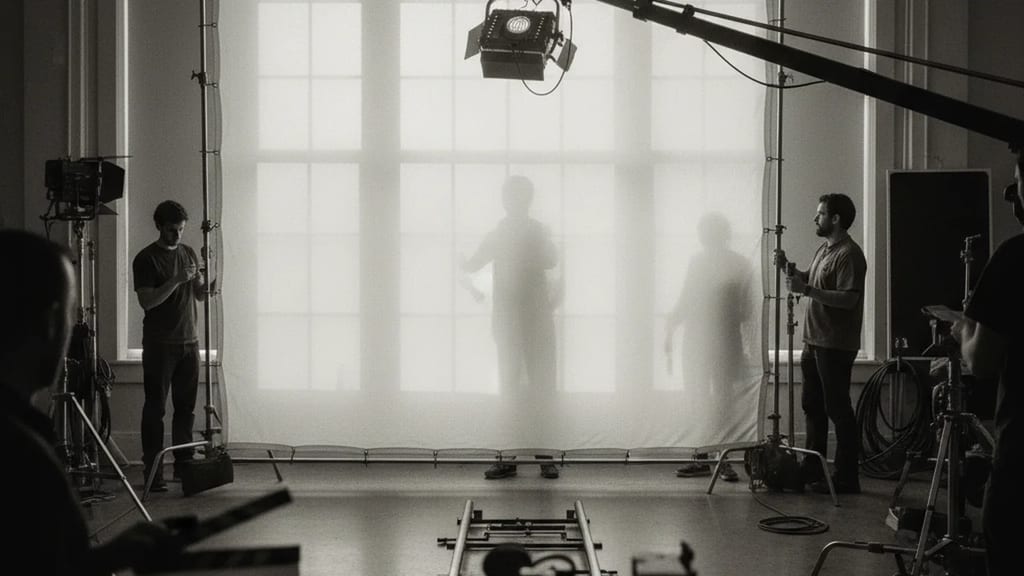
Diffusion fabric rigged in front of window or light — reduces intensity, scatters soft. Cheapest daylight modifier on any budget.
You bring an Interior Screen — or as we say on set, an Interior Screen — in front of a window or a light source whenever you need to tame strong, hard light without collapsing the overall brightness level. The fabric — usually ripstop nylon or special diffuser material — sits in front of the light source, not behind it. It scatters the photons broadly, transforming a laser-like beam into a soft, even floodlight.
The practical advantage is this: You don't need an additional 12k HMI or a giant bounce for your interior set. Instead, you open the window, mount the screen fabric in the frame — usually with gaffer's tape or small C-stands — and you have a huge, diffuse light surface that floods your scene without casting harsh shadows. The loss of brightness is between 1–1.5 stops, depending on the material; this is manageable and predictable. Especially for daylight interior shots, it's a classic: fire and police dramas, courtrooms, office scenes. You set up the screen and forget about it afterward; it just works.
On set, we differentiate between Full Diffusion — the material is completely opaque — and Single or Double Diffusion, where some transparency remains. A full diffusion screen is more aggressive but requires more light power behind it. You choose depending on the situation: Is the sun blasting in and you need controlled, soft light for close-ups? Full screen. Do you still want some modeling and just want to soften the edges? Single is enough.
Mounting is simple: grip frame, speed rail, or if necessary, two C-stands and a pole. Gaffers and grips often talk about a « Spreader Bar » or « Frame » here — the screen itself is just the fabric. Important: always check for wind. A fluttering diffuser cloth at the window is uncontrolled light. Also, plan the surface area — you need enough material to cover the entire window area, otherwise hard edges will form around it that will bother you during editing.
Related terms
Quiz
1. Was beschreibt „Fensterdiffusor" am besten?
2. Zu welchem Department gehört „Fensterdiffusor"?