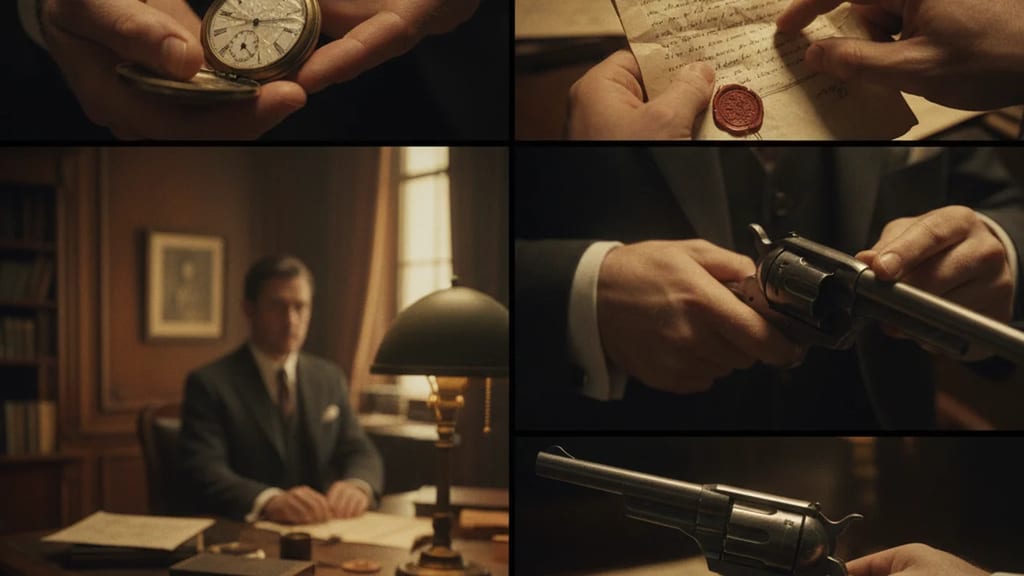
A close-up shot of a specific object or detail (watch, document, weapon, hand) that is edited into a scene to provide narrative information, emphasize action, or amplify emotional impact.
Definition
The Insert Shot (German: Detailaufnahme) is a tight close-up of a specific object or detail, cut into a scene to convey narrative information, emphasize an action, or enhance emotional impact. Unlike close-ups of faces or body parts, inserts focus on meaningful objects.
Typical Insert Objects
Narrative Information
- Clock/Time Display – Indicates time pressure
- Document/Contract – Shows legal or financial information
- Photograph – Represents memory or emotional connection
- Map – Provides geographical information
- Letter/Message – Conveys information without dialogue
Emotional/Psychological Enhancement
- Trembling Hand – Shows nervousness or fear
- Sweating Forehead – Indicates stress
- Grip on Weapon – Signifies determination or fear
- Tears – Displays emotional distress
- Gaze at Something – Shows focus and attention
Action/Security
- Weapon – Indicates threat
- Door Handle – Signifies entry
- Car Keys – Represents escape
- Mobile Phone – Shows communication
- Money – Denotes bribery or desperation
Difference Between Insert Shot, Close-up, and Cutaway
Insert Shot
- Focus on object/detail
- Narrative function – conveys information
- Directly relevant to the current action
- Cut into the scene
Close-up
- Focus on face or body part
- Emotional or psychological function
- Often of a character in the scene
- Shows reaction or expression
Cutaway
- Distraction element
- Bridges time or hides continuity errors
- Can be completely independent of the current location
- Often spatially or temporally displaced
Insert Shot Techniques
Matching Insert
- Same lighting and mood as the master shot
- Appears "seamless" and "authentic"
- Feels like part of the scene
- More difficult to shoot, but more natural
Non-Matching Insert
- Deviating lighting or mood
- Enhances significance or danger
- Can have a psychological effect (darker light = threat)
- Easier to shoot, but deliberately stylized
Fast Insert
- Rapid montage of multiple insert details
- Shows intense emotion or fast action
- Creates tension or chaos
- Editing technique
Sergei Eisenstein – "Battleship Potemkin" (1925)
The broken spectacles and the baby carriage on the steps are iconic insert shots. They evoke horror and humanity without explicit violence. The inserts are psychologically reinforcing – they show consequences.
Stanley Kubrick – "2001: A Space Odyssey" (1968)
Inserts of HAL's camera lens eye create psychological tension. The red "eye" of the computer becomes an insert that conveys fear – a machine is "watching" us.
Quentin Tarantino – "Pulp Fiction" (1994)
Famous insert of the mysterious briefcase. We never see what's inside – only the reactions. The insert creates mystery through what it doesn't show.
Martin Scorsese – "Goodfellas" (1990)
Montage inserts of wads of cash, drugs, weapons. The rapid sequence creates a rush and tension – visual rhythm through inserts.
David Fincher – "Se7en" (1995)
Gruesome inserts of the murder scenes, but often not shown completely. The insert enhances horror through what is not fully seen – a psychological technique.
Insert Shot Planning and Production
Pre-Production Planning
- Identify – Which objects need inserts?
- Plan Timing – When will inserts be cut?
- Decide Focal Length – 50-100mm typical
- Lighting Plan – Matching or Non-matching?
- Prepare Props – Objects must be ready
Production Workflow
Option 1: Live During Main Scene
- Second camera with a longer focal length
- Shoots inserts parallel to the main scene
- Saves time, but requires precise coordination
Option 2: After Main Scene, Same Day
- After principal photography wrap
- Focus on inserts and props
- Lighting must be kept consistent
Option 3: Separate Second Unit
- A day or week later
- Only props and set dressing
- Cheapest option, but more difficult for matching
Technical Specifications
Focal Length: 50-100mm (Super 35mm sensor)
Aperture: f/2.8 – f/4.0 (for depth of field control)
Depth of Field: 2-5mm at 100mm lens focal length
Focus Pulling: Critical and millimeter-precise
Lighting: Often brighter/harsher for detail visibility
Common Insert Errors
Poor Focus Control
- Inserts are out of focus
- Unusable in editing
- Requires reshoots
Non-Matching Lighting (Unintentional)
- Looks out of place
- Breaks visual continuity
- Appears amateurish
Too Obvious / Too Slow
- Audience has already understood
- Unconscious over-communication
- Underestimates audience intelligence
Too Many Insignificant Inserts
- Important information gets lost
- Editing becomes overloaded
- No clear prioritization
Insert Shots in Various Genres
Thriller/Horror
- Non-matching inserts enhance tension
- Frequent and strategic
- Example: Inserts of the weapon in "Halloween"
Drama
- Matching inserts for emotional authenticity
- Subtler, less frequent
- Example: Inserts of the wedding ring in romantic dramas
Action
- Fast montage inserts
- Show details of the action
- Example: Fast-motion inserts of projectiles
Comedy
- Can be humorous
- Surprising or absurd inserts
- Example: Insert of a menacing cat
The Art of the Insert Shot
A perfect insert shot:
- Is visually interesting – aesthetically lit
- Is functional – conveys necessary information
- Fits the editing rhythm – timing is correct
- Is emotionally enhancing – not just informing
- Is subtle – not too obvious
- Is memorable – stays in the viewer's mind