Filmlexikon.
Support
In-Camera VFX
VFX · Terms

In-Camera VFX

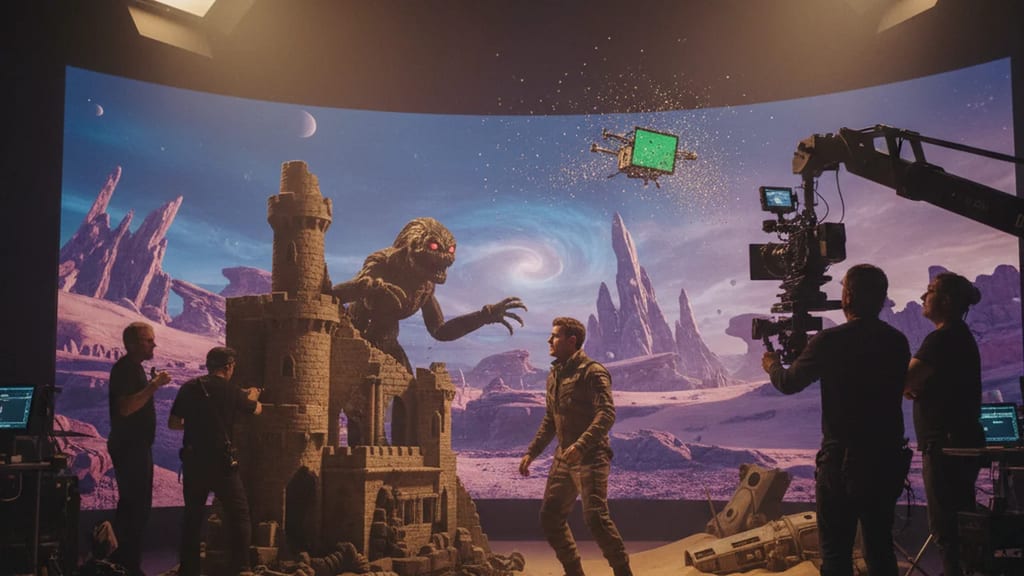
Murnau AI illustration
in camera effects practical effect in camera trick special effect

Visual effects created live on-set in real-time, typically with LED walls and real-time rendering, eliminating traditional greenscreen compositing in post-production.

Overview

In-Camera VFX (ICVFX) refers not to a single fixture or grip device, but to a Virtual Production shooting technique: the final image background is created directly in-camera during the shoot, rather than in post-production compositing. In its currently widespread form, large-scale LED walls (LED Volumes) are used, which display a digital environment in real-time, in front of which actors and real set constructions are filmed.

In contrast to the classic greenscreen/chroma key, the crew sees the finished image frame immediately in the viewfinder. This eliminates the need for post-production keying and background insertion; directors, camera operators, and actors work against a visible image instead of a green surface.

How It Works

Three components interact:

  • Real-time Render Engine: A game engine – commonly Unreal Engine by Epic Games – calculates the digital scene in real-time and outputs it to the LED wall.
  • Camera Tracking: The position, orientation, and movement of the real camera are continuously captured and transmitted to the engine, so that the virtual camera moves in sync and the perspective parallax of the background is correct.
  • Frustum Rendering: Within the camera's field of view (Inner Frustum), the image is rendered in high resolution and with correct perspective; the surrounding area (Outer Frustum) primarily serves as a light source and reflection surface.

Significance for Lighting and Reflections

For lighting and set work, the LED wall itself is an active, large-scale light source. It casts the light of the displayed scene – color, brightness, direction – directly onto actors and the set. This creates contextually appropriate interactive light as well as realistic reflections on eyes, skin, paint, glass, and metal, which would have to be laboriously added in post-production in a greenscreen workflow. If the background changes (e.g., sunset, passing lights), the light on the faces changes automatically with it.

Usage and History

The LED Volume variant became widely known with the series The Mandalorian (starting 2019) and the StageCraft system developed by Industrial Light & Magic (ILM), which combined Unreal Engine with a semicircular LED wall and ceiling. Since then, ICVFX has become established in series and film production. It should be noted that the term, in a broader sense, also encompasses practical effects created "in-camera" without post-production (e.g., multiple exposures or real optical tricks); however, in current usage, ICVFX most often refers to the LED Volume/real-time rendering technique.
From the crafts

Perspectives

Cinematographer

Als DoP muss ich die Kamera-Tracking-Systeme bereits beim Blocking berücksichtigen, da jede Bewegung in Echtzeit die Hintergrundperspektive beeinflusst. Die LED-Wände erzeugen automatisch Spill-Light und Reflexionen auf den Schauspielern, wodurch sich meine Lichtführung grundlegend ändert – ich arbeite mehr mit Negativfill und gezieltem Key-Light statt kompletter Ausleuchtung. Die 120Hz-Bildwiederholung eliminiert zwar Flicker-Probleme, aber ich muss Shutter-Angles unter 180° vermeiden, um Moiré-Effekte zu verhindern.

Director

Mit In-Camera VFX kann ich Schauspielern echte Environments zeigen statt Green-Screen-Leere, was ihre Performance drastisch verbessert – Pedro Pascal reagierte in "The Mandalorian" völlig anders auf sichtbare Alien-Welten. Die Technologie zwingt mich zur präzisen Planung, da ich alle Locations digital vor Drehbeginn festlegen muss, bietet aber spontane Anpassungen wie Tageszeit oder Wetter per Knopfdruck. Komplexe Kamerabewegungen wie 360°-Schwenks funktionieren nahtlos, während bei Green-Screen die Orientierung oft verloren geht.

Producer

Ein Volume-Stage kostet 150.000-300.000€ pro Drehtag, aber eliminiert Location-Reisen und Wetterabhängigkeit komplett – "The Mandalorian" sparte geschätzt 40% der ursprünglich geplanten Reisekosten. Die Vorlaufzeit steigt um 8-12 Wochen für Asset-Erstellung, dafür reduziert sich die VFX-Postproduktion von 12 auf 6 Monate. COVID-Beschränkungen machten kontrollierte Studio-Environments unverzichtbar, wodurch sich auch kleinere Produktionen für Volume-Tage entscheiden statt Auslandsreisen zu riskieren.

More in the lexikon

Related terms

Test your knowledge

Quiz

1. Zu welchem Department gehört „In-Camera VFX"?

2. Wie viele verschiedene Fachperspektiven bietet dieser Eintrag?

Report an error
From the Filmfarm ecosystem

Understand visual language, budget productions, connect crew.

The Lexikon is part of the Filmfarm ecosystem — alongside budgeting (FilmBalance), an industry magazine (FilmCircus) and crew networking (FilmCall, CrewMesh). One shared vocabulary for the whole production.

FilmFarm FilmRadarComing soonFilmPulseComing soonFilmNumbersComing soonFilmCapitalComing soonFilmLabComing soonFilmBalanceComing soonFilmCircusComing soon