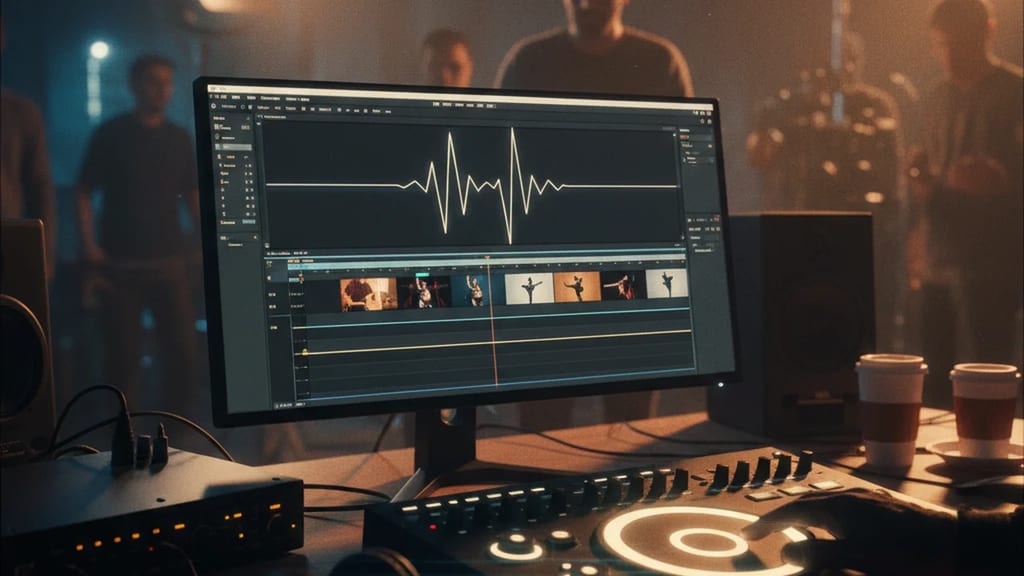
Visual cut synchronized precisely to music or dialogue rhythm — image echoes the audio line. Rhythmic editing as design, not coincidence.
Illustration
The edit follows the music or dialogue with precise intent — every cut, every visual change occurs exactly where the soundtrack makes a rhythmic or melodic turn. This is illustration: not random synchronization, but conscious editing that confirms the ear through the eye. You only truly notice this on set during the edit; it's there that the decision is made whether to leave a moment as mere action or to make it the visual echo of a musical phrase.
In practice, illustration works like this: You cut precisely on the beat of a drum bass line, a dissolve on the exact moment of a piano chord, a zoom movement synchronized to a change in vocal inflection during dialogue. This creates an unconscious but strong coherence — the viewer doesn't feel manipulated, but experiences image and sound as an organic unit. A classic example: You cut between two characters not at some point during their speech, but exactly on the beat where one exhales or finishes a sentence. The viewer registers the timing as natural, even though it's calculated.
Illustration differs from mere lip-sync in that it also translates emotional and rhythmic content of the soundtrack — not just mouth movements. A slow, melancholic soundtrack can slow down an editing rhythm; the visual pulse is subordinated to the sound. An energetic track accelerates the cutting sequences. Some editors handle illustration very literally, others more subtly: The art lies in sensing when exact synchronization enhances the drama and when it appears kitschy.
Typical for music videos, montage sequences, and action scenes with a score. But even in dramatic scenes, precisely placed illustration has a psychological effect — a dialogue cut at the wrong moment feels jerky, at the right moment powerful. You must learn to read the soundtrack like a choreography. Related terms: Dynamic editing, Rhythmic editing — both work with similar principles but differ in whether the rhythm primarily comes from the editing or the music.
Related terms
Quiz
1. Was beschreibt „Illustration" am besten?
2. Zu welchem Department gehört „Illustration"?