Technical Details
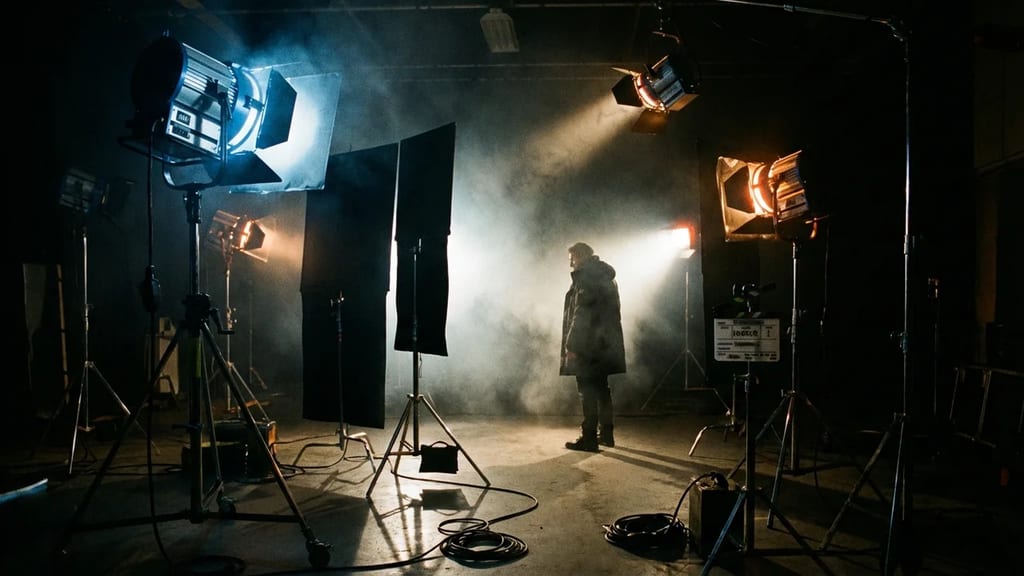
Classic horror lighting primarily uses hard light sources with Fresnel lenses between 650W and 2kW for precise shadow formation. Uplighting is typically employed at a 30-60 degree angle to the face axis, while side lighting operates with a 90-120 degree deviation from the camera axis. Color temperatures are preferably at 3200K (Tungsten) or corrected to 5600K using CTB filters. Modern LED panels allow precise color control between 2700K-6500K with RGB additions for unnatural color accents.
Specific techniques include: Rim lighting for character isolation, Chiaroscuro lighting with 80-90% shadow content in the frame, and the use of cookies (cucoloris) for organic shadow patterns.
History & Development
Fritz Lang's "The Cabinet of Dr. Caligari" (1920) first systematically defined horror lighting through painted shadows and geometric light direction. Karl Freund perfected the uplighting aesthetic in 1931's "Dracula" using 500W bulbs under Plexiglas sheets. James Whale introduced the "Monster Light" in 1931's "Frankenstein" – direct uplighting at a 45-degree angle for facial distortion.
The 1970s brought mobile battery lighting for spontaneous lighting effects through "The Exorcist" (1973). Dario Argento's "Suspiria" (1977) established colored horror lighting through gelatin filters. Modern Digital Intermediate has enabled precise post-production of light contrasts since 2000.
Practical Use in Film
"The Shining" (1980) combines 5kW Tungsten spots with neon practicals for a sterile hotel aesthetic. "Se7en" (1995) uses dimmed 200W bulbs at 20% power for permanent underexposure. "It Follows" (2014) utilizes 360-degree lighting with LED rings for an omnipresent threat.
Workflows begin with shadow plot creation, followed by contrast ratio tests between 1:8 and 1:16. Modern productions use spot meters to precisely measure exposure values and log color temperature shifts.
Comparison & Alternatives
Horror lighting differs from Film Noir through more extreme contrasts (Horror: 1:20+, Noir: 1:8) and less natural light directions. Thriller lighting works more subtly with 1:4 contrasts. Modern LED technology is increasingly replacing Tungsten setups with more precise color control and lower power consumption.
SkyPanel S360-C today enable RGB mixing for supernatural color grading, while Astera Tubes offer battery-powered mobility for spontaneous lighting accents.