Filmlexikon.
Support
Hollywood Star Filter
Camera · Equipment

Hollywood Star Filter

Murnau AI illustration
15lb sandbag 20 c stand 216 diffusion 250 diffusion 251 diffusion 25lb sandbag 35lb sandbag 40 c stand

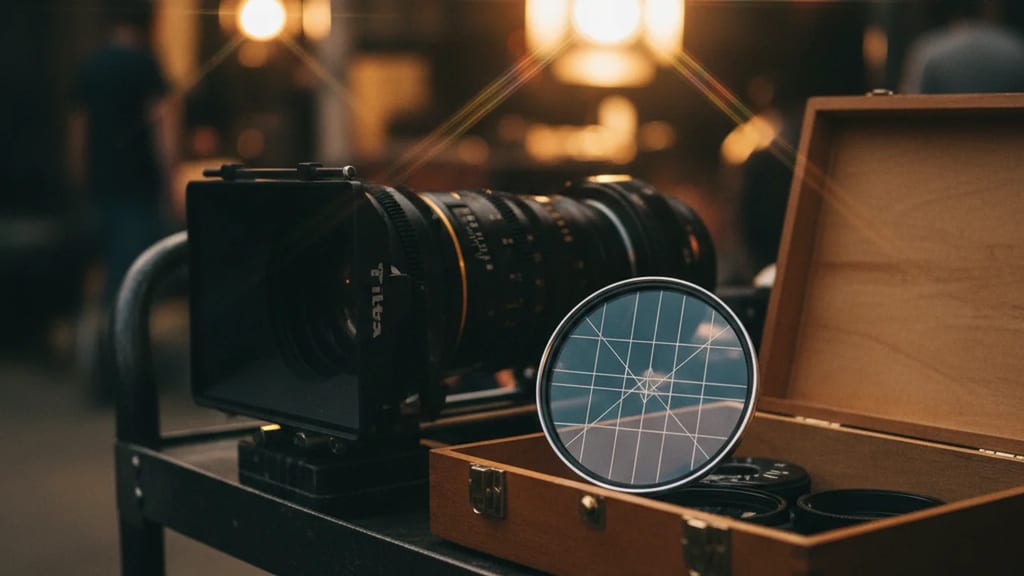
Optical filter with engraved line pattern (300–500 lines/inch) that transforms light sources into geometric rays. Available in 4-point, 6-point, or 8-point versions depending on line orientation.

Technical Details

Standard star filters have lines 2-6 mm wide spaced 0.1-0.5 mm apart, etched into optical glass or acrylic. The line density is typically 300-500 lines per inch. 4-point filters use one line direction, 6-point filters use three line directions at 60° angles, and 8-point filters use two crossed 45° directions. Modern variants like the Tiffen Pro-Mist combine the star effect with contrast reduction from 1/8 to 1 stop. The ray length correlates directly with the aperture – f/2.8 produces longer rays than f/11.

History & Development

Tiffen introduced the first commercial star filter for the film industry in 1968, after cinematographers had previously used improvised solutions with nylon stockings or crossed wires. Douglas Slocombe systematically used star filters for "Willy Wonka & the Chocolate Factory" in 1971. In the 1970s-80s, the effect became a trademark of music videos and science fiction films. Digital VFX tools like After Effects integrated star simulations starting in 1995, but this did not reduce the demand for practical filters.

Practical Use in Film

Ridley Scott used star filters extensively in "Blade Runner" (1982) for the neon-lit city scenes, combined with 1/4 Pro-Mist for atmospheric diffusion. Steven Spielberg specifically employed them for UFO light effects in "Close Encounters of the Third Kind" (1977). Modern productions like "Blade Runner 2049" (2017) use star filters more sparingly for specific light sources such as car headlights or streetlights. The workflow requires precise lighting control, as even small reflections can become dominant ray effects.

Comparison & Alternatives

Unlike soft filters, which reduce contrast, star filters visually enhance light intensity. Anamorphic lenses create natural horizontal lens flares, while star filters create geometrically precise rays in all directions. Digital alternatives like Red Giant's "Optical Flares" offer more control but often produce artificial-looking results. Black Pro-Mist filters combine flattering skin tones with subtle star effects at a filter strength. Practicing DoPs prefer physical filters for authentic light refraction.
From the crafts

Perspectives

Cinematographer

Ich setze Star-Filter strategisch nur bei spezifischen Lichtquellen ein, nie als permanenten Look-Filter, da sie schnell überwältigend wirken. Die Kombination mit LED-Panels erfordert besondere Vorsicht, da deren Spektrum unnatürliche Farbsäume in den Strahlen erzeugt. Bei Nachtaufnahmen teste ich verschiedene Filterstärken am Monitor, um die optimale Balance zwischen Drama und Realismus zu finden.

Director

Ich nutze Star-Filter gezielt für emotionale Höhepunkte oder surreale Sequenzen, da sie dem Publikum sofort signalisieren, dass etwas Besonderes geschieht. In Liebesszenen verstärken sie romantische Stimmung durch Kerzenlicht oder Stadtlichter, während sie in Sci-Fi-Kontexten technologische Überlegenheit vermitteln. Der Schlüssel liegt im sparsamen Einsatz – zu viel Star-Effekt wirkt schnell wie ein Musikvideo aus den 80ern.

Producer

Star-Filter kosten zwischen 150-800 Euro je nach Größe und Hersteller, amortisieren sich aber durch Wiederverwendbarkeit über Jahre. Sie reduzieren Post-Production-Kosten erheblich, da digitale Star-Effekte mindestens 2-3 Stunden VFX-Arbeit pro Shot benötigen. Bei Nachtdrehs spare ich Budget, da weniger aufwändige Lichtinstallationen nötig sind – der Filter verstärkt bereits vorhandene Lichtquellen dramatisch.

More in the lexikon

Related terms

Test your knowledge

Quiz

1. Was beschreibt „Hollywood-Star-Filter" am besten?

2. Zu welchem Department gehört „Hollywood-Star-Filter"?

3. Wie viele verschiedene Fachperspektiven bietet dieser Eintrag?

Report an error
From the Filmfarm ecosystem

Understand visual language, budget productions, connect crew.

The Lexikon is part of the Filmfarm ecosystem — alongside budgeting (FilmBalance), an industry magazine (FilmCircus) and crew networking (FilmCall, CrewMesh). One shared vocabulary for the whole production.

FilmFarm FilmRadarComing soonFilmPulseComing soonFilmNumbersComing soonFilmCapitalComing soonFilmLabComing soonFilmBalanceComing soonFilmCircusComing soon