Technical Details
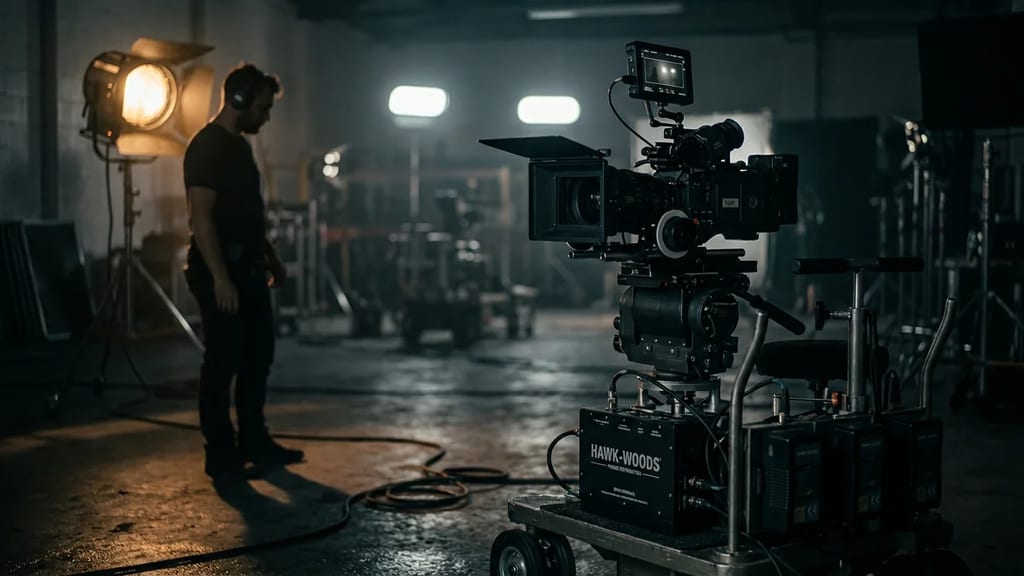
Hawk-Woods V-Lock batteries typically deliver 14.4V with capacities ranging from 95Wh to 290Wh, with maximum discharge currents up to 12A. The DV-F970 series for Sony cameras offers 7.2V at 47Wh to 100Wh. Power-Con systems enable hot-swap functionality without interrupting camera power. Modern batteries use Lithium-Ion technology with integrated fuel gauge displays that show remaining runtime in minutes. The Shark-Fin series achieves charging times of under 3 hours while simultaneously charging four batteries.
History & Development
In 1973, the founders developed the first battery packs for BBC cameras as portable electronic cameras replaced heavy 16mm systems. In 1985, Hawk-Woods introduced the first hot-swap system for broadcast cameras. With the advent of digital cameras in the 1990s, the portfolio expanded to V-Mount and Anton Bauer Gold Mount systems. In 2010, the company first integrated LED fuel gauges into battery packs. Since 2018, Hawk-Woods has also offered USB-C Power Delivery for mirrorless cameras and monitors.
Practical Application in Film
Documentary filmmakers appreciate the NP-1 Mini V-Lok batteries for gimbal setups, as they only add 15mm thickness at 150g. For long shoots like "Planet Earth II" (2016), Hawk-Woods dual chargers enabled the continuous parallel charging of eight batteries. Power-Con systems are used by Steadicam operators where weight balance is critical – a battery change takes under 5 seconds without camera interruption. Wireless video transmitters benefit from the D-Tap output voltage of 11-17V for constant RF performance.
Comparison & Alternatives
Unlike Anton Bauer, Hawk-Woods focuses on compact, lightweight solutions rather than maximum capacity. V-Mount batteries are mechanically more robust than Sony NP-F systems but require special camera adapters. Core SWX offers similar functionality at lower prices but rarely achieves Hawk-Woods' charge cycles of over 1000 cycles. Gold Mount systems rotate 360°, while V-Mount batteries lock in only one position. Modern USB-C power banks are increasingly replacing proprietary systems for mirrorless cameras with consumption under 50W.