Technical Details
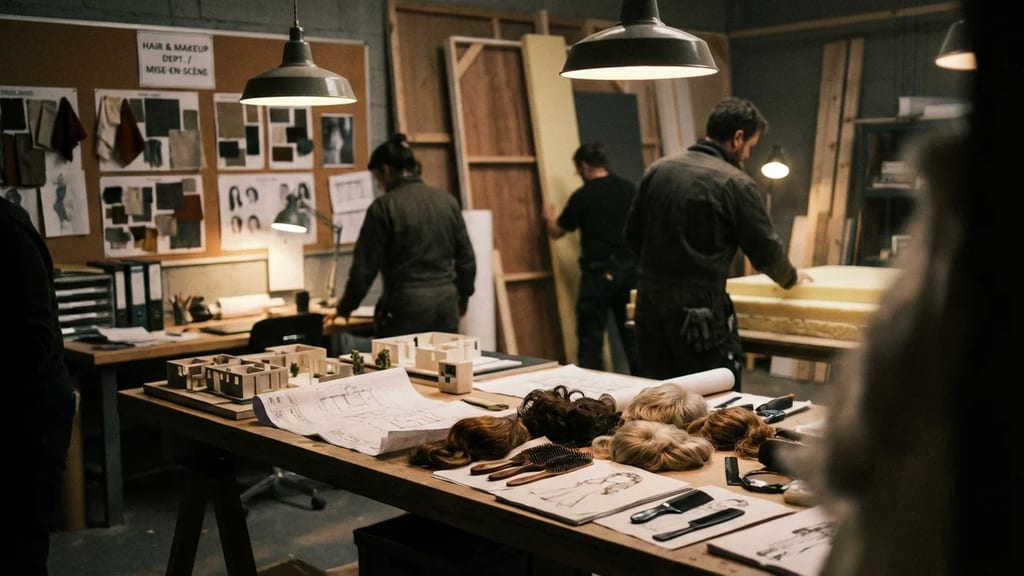
Professional Hair Designers use real hair pieces with a density of 120-160 hairs per square centimeter for a natural effect. Wigs are made from hand-tied monofilament nets with a thread thickness of 0.08mm and weigh between 65-120 grams. Hair extensions are attached with keratin bonds at 160°C and last for 8-12 shooting days under studio conditions. Special products like spirit gum for beards achieve an adhesive strength of 2.1 N/cm² at 35°C body temperature.
Basic types include Contemporary Hair (modern hairstyles), Period Hair (historical reconstructions), and Fantasy Hair (unrealistic designs). Aging techniques use gray shades in 12-step gradients from 10% to 85% gray content.
History & Development
The first film Hair Designer, Max Factor Sr., established standardized wig systems at Paramount Studios in 1914. In 1935, Factor introduced the "Color Harmony" principle, which mathematically calculated hair colors to skin tone and costume colors. In 1962, Sydney Guilaroff revolutionized the portrayal of historical hairstyles with "Lawrence of Arabia" through archaeologically documented reconstructions.
The introduction of synthetic Kanekalon fibers in 1972 reduced wig weight by 40% compared to real hair. Modern motion capture productions since 2009 require special magnet-free materials, as conventional hairpins can distort tracking by up to 15mm.
Practical Application in Film
"Mad Max: Fury Road" (2015) used 150 individually aged wigs with incorporated desert sand for authentic textures. The transformation of Gary Oldman in "Darkest Hour" (2017) required 200 individually glued beard hairs daily for Churchill's characteristic facial hair.
The Hair Designer creates continuity charts with photographic documentation of all 15° head turns for exact reproduction between shooting days. For action scenes, up to four identical wig doubles per actor are kept on hand, as stunt sequences have a damage rate of 60%.
Comparison & Alternatives
Hair Design differs from makeup through permanent alteration of the silhouette versus temporary surface styling. CGI Hair Replacement costs 800-1,200 Euros per second of footage, while practical solutions range from 50-150 Euros daily. Modern de-aging techniques combine physical wigs with digital post-production in a 70:30 ratio for optimal cost-efficiency.