Overview
"Hair and Fur" in digital post-production refers to the computer-generated creation of hair, fur, and similar fibrous structures on CGI objects and characters. Instead of modeling each strand of hair individually, procedural systems "grow" a large number of strands from a base surface, with their shape, density, and behavior controlled by parameters.
The best-known namesake representative is the toolset of the same name in Autodesk 3ds Max. At its core, it consists of the World Space Modifier Hair And Fur and an associated render effect. This system was integrated into 3ds Max as of version 7.5 and is technologically based on the hair solution Shave and a Haircut by Joe Alter.
Functionality
The modifier is applied to an existing object – either a mesh or a spline. For a mesh, hair grows from the entire surface by default; the area can be restricted using sub-object selection. Once an object modified in this way is selected, the hair is displayed in the viewport.
- Controllable Properties: including the number and density of strands, length, and thickness at the root and tip.
- Styling: Using the Guides sub-object level and the styling tools, hair can be interactively combed and shaped in the viewport.
- Render Restriction: Hair And Fur renders exclusively in perspective and camera views; hair does not appear in orthographic views.
Rendering and Use on Set or in Post-Production
The appearance of the fur is determined by a render effect or assigned materials. External render engines directly support the native 3ds Max Hair and Fur system: V-Ray can natively render the World Space Modifier and allows the assignment of custom materials, and OctaneRender also supports its display. For more control, the fur can also be converted into mesh geometry, allowing a custom material to be assigned to the converted object.
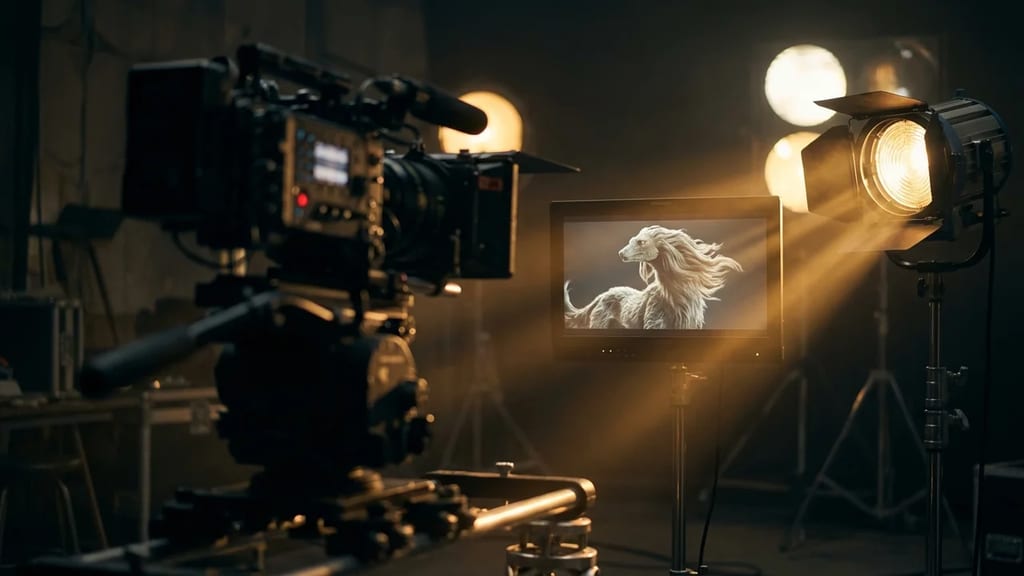
In film and TV workflows, "Hair and Fur" is thus part of the VFX/CGI pipeline: it is used when digital doubles, creatures, or animals need to be equipped with believable hair or fur growth – an area that must replicate real lighting and camera movement in compositing but is created entirely in post-production. In addition to the integrated 3ds Max system, other specialized solutions such as Ornatrix or HairFarm are also widely used.