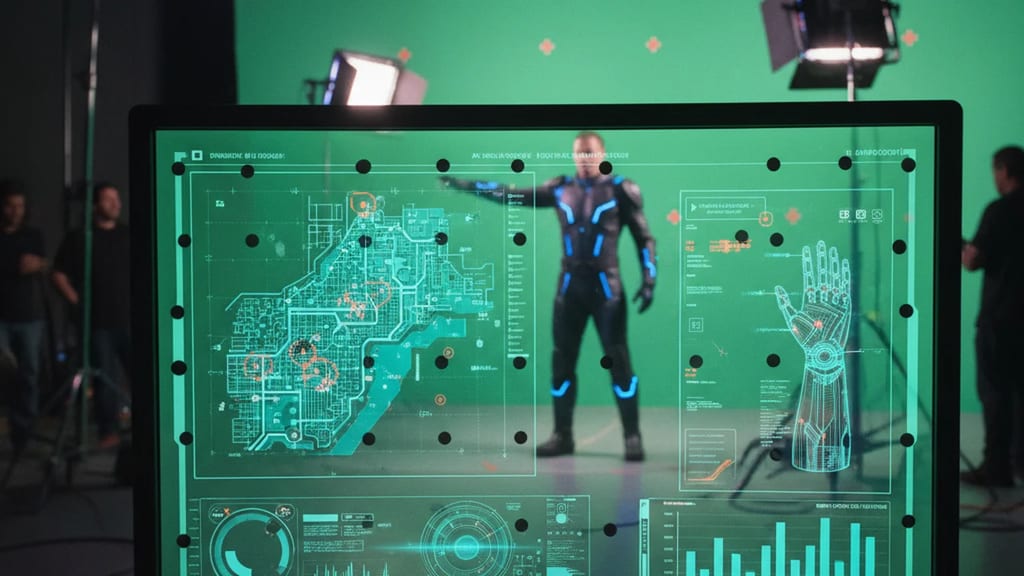
On-screen elements — phones, monitors, dashboards — placed or added in post. Critical for visual storytelling without dialogue.
On set or in editing, you often need screen content that advances the story without a character having to explain everything. This is the core task of GUI elements — they convey information to the viewer directly, visually, and credibly. A hacker breaking into a server doesn't need to say what they're doing; the windows flickering across their monitor tell the story. This is more efficient filmmaking.
In practice, you distinguish between two approaches. On-Set Solution: You shoot real monitors with prepared content — browser windows, databases, chat logs. The advantage here is that actors can react to it realistically, their eyes following actual elements. The disadvantage: reflections, flicker during fast cuts, and if you change details later, reshooting is expensive. Post-Based: You shoot against black or neutral screens, creating the GUI entirely in the VFX suite. This gives you absolute control — timing, color corrections, font errors can still be fixed two weeks before delivery. Modern projects usually use a hybrid: some basic content on-set for the actor's performance, with most of it then designed in post.
Important in design: Authenticity trumps beauty. A realistic, slightly chaotic interface with overlapping windows and real system clutter looks more credible than a sterile, perfectly composed graphic design solution. Typical beginner mistakes — too much text at once, font that's too large, colors that don't match the film's aesthetic. Also consider: viewers' eyes only have a second to absorb information. If a dashboard is too complex, the story's focus gets lost.
Technically, you work closely with the VFX supervisor here. Your camera perspective on the monitor must be stable — any wobble becomes a visual torment. Think about tracking for screens shot with camera movement; without correct motion tracking, the GUI looks overlaid, not integrated. And: the color temperature and contrast of a monitor differ significantly from daylight. This must be adjusted in color correction, otherwise, it's immediately obvious that it was added later.
Related terms
Quiz
1. Was beschreibt „Grafische Benutzeroberfläche" am besten?
2. Zu welchem Department gehört „Grafische Benutzeroberfläche"?