Cinematographer
Aus DoP-Perspektive ist dieses Element essentiell für die visuelle Gestaltung. Es ermöglicht mir die gewünschte Farbstimmung und das ästhetische Bild konsistent umzusetzen.
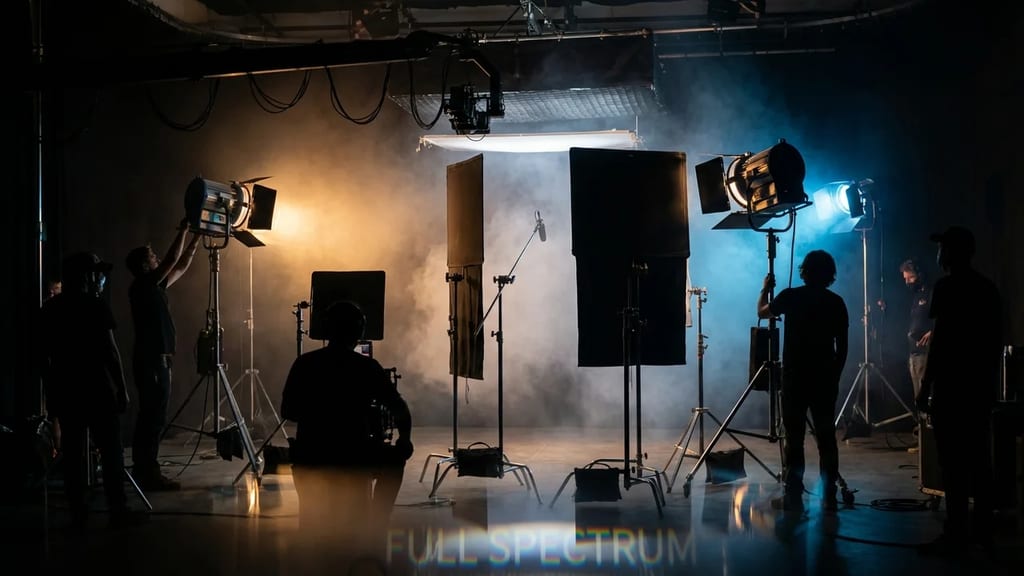
Light containing all visible wavelengths for accurate color reproduction, matching the full solar daylight spectrum.
"Full Spectrum" in film lighting refers not to a specific lamp, device, or manufacturer code, but to a quality characteristic of a source's light spectrum. It denotes light that covers the entire visible wavelength range – roughly from blue/violet through green and yellow to red – as continuously as possible and without significant gaps or peaks. The reference points are classic continuous emitters: daylight (sun) and the glowing tungsten filament of a tungsten lamp.
Important: The term is not technically standardized. There is no official threshold above which a light is considered "Full Spectrum" – the term originally stems from marketing and qualitatively describes the naturalness of the spectral distribution. The actual spectral quality is therefore quantified using metrics like CRI, TLCI, and SSI (see below), not by the label itself.
The counterpart to full spectrum are "broken-spectrum" sources with pronounced peaks and gaps in the spectrum: simple RGB LEDs, older fluorescent tubes, or discharge lamps. Such sources may appear white to the eye but render certain object colors incorrectly – particularly critical for skin tones, as skin transmits light into deeper tissue layers and reflects it back colored. If, for example, the deep red component (R9) is missing from the spectrum, skin will appear pale or lifeless on camera and will be difficult to correct in grading.
Modern professional luminaires therefore produce full-spectrum light not with pure RGB, but with multi-emitter engines that mix several LED colors to fill spectral gaps – such as RGBWW (RGB plus warm and cool white) or systems with additional colors like amber, cyan, or lime. The ARRI Orbiter, for instance, uses a six-color engine (red, green, blue, amber, cyan, lime) to maintain high color fidelity across the entire CCT range. Such engines deliver high CRI/TLCI values and more uniform spectral coverage than pure RGB or RGBW solutions.
Since "Full Spectrum" itself is not measurable, the spectral quality of a source is assessed using standardized indices:
| Metric | What it Measures | Background |
|---|---|---|
| CRI (Ra) | Color rendering against a reference emitter, classically over 8 pastel color samples (extended R9–R15, including saturated red/skin tones) | General lighting technology; not camera-specific |
| TLCI | Color fidelity from the perspective of a "standard" camera; the 18 colored patches of the ColorChecker chart are evaluated (24 patches total, excluding 6 grayscale patches), including skin tones | Developed by Alan Roberts (formerly BBC, with the EBU); optimized for TV/film |
| SSI | Spectral similarity to a continuous reference source (e.g., SSI[D55] for daylight, SSI[3200K] for tungsten) | Developed by the Academy (AMPAS) specifically for LEDs in cinematography |
SSI in particular is closely linked to the concept of full spectrum: it compares the actual spectrum of a light to that of an ideal continuous emitter, thus directly showing how close an LED is to "true" full-spectrum light.
When purchasing or renting equipment, one should not rely solely on the marketing label "Full Spectrum" but should pay attention to the published CRI, TLCI, and ideally SSI values – preferably across multiple color temperatures, as the spectral quality of many mixed-light engines fluctuates with the set CCT. As an example of current full-spectrum-capable devices, ARRI mentions the Omnibar with values of CRI 98 / TLCI 98 at 5600 K.
Rule of thumb: Daylight, tungsten, and high-quality mixed-light LEDs provide full-spectrum, skin-friendly light; pure RGB effect lamps and old fluorescent sources, on the other hand, should be treated with caution for close-ups on faces.
Aus DoP-Perspektive ist dieses Element essentiell für die visuelle Gestaltung. Es ermöglicht mir die gewünschte Farbstimmung und das ästhetische Bild konsistent umzusetzen.
Diese professionelle Lösung erhöht die Produktionseffizienz und reduziert Post-Production-Anforderungen. Sie ermöglicht flexible, schnelle Anpassungen während des Drehs.
Als Gaffer ist dies ein unverzichtbares Werkzeug meines täglichen Handwerkszeugs. Es ermöglicht mir professionelle Lichtkontrolle und schnelle Anpassungen auf Set, was Zeit spart und Qualität sichert.
1. Zu welchem Department gehört „Vollspektrum"?
2. Wie viele verschiedene Fachperspektiven bietet dieser Eintrag?
The Lexikon is part of the Filmfarm ecosystem — alongside budgeting (FilmBalance), an industry magazine (FilmCircus) and crew networking (FilmCall, CrewMesh). One shared vocabulary for the whole production.