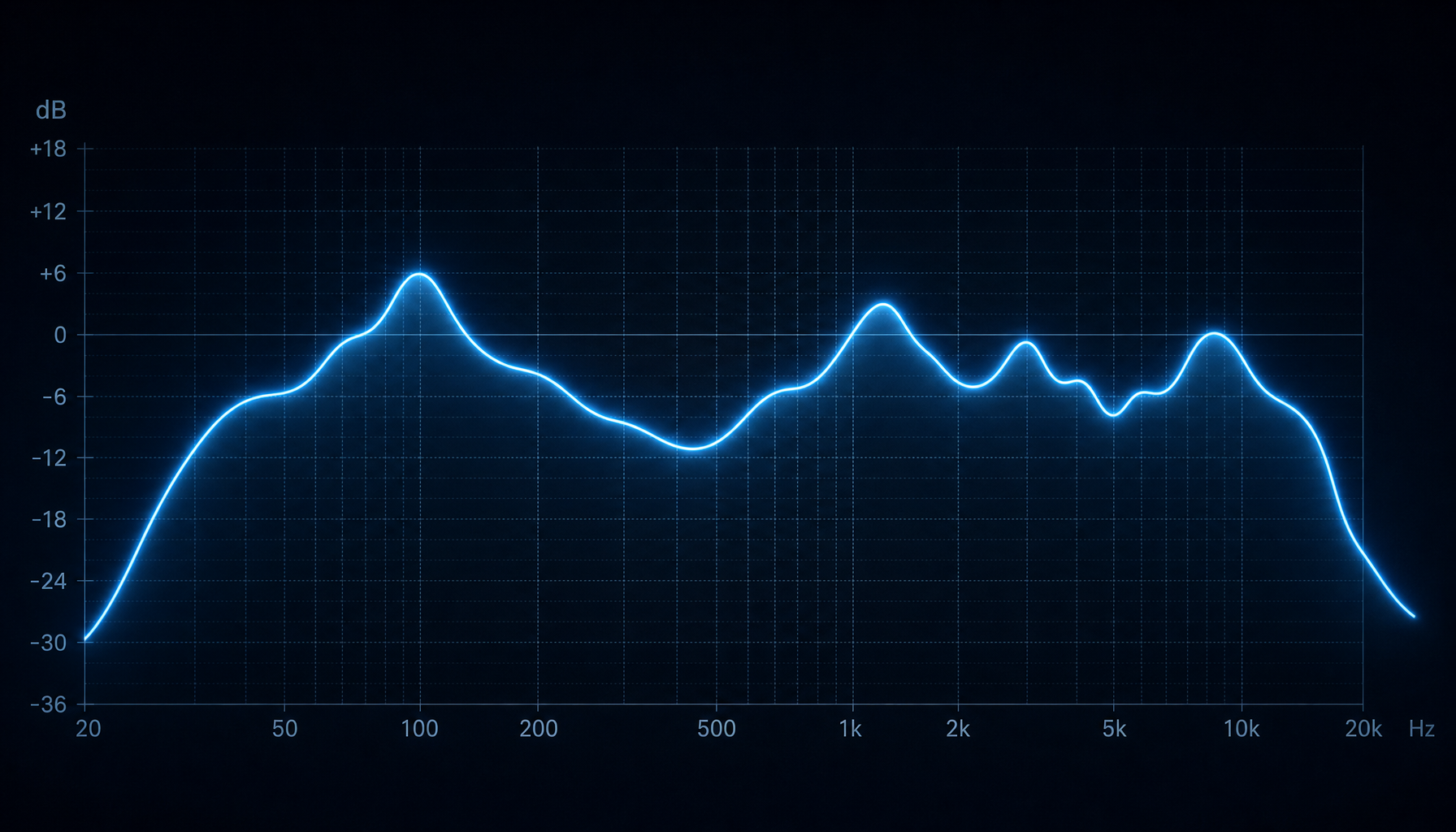
Describes how a microphone or audio chain reproduces different frequencies — flat or colored. A key factor in speech intelligibility and tonal character.
Frequency response describes how loudly a microphone—or an entire audio chain of mic, preamp, and recorder—reproduces individual frequencies. A linear ("flat") frequency response reproduces bass, mids, and treble with equal strength; any deviation colors the sound. Manufacturers print the curve in the datasheet: frequency on the x-axis, level deviation on the y-axis. It's worth reading—the curve reveals more about a microphone's sound character than any product description.
Why Shotgun Mics Sound Colored
No microphone is perfectly neutral across all frequencies, and shotgun microphones are the least so by design: their directionality is created by the interference tube, and this doesn't work equally well at all frequencies. Low frequencies are harder to focus, and off-axis the sound is audibly colored—if you aim past the boom, you get not only quieter but also duller, more phasey sound. Added to this is the proximity effect: the closer the source, the more many shotgun mics boost the bass.
Speech Intelligibility and Low-Cut
For dialogue, the range that carries speech intelligibility is most important—the mids and lower highs where consonants reside. A slight boost there can make dialogue more assertive; a dip makes it muffled. At the lower end is the low-cut (high-pass filter): it cuts out footfall noise, wind rumble, and handling noise below the fundamental speech frequency before they eat up the level. Many microphones and recorders offer it as a switchable option—on set, it's almost always activated for dialogue recordings; in the mix, what's cut cannot be recovered, but what remains can still be filtered.
- Look at the datasheet curve before buying or renting—and trust your own ear in an A/B comparison more than the brochure text.
- Choose a moderate low-cut: set too high, the voice loses body and sounds tinny.
- Take boom alignment seriously—off-axis, not only the level changes, but the frequency response itself.
Related terms
Quiz
1. Zu welchem Department gehört „Frequenzgang"?