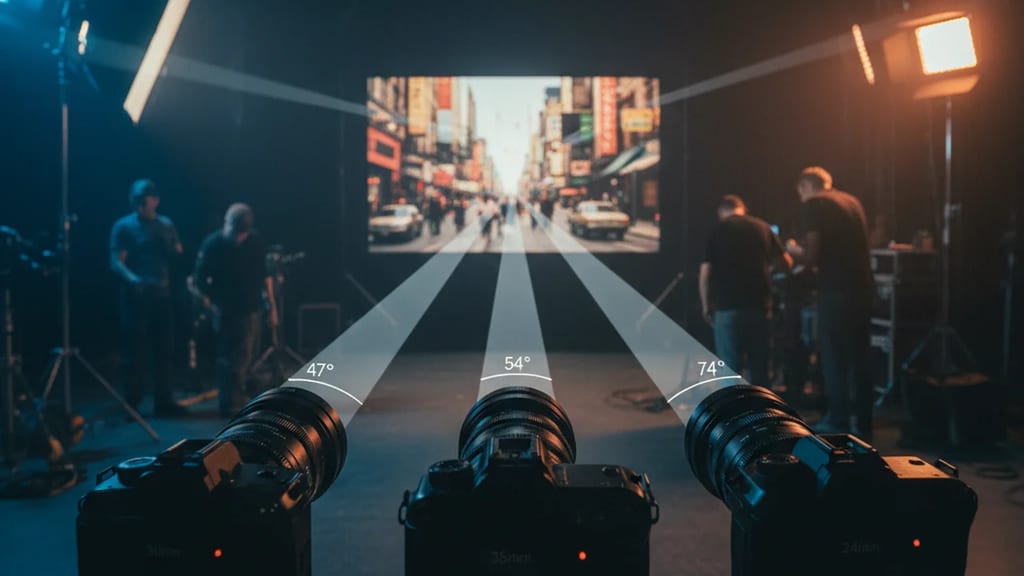
Horizontal angle visible through the lens — determines how much of the space fits into the frame. 50mm ≈ 47°, 35mm ≈ 54°, 24mm ≈ 74°.
Understanding the field of view (FOV) — the angle the camera captures — is fundamental to any image composition. A 50mm lens on full-frame sees about 47 degrees, a 35mm around 54 degrees, and a 24mm just under 75 degrees. These angles don't determine the physical length of the lens, but rather how much space in front of the lens fits into the frame; how that space looks in perspective depends on the camera distance.
On set, you notice the difference immediately: with a wide field of view (16mm, 90+ degrees), you move in close and dramatically exaggerate proximity — actors appear closer, distances stretch. With a narrow field of view (85mm, 28 degrees) and the distance it requires, foreground and background move visually closer together. This isn't just aesthetics; it changes the emotional spatial impact of the entire shot. A narrow lens angle feels more intimate, voyeuristic; a wide one feels exposed, overwhelming. This choice is an emotional decision, not a technical exercise.
In practice: when shooting a dialogue scene in a car, don't just grab the available lens. A 50mm angle allows for close, flat facial angles and reduces spatial depth — two people are intensely facing each other. With 24mm, the entire cabin fits into the frame from the same position; the characters appear farther away, and the drive feels faster. The choice of field of view is direction, not an optics catalog. The same applies to architectural shots: 35mm shows the space naturally, 24mm makes it monumental, 50mm almost photographically neutral. In editing, this becomes relevant when you cross-cut between different fields of view — large jumps feel fragmented, small gradations fluid.
A common mistake: confusing FOV with focal length. The 50mm is the physical measurement; the 47-degree field of view is the result of this construction on full-frame. On APS-C sensors (crop factor 1.5x), the same lens becomes narrower, about 31 degrees — same glass, different spatial effect. This is why digital cinematographers must always keep sensor size in mind. To reproduce a 24mm sequence shot for cinema on an A6700 (APS-C) requires, computationally, a 16mm lens — the same angle, different hardware. When casting lenses for a production, FOV is your primary language, not millimeters.
Related terms
Quiz
1. Was beschreibt „FOV" am besten?
2. Zu welchem Department gehört „FOV"?